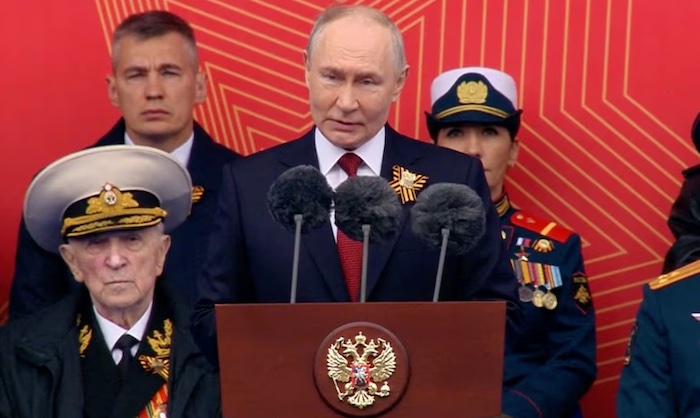
Russian President Vladimir Putin used his annual Victory Day address in Moscow’s Red Square to defend Russia’s war in Ukraine and accuse NATO of supporting aggression against his country.
Speaking before hundreds of military personnel during the scaled-back parade on Friday, Putin described the war in Ukraine as a “just” conflict and claimed Russian troops were confronting “an aggressive force armed and supported by the whole bloc of Nato.”
“The great feat of the generation of victors inspires the soldiers carrying out the goals of the special military operation today,” Putin said, referring to Russia’s invasion of Ukraine.
“They are confronting an aggressive force armed and supported by the whole bloc of Nato. And despite this, our heroes move forward,” he added.
The annual Victory Day event commemorates the Soviet Union’s defeat of Nazi Germany during World War II and remains one of Russia’s most significant national ceremonies.
This year’s celebrations, however, were notably reduced amid heightened security concerns and fears of possible Ukrainian drone attacks. For the first time in years, the Moscow parade did not feature tanks, ballistic missiles or other major military hardware.
Russian authorities said the event was scaled back because of the “current operational situation,” while Russian lawmaker Yevgeny Popov remarked earlier in the week that “our tanks are busy right now.”
Foreign leaders attending the ceremony included Alexander Lukashenko, Sultan Ibrahim, Shavkat Mirziyoyev and Robert Fico, the only European Union leader present.
Following the parade, Putin laid flowers at the Tomb of the Unknown Soldier before attending a Kremlin reception.
The ceremony also coincided with a temporary three-day ceasefire between Russia and Ukraine announced earlier this week. However, Russia’s defence ministry later accused Ukraine of violating the truce, though no evidence was immediately provided. Ukraine did not respond to the allegation.
Russia launched its full-scale invasion of Ukraine in 2022, triggering the largest conflict in Europe since World War II.
Erizia Rubyjeana