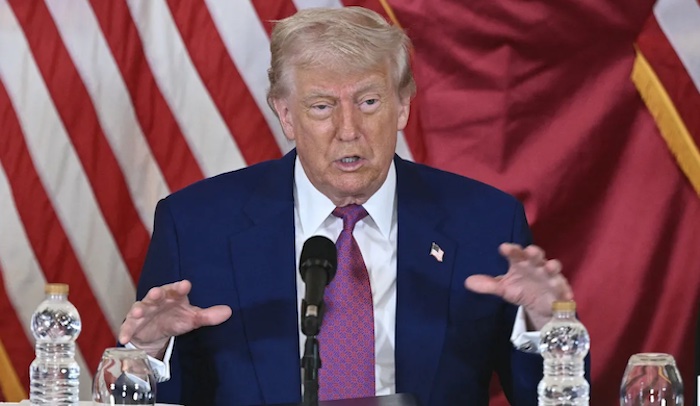
U.S. President Donald Trump is scheduled to deliver a primetime address on Thursday centred on election security, renewing his long-standing criticism of America’s voting system ahead of November’s midterm elections.
White House officials are still deciding whether the president’s speech will include sensitive intelligence related to China’s alleged intentions or capability to interfere in the 2020 U.S. presidential election.
The report, citing four sources, said some administration officials were concerned that presenting the intelligence could be misleading.
Trump has repeatedly challenged the credibility of U.S. elections, maintaining without evidence that his 2020 defeat to former President Joe Biden was the result of widespread fraud.
He has also alleged that mail-in voting is vulnerable to fraud, that voting machines can be manipulated and that non-citizens vote in significant numbers.
However, multiple court rulings and election recounts found no evidence of widespread fraud in the 2020 presidential election.
Sources familiar with the intelligence said that the material collected during Trump’s first term did not show that China manipulated vote counts or altered election results.
A White House task force led by conservative journalist John Solomon has reportedly reviewed documents related to the intelligence in preparation for the president’s address.
Responding to reports about the speech, White House spokeswoman Karoline Leavitt said no final decision had been made on its contents.
“As usual, anonymous sources are speculating about what President Trump will say during his speech on Thursday evening. The truth is, nobody knows yet what President Trump will ultimately say,” she said.
The Office of the Director of National Intelligence did not respond to requests for comment, while the Central Intelligence Agency declined to comment.
Since returning to office in January 2025, Trump has pushed for greater federal involvement in election administration, although the U.S. Constitution places primary responsibility for conducting elections on state governments.
He has also urged Republican lawmakers to support the SAVE America Act, legislation that would require voters to present photo identification and proof of U.S. citizenship before registering to vote, while also requiring states to share voter registration data with the federal government.
Democrats and voting rights advocates have opposed the proposal, arguing that voter fraud is extremely rare and warning that the measures could make it harder for eligible citizens to vote.
Some senior Republicans have suggested Trump should focus on current economic challenges rather than revisiting the 2020 election.
Senate Majority Leader John Thune said he was concentrating on the 2026 elections and expected many of his Republican colleagues to do the same.
Republicans face a difficult political environment ahead of the midterm elections, with concerns over Trump’s approval ratings, the ongoing conflict involving Iran and rising energy prices.
Democrats need to gain three Republican-held seats to secure a majority in the House of Representatives, while the battle for control of the Senate remains more challenging because several key races are taking place in Republican-leaning states.
Senate Democratic Leader Chuck Schumer accused the White House of preparing to influence the November elections, claiming Democrats were closely monitoring developments.
It remains unclear whether major U.S. television networks will broadcast Trump’s speech live, as such airtime is usually reserved for major national addresses. Some Democratic lawmakers, including Representative Alexandria Ocasio-Cortez, have urged broadcasters not to air the address, arguing that it could include previously debunked claims about election integrity.
Ojo Triumph