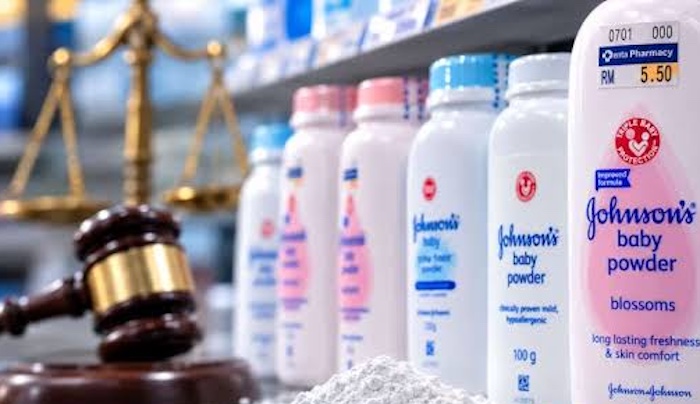
Johnson & Johnson has announced a provisional settlement of an estimated $5.5 billion to resolve tens of thousands of lawsuits alleging its talc-based products, including baby powder, caused ovarian cancer.
The landmark agreement could bring an end to a contentious legal battle that has plagued the pharmaceutical giant for a decade.
The proposed settlement encompasses approximately 76,000 claims, including those consolidated in federal court in New Jersey and related cases in state courts, representing nearly all outstanding talc-related allegations against the company.
J&J had previously settled the majority of cases asserting that its talc contained asbestos and led to mesothelioma, The Independent UK reported yesterday. Plaintiff law firms confirmed the deal, describing it as a positive resolution following the protracted court proceedings.
For the agreement to become final, it requires acceptance from 95 per cent of the ovarian cancer claimants across state or federal jurisdictions. Erik Haas, J&J’s Vice President of Litigation, maintained that the claims were “meritless” but stated the company was willing to settle to achieve “closure.”
J&J said the settlement covers about 76,000 claims, including ones consolidated in federal court in New Jersey, and related cases in state court, representing nearly all of the remaining talc claims against the company
The company said the settlement covers about 76,000 claims, including ones consolidated in federal court in New Jersey, and related cases in state court, representing nearly all of the remaining talc claims against it.
“While we are confident the company would have ultimately prevailed with further litigation, as it has in the vast majority of cases tried to date, this resolution allows the company to put this matter behind it and remain focused on its mission to develop medicines and devices that save lives,” Haas said.
J&J expects to pay $3 billion in 2027, and it will make further payments in 2028. But the deal could be worth more, depending on how many people participate in the settlement.
Chris Seeger, an attorney who represents about 2,500 clients with talc claims and helped negotiate the agreement, said J&J could ultimately pay $7 billion or more. The settlement assigns specific values to qualifying ovarian cancer claims but does not cap J&J’s total payout, he said.
“We got a fair settlement, and our clients are going to be happy with it,” Seeger said in an interview reported by The UK Independent.
J&J reached the settlement after a series of wins in court, including victories in individual trials, successful efforts to disqualify plaintiffs’ lawyers from the litigation, and court rulings against experts that plaintiffs had used to prove their cases in court.
The company won a significant court victory in the long-running legal battle last week, when a federal judge cast doubt on individual plaintiffs’ ability to prove that talc specifically caused their ovarian cancer, the report said.
J&J has long denied that its talc products caused cancer, saying that talc was safe and did not contain asbestos. The company stopped selling talc-based baby powder in the U.S. in 2020, switching to a cornstarch product.
The litigation resumed in March 2025, after being put on hold for more than three years while J&J unsuccessfully pursued a strategy known as the “Texas two step,” filing three bankruptcies through a shell-company subsidiary in an effort to settle the cases. Each bankruptcy ended in dismissal.
Before the bankruptcy attempts, J&J had a mixed record in talc trials, with a multibillion verdict in favour of 22 women who said baby powder caused their ovarian cancer. The company won some trials outright and had other verdicts reduced on appeal.
Unlike the proposed bankruptcy settlements, the fresh agreement applies only to existing claims and does not address future lawsuits.
The exclusion of future claims made more money available to current plaintiffs than the bankruptcy proposal did, and it also accelerates the payments so that all claims will be paid within 18 months instead of being spread out over more than a decade, Seeger said.
Meanwhile, EY and a partner at the firm have been fined around £1.2 million over failures linked to its audit of online furniture retailer Made.com.
The Financial Reporting Council (FRC) said it has hit the corporate finance firm with a £1.197 million sanction after it breached audit rules. The accounting watchdog also fined Julie Carlyle, an audit engagement partner at the firm who oversaw the Made audit, around £49,000.
Watchdog officials said the auditors relied too heavily on the retail group’s own forecasts and did not sufficiently challenge them to check Made’s financial resilience. Hundreds of jobs were lost after Made collapsed into administration in November 2022, The Independent said.
The company suffered a sharp downturn after launching on the London Stock Exchange less than two years earlier with a £775 million price tag. The brand was then snapped up in a rescue deal by retail group Next, which continues to run the business.
The FRC said the failures related to EY’s audit of Made’s finances for the year to December 2021, prior to its collapse.
It flagged that there was a “failure to perform adequate procedures” to assess the accuracy and reliability of management forecasts related to whether the firm could operate as a going concern.
There was also a failure to obtain sufficient appropriate audit evidence in relation to a deferred tax asset. The fines for the firm and the audit partner were both reduced by 30 per cent compared with their initial potential fine due to early admission.
Penrose Foss, executive counsel at the FRC, said: “In this case the auditors relied on management’s forecasts without applying sufficient challenge or carrying out adequate testing to obtain sufficient evidence.
“Absent such challenge and evidence, there is a heightened risk that financial statements present an inaccurate picture of a company’s financial position.”
An EY spokesman said: “The delivery of high-quality audits remains our priority.
“While there was no suggestion by the FRC that the full-year financial statements had been misstated, we committed to learning from this matter and, in the years since this audit, have updated our internal guidance as part of our focus on continuous improvement.”
Emmanuel Addeh