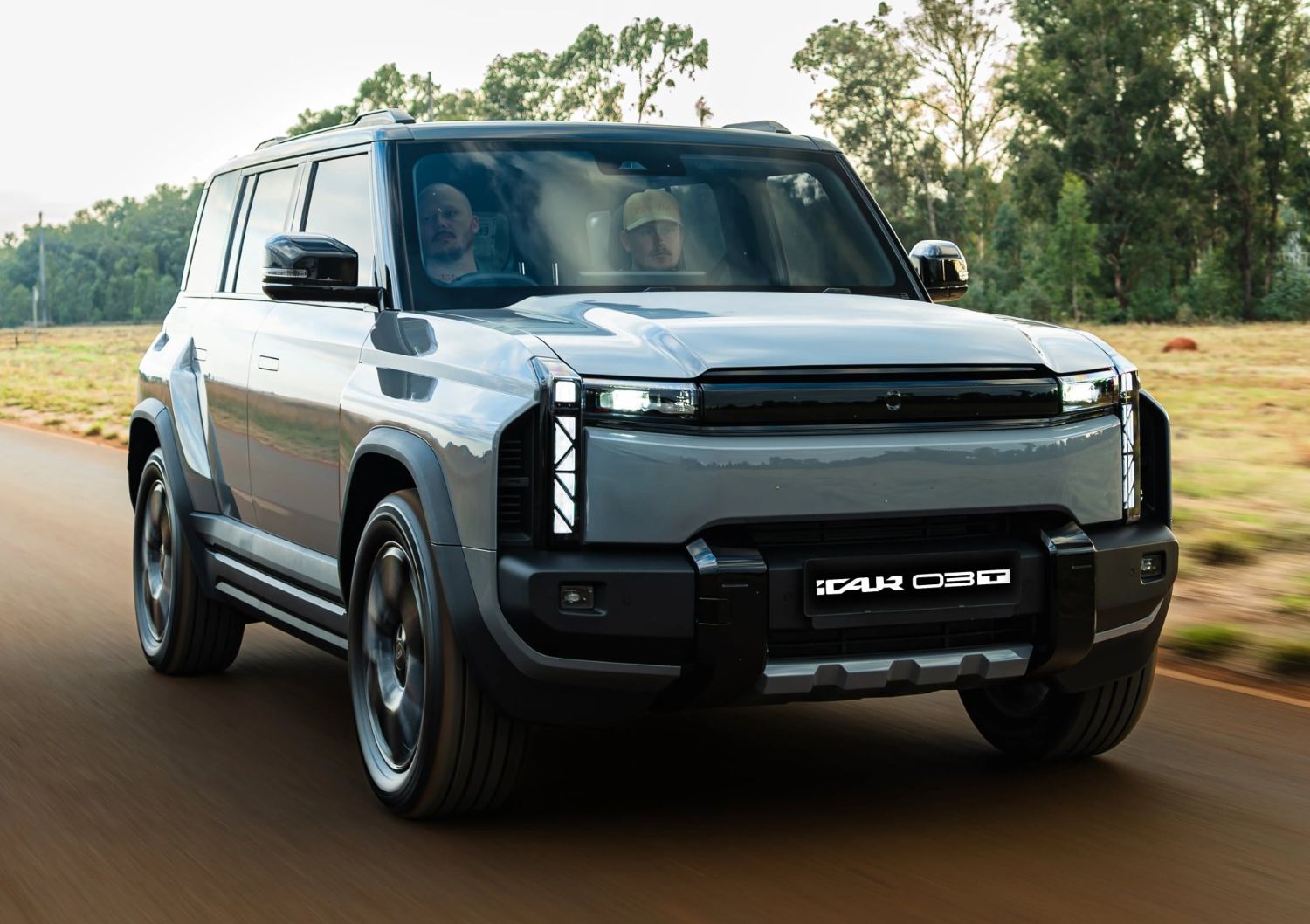
Chery showcased its latest local sub-brand iCaur with the introduction of the all-electric V23 and 03T last month.
Uptick to electric vehicles (EVs) has been slow in South Africa. But this year’s record fuel price hikes have seen interest in new energy vehicle spike due to their cheaper running costs.
The Citizen Motoring dusted off the calculator to work out how much the iCaur models will cost to run compared to cars powered by international combustion engines (ICE). Our calculations are based on how much Rand it will cost to travel one kilometre and does not take into account the car’s price, maintenance, finance or insurance costs.
Frugal iCaur models
The iCaur V23 is available in two models; rear-wheel drive (2WD) and four-wheel drive (4WD). The 2WD has a claimed energy consumption of 20kWh per 100km, while the 4WD will consume 22kWh/100km. The iCaur 03T is offered with the same two derivatives. Consumption for the 2WD is claimed to be 18.3kWh/100km and consumption for the 4WD 19.9kWh/100km.
If you use a prepaid domestic electricity rate of R4/kWh, then it will range between R80 to R88 to drive 100km in the iCaur V23. This works out to 80c to 88c per kilometre. 100km in the 03T will range between R73 and R79 and will cost between 73 and 79c per kilo.
Let’s see how this number weighs up against ICE SUVs of comparative size. At a length of 4 220mm, the iCaur V23 can be classified as a compact small SUV. In our calculation, it goes up against a Volkswagen T-Cross, Chery Tiggo 4 Pro and Mazda CX-3.
T-Cross almost double the cost
VW claims that the automatic T-Cross’ 1.0-litre turbo petrol engine will sip 5.6 litres per 100km. At the current Inland price of R28.06 for a litre of 95 ULP, 100km will cost R157 in the T-Cross. This works out to R1.57 per kilometre.
The Mazda CX-3 is powered by a 2.0-litre petrol engine and has claimed fuel economy of 6.3L/100km. It will cost R176 per 100km and R1.76 per kilo.
If the naturally aspirated 1.5-litre engine in the Chery Tiggo 4 Pro achieves the claimed 6.8L/100km, then 100km will cost R190 which breaks down to R1.90/km.
iCaur 03T outshines petrol rivals
At 4 433mm, the iCaur 03T just makes it into the medium-sized SUV category. Similarly sized SUV/crossovers include the Renault Duster, Toyota Corolla Cross and GWM Haval Jolion City.
Based on its claimed fuel economy of 6.5L/100km, 100km in the 1.3-litre turbo petrol Renault Duster will cost R182 and every kilometre R1.82.
The naturally aspirated 1.8-litre Corolla Cross’ fuel consumption of 6.7L/100km means that every kilo will cost R1.88 and 100km will work out to R188.
With a claimed fuel consumption of 7.8L/100km, the 1.5-litre turbo Haval Jolion City will cost R218 per 100km. This works out to R2.18 per kilometre.
EVs cheaper to run, but…
The calculations shows that the iCaur V23 and 03T, like all EVs, are more affordable to “fuel” than comparative ICE products. On average, ICE cars in our comparison are roughly double per kilometre in cost, while some even higher.
The savings in running costs is however offset by the premium carmakers charger for EVs compared to ICE cars due to the heavy taxation.