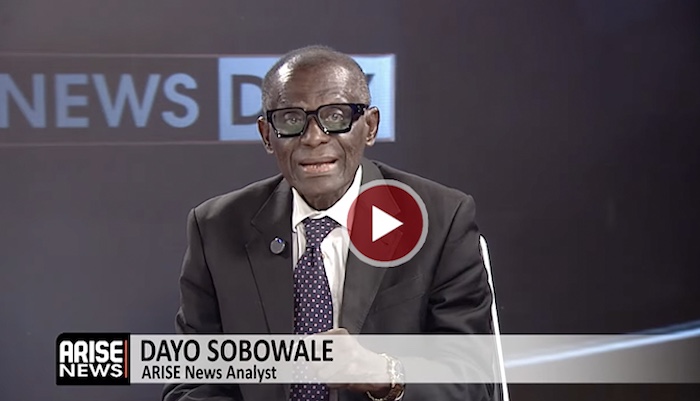

Nigeria’s opposition parties remain too fragmented and disorganised to present a coherent challenge ahead of the 2027 presidential election, according to analyst Dayo Sobowale.
Speaking during an interview on ARISE News, Sobowale said ongoing disputes over zoning, coalition talks, and presidential ambitions within opposition circles reveal a political bloc that is still struggling to define a united direction.
“The opposition is not organised for 2027 yet,” he said.
Sobowale was reacting to comments by former Vice President Atiku Abubakar questioning zoning arrangements within opposition parties and coalition discussions ahead of the next election cycle.
“I will not agree, and I will not disagree,” he stated while describing Atiku’s position as “food for thought.”
According to Sobowale, Nigeria’s political system has historically relied on zoning and balancing arrangements to manage the country’s ethnic and religious diversity.
“We have a way of balancing our differences,” he said.
However, he said that recent political developments, including the success of the Muslim-Muslim presidential ticket in 2023, have complicated traditional political calculations.
“We had the Muslim-Muslim ticket… and it won,” he stated.
Sobowale also questioned the current political standing of some opposition figures positioning themselves for 2027.
“He’s party-less, literally,” he said while referring to Atiku Abubakar.
According to him, several major opposition politicians are still searching for viable political platforms and alliances ahead of the elections.
“They are shopping for parties,” he stated.
Sobowale argued that the opposition remains unstable because no clear political structure or coalition has fully emerged.
“The opposition is shrinking by the day,” he said.
He also dismissed suggestions that figures such as Peter Obi and Rabiu Musa Kwankwaso currently possess fully consolidated political structures capable of guaranteeing victory.
“Kwakwaso is a one-party man,” he stated.
According to Sobowale, many opposition figures are still repositioning themselves politically rather than building a coherent electoral movement.
“You cannot really say now who is who,” he said.
He stressed that the real political picture may only become clearer closer to official electoral deadlines and party primaries.
“Until the INEC deadline… we may not even know what the opposition is,” he stated.
Sobowale further argued that internal fragmentation within opposition parties currently benefits the ruling APC.
“With the ruling party, you can see this is a stable structure,” he said.
He noted that the APC’s control of most state governments gives it a stronger organisational advantage ahead of 2027.
“They have 31 out of 36 states,” he stated.
According to Sobowale, opposition parties are still struggling with leadership disputes, coalition uncertainty, and competing presidential ambitions.
“It’s too serious now because they are not organised,” he said.
Despite the uncertainty, Sobowale maintained that Nigeria’s political equation remains fluid and could still change significantly before the next election.
“The political equation is changing by the day,” he added.
Sobowale concluded that while opposition politicians continue holding coalition talks and debating zoning arrangements, the absence of a unified structure, clear leadership, and stable political alliances means the opposition remains largely fragmented and unprepared for the 2027 elections.
By Ojo Triumph