In Luweero’s busy trading centres, the mobile phone is never far from reach.
It rings with customer calls, lights up with mobile money alerts, and quietly keeps the rhythm of small businesses alive. For many entrepreneurs, it is the backbone of daily survival. But for all its presence, it has rarely been seen as something more.
For years, the phone has functioned mainly as a tool for transactions, sending, receiving, confirming. Money comes in, money goes out. Business moves, but often without a clear record, a pattern, or a story that can be built on.
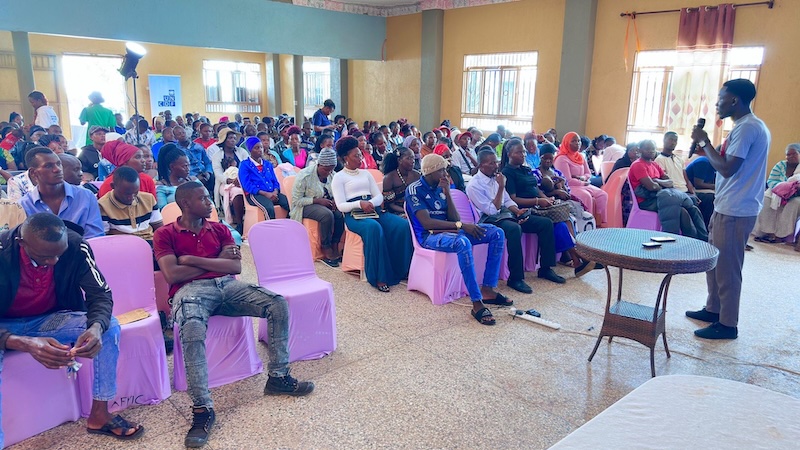
Now, a new initiative is trying to change that. The United Nations Capital Development Fund (UNCDF), working with Out-Box Uganda and in partnership with the Mastercard Foundation, has launched a campaign in Luweero aimed at reshaping how small business owners think about the devices in their hands.
The campaign, dubbed “Business Ku Ssimu Yo,” is part of a wider effort under the 10X programme, an initiative designed to accelerate the growth of youth-led micro, small and medium enterprises through digital tools.
At its core, the message is simple but ambitious: the phone is not just a channel for money. It can be the business itself. Across Luweero, that shift is both necessary and overdue. Many entrepreneurs already rely heavily on mobile money platforms.
Payments are made quickly, customers are reached easily, and operations continue with minimal interruption. Yet the deeper potential of those same tools often remains untapped.
Transactions happen, but they are not always tracked in a way that tells a larger story. That gap matters more than it might seem. As Uganda’s financial sector evolves, access to credit is increasingly tied to digital footprints.
Banks and lenders are paying closer attention to transaction histories, patterns of income, and how consistently a business operates over time. For entrepreneurs without traditional collateral, that data can become the difference between stagnation and growth.
The challenge, however, is that many small businesses are not yet capturing that data effectively. Money is withdrawn almost as soon as it is received. Personal and business transactions are mixed.
Records exist, but only in fragments, difficult to interpret, harder still to use as proof of stability. The 10X programme is stepping into that space with a different approach. Rather than introducing entirely new systems, it focuses on changing behaviour, small, practical shifts that build over time.
Entrepreneurs are encouraged to separate personal and business transactions, to rely more consistently on mobile money for business operations, and to retain funds digitally long enough to create a meaningful transaction history. Individually, these actions may seem minor.
Together, they begin to reshape how a business is seen, not just by its owner, but by potential lenders and partners. The programme’s broader ambition is significant. It targets financially disadvantaged young women, including refugees and persons with disabilities, across sectors ranging from agriculture and trade to technology, tourism, and light manufacturing.
By 2027, it aims to reach 61,000 young women, with at least 34,000 gaining new, improved, or sustained work opportunities.