President Bola Tinubu on Tuesday called for urgent reforms to the global financial architecture, warning that the current system is frustrating Africa’s industrialisation efforts and slowing the continent’s economic development.
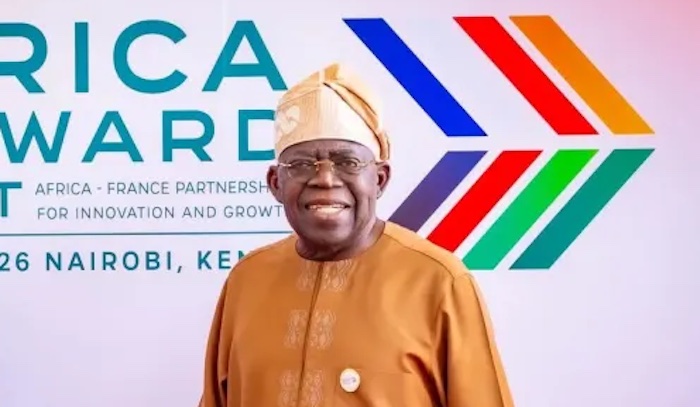
Speaking at the Africa Forward Forum in Nairobi, Kenya, Tinubu made a strong case for a fairer international financial system that prioritises Africa’s growth, prosperity, and industrial transformation.
The President argued that global financial and trade structures continue to disadvantage African economies by denying them access to affordable capital while encouraging the export of raw materials instead of value-added production.
“Last September, from the podium of the United Nations General Assembly, Nigeria warned that the international system must reform or risk irrelevance,” Tinubu said.
“We spoke not only of the Security Council but of the financial and trade structures that quietly de-industrialise our nations.”
According to him, Africa’s share of global manufacturing value-added remains below two per cent despite decades of political independence.
“We export raw minerals, crude oil, and agricultural commodities, and we import processed goods at a premium,” he said.
“This pattern is not an accident. It is the product of a global financial architecture that starves our industries of affordable capital, tolerates massive illicit financial flows, and imposes policy constraints that our competitors themselves never observed when they built their own industrial bases.”
Tinubu stressed that Nigeria had already taken difficult but necessary economic decisions aimed at restoring macroeconomic stability and rebuilding investor confidence.
He listed key reforms undertaken by his administration to include the removal of fuel subsidies, exchange rate unification, recapitalisation of the banking system with over $3.4 billion, and Nigeria’s exit from the Financial Action Task Force (FATF) grey list.
“These reforms were sovereign choices, not external conditions,” the President noted.
He said the reforms had helped improve Nigeria’s economic outlook, including stronger external reserves estimated at $45.5 billion and a projected debt-to-GDP ratio of 32.3 per cent in 2026.
Despite these gains, Tinubu argued that African countries continue to face unfair borrowing conditions that weaken industrial growth and economic competitiveness.
“In 2026, Nigeria will spend about $11.6 billion on debt service — nearly half of projected revenue,” he said.
“Every single dollar that leaves our treasury to pay punitive interest rates is a dollar that did not go into our steel sector, textile mills, agro-processing plants, or digital industries.”
The President described the current global financial structure as “an instrument of industrial disarmament for Africa,” insisting that the continent is demanding fairness rather than charity.
“Nigeria is not asking for charity. We are demanding a financial system that intentionally enables Africa to industrialise — to process its own minerals, refine its own crude oil, manufacture its own pharmaceuticals, and compete fairly in global markets,” he said.
Tinubu also addressed migration and security issues, arguing that economic opportunity remains the most effective response to irregular migration.
“People who have jobs, security, and hope at home do not typically risk their lives in the back of a smuggler’s truck,” he said.
The President urged development partners to increase investments in infrastructure, energy access, climate adaptation, digital skills, and job creation programmes capable of reducing economic desperation across Africa.
He also called for stronger international cooperation on migration governance and backed efforts by the African Union to create more coordinated migration frameworks.
On maritime development, Tinubu highlighted Nigeria’s blue economy potential and pledged stronger regional coordination on maritime security in the Gulf of Guinea.
He announced that Nigeria would make its Deep Blue Project’s maritime intelligence infrastructure available as a shared data platform for willing countries in the region.
“Maritime sovereignty does not repel investment — it attracts it,” the President said, stressing that secure sea lanes and effective regulation are essential for attracting private capital into Africa’s maritime sector.
Tinubu further welcomed the outcome of the 10th France-Nigeria Business Council Meeting held on the sidelines of the summit, describing it as evidence that economic relations between Nigeria and France have entered an “execution stage.”
With trade between both countries reaching $4.7 billion in 2025, Tinubu said the relationship must now translate into jobs, industries, infrastructure, and broader prosperity for both nations.
The meeting brought together leading Nigerian and French business leaders, including Aliko Dangote, Abdulsamad Rabiu, Tony Elumelu, Aigboje Aig-Imoukhuede, Patrick Pouyanné of TotalEnergies, and Rodolphe Saadé of CMA CGM.
Tinubu particularly welcomed the partnership agreement between Accor and Shoreline Group for Nigeria’s first national hotel platform, describing it as a major vote of confidence in Nigeria’s hospitality and tourism sectors.
“This is the partnership Nigeria is ready for,” Tinubu said.
“We are ready for investment that builds, capital that produces, and enterprise that creates jobs.”
The President reaffirmed his administration’s commitment to strengthening the business environment, supporting investors, and deepening reforms aimed at making Nigeria a more stable and competitive economy.
“The next chapter of Africa-Europe relations will be written in factories, hotels, ports, energy projects, technology platforms, farms, jobs and new value chains,” he added.
Deji Elumoye