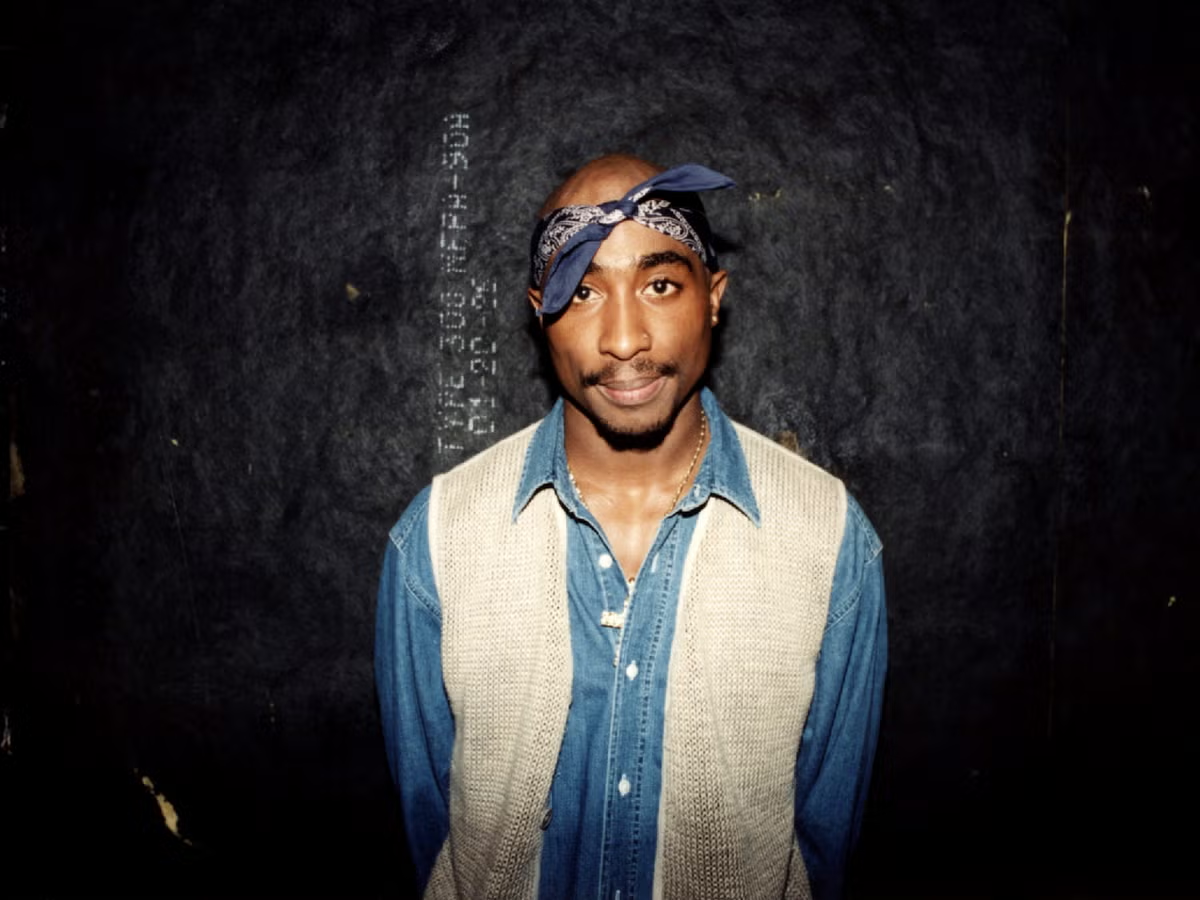
Nearly 30 years after Tupac Shakur was gunned down in Las Vegas, the long-running murder investigation has finally entered a courtroom.
Jury selection began Monday in the trial of Duane “Keffe D” Davis, a former South Side Compton Crips leader accused of orchestrating the September 1996 killing of the celebrated rapper.
Davis, 63, has pleaded not guilty to murder. Prosecutors allege that he organised the attack and supplied the firearm used in the drive-by shooting, although they are not required to prove that he personally pulled the trigger.
If convicted, Davis faces life imprisonment without the possibility of parole.
The night Tupac was killed
Shakur was in Las Vegas on September 7, 1996, to attend a heavyweight boxing bout between Mike Tyson and Bruce Seldon at the MGM Grand.
After the fight, Shakur and Death Row Records co-founder Marion “Suge” Knight were involved in a confrontation with Orlando “Baby Lane” Anderson, Davis’ nephew and a member of the South Side Compton Crips.
Prosecutors say the confrontation became the motive for a retaliatory attack later that night.
Shakur was travelling in a BMW with Knight when a white Cadillac pulled alongside them. Gunmen opened fire, striking Shakur multiple times.
The 25-year-old rapper died from his injuries six days later.
His death became one of the most enduring mysteries in American music, with investigators and fans spending decades debating who was responsible.
Davis’ own words became central to the case
The investigation remained unresolved for years, but attention returned to Davis after he began publicly discussing his knowledge of the shooting.
In his 2019 memoir, Compton Street Legend, Davis acknowledged being in the front passenger seat of the Cadillac involved in the attack. He also described handing a firearm to people in the back of the vehicle.
However, he did not identify himself as the person who fired at Shakur.
Prosecutors have seized on those accounts as evidence that Davis played a central role in the killing. A Nevada judge ruled in June that the memoir could be presented to jurors. The court also allowed a 2008 police interview involving Davis to be used at trial.
Davis was arrested in September 2023 after a grand jury indicted him in connection with Shakur’s murder.
Defendant now disputes his earlier account
Davis has since rejected the prosecution’s version of events.
In a 2025 interview from prison, he maintained that he was not responsible for Shakur’s death and questioned the reliability of his memoir, saying his co-author expanded on details he had provided.
He has also claimed that he was in Los Angeles on the night Shakur was shot.
The defence has attempted to challenge the use of both the memoir and statements Davis previously made to investigators. Those efforts have largely failed, leaving prosecutors with access to some of the defendant’s earlier accounts as they build their case.
A feud that shook hip-hop
The case also revisits the violent rivalry that dominated American hip-hop during the 1990s.
Shakur was one of the biggest stars associated with Los Angeles-based Death Row Records, while Bad Boy Records represented the rival East Coast camp led by Sean “Diddy” Combs and featuring Christopher Wallace, better known as The Notorious B.I.G.
Wallace was himself murdered in Los Angeles in March 1997, just months after Shakur’s death.
The two killings became defining tragedies of the era’s East Coast-West Coast rap rivalry.
Shakur, whose mother was former Black Panther Afeni Shakur, had risen from New York and Baltimore before becoming closely identified with California’s hip-hop scene. His catalogue included major hits such as “California Love” and “All Eyez on Me.”
What the trial may — and may not — establish
The proceedings are expected to last several weeks, with jury selection beginning the process of determining who will hear the evidence. About 75 prospective jurors were initially being considered.
A central question will be whether prosecutors can establish that Davis deliberately helped organise the attack and supplied the weapon, even if they cannot prove that he fired the fatal shots.
The case could therefore produce a conviction without definitively answering one of the questions that has surrounded Shakur’s death for three decades: who actually pulled the trigger?
For Shakur’s family and millions of fans, the trial represents a long-awaited attempt to bring legal accountability to a killing that has remained unresolved for almost an entire generation.
The rapper’s stepbrother, Maurice Shakur, also filed a wrongful-death lawsuit in May, arguing that others involved in the killing have yet to face accountability.
Nearly three decades after gunfire ended Tupac Shakur’s life, the mystery has moved from the streets and music culture into a Nevada courtroom.