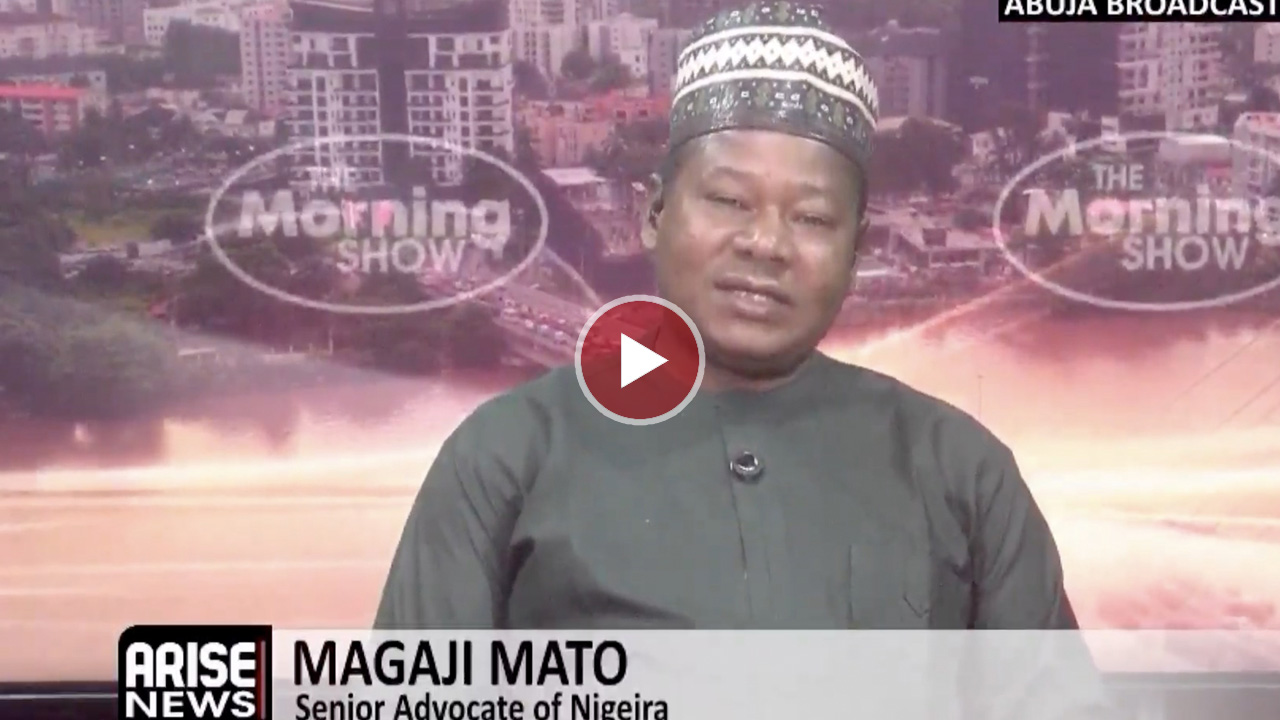
A Senior Advocate of Nigeria, Magaji Mato, has clarified that Nigerian courts retain jurisdiction over political party disputes where there are violations of the Constitution, the Electoral Act, or party guidelines, despite provisions limiting judicial interference in internal party affairs.
Speaking in an interview with ARISE News on Wednesday, Mato addressed the controversy surrounding Section 83 of the Electoral Act, stressing that it must not be interpreted in isolation.
“I think to comprehend the provisions of the statute, the law has always been that you look at it holistically, you don’t isolate a particular section of the statute and then make every way that it fits.
“For you to have a better understanding of the intention of the legislature is to be able to go over to control the entire provisions of the statute,” he said.
He explained that Section 83, which states that internal affairs of political parties are non-justiciable, is only one part of a broader legal framework.
“Section eighty-three, of course, because it is even plain eighty-three, it means that it is not the only section in the new Electoral Act. What that supposes is that there are other sections under the law, so for better or for worse, you need to be able to go through other sections, especially those sections that are related to that particular provision. Yes, eighty-three is clear, subsection five says internal affairs of political parties are not justiciable,” he said.
Mato pointed out that other provisions, particularly Section 88(2) of the Electoral Act, create clear exceptions allowing aggrieved aspirants to approach the courts.
“Section eighty-eight, subsection two, has allowed for pre-electoral matters and has given certain individuals the right to access the court on issues relating to political parties.
“While it has given an aspirant, that is somebody who has already obtained a form and has expressed interest to contest for the nomination of a particular position by his political party, the right to approach the court — what are the conditions? Where you feel that a section of the Constitution, a section of the Electoral Act, the guidelines and the constitution of the political party has been infringed, you are permitted by the Electoral Act to challenge that act in the court of law, particularly at the Federal High Court.”
He added that this position aligns with constitutional provisions.
“We should also look at Section 295 subsection 14 of the Constitution, which is the grundnorm. It has also been captured almost verbatim in Section 88 subsection two of the Electoral Act 2022. So when the argument comes to bear that that is a direct denial of the rights of political parties and candidates to access the court, I beg to differ.”
Mato aligned with legal interpretations that courts still have a role in ensuring compliance with the law.
“It was a very extensive position of the law. It has not in any way derogated the rights of individuals to approach the court. What it does is to align the statutes with the already decided cases of the Supreme Court.”
He explained that the Supreme Court had long limited judicial interference in purely internal party matters to reduce frivolous litigation.
“The Supreme Court has long before now, in their wisdom, adjudicated on this issue in order to narrow down the influx, and most times unnecessary influx, of cases in courts that in themselves lack merit, not just meant to cause distractions, to litter down the court’s dockets and overwhelm the judges themselves, so that at the end of the day, those cases that have merit and that need expeditious treatment will not be having such opportunity.”
According to him, internal party disputes should primarily be resolved within party structures.
“All internal affairs of every political party, ranging from leadership issues, nomination, who does what and who goes where, all these are internal affairs of political parties.
“And the various constitutions of the political parties have made adequate provisions to settle any grievance that may come up in respect of them.”
He noted that parties already have internal disciplinary and appellate mechanisms.
“Erring members can be disciplined, and where even the erring member that is disciplined is not satisfied with the disciplinary measure taken, there are also appellate provisions for you to appeal those decisions from the state, to zonal, from zonal to national level.”
However, he emphasised that exceptions remain where legal breaches occur.
“So the Supreme Court said, where you feel a section of the Constitution, or the Electoral Act, or the party’s guideline has been infringed, you can approach the court — that is the exception. But every other internal issue, don’t come to court.”
On the issue of delays in delivering judgments, particularly in election-related cases, Mato stressed the importance of speed.
“The age-long legal maxim says that justice delayed is justice denied. Every decision deserves expedition, but more particularly decisions in electoral matters, because the entire nation is involved.”
He justified calls for accelerated rulings in ongoing political disputes.
“If the ADC feel that there is a need for decisions in the appeal to be given expeditiously, they are not wrong. The court will also not have a problem with any party, especially in a political situation where there are deadlines and timetables set by INEC.”
Mato expressed confidence that the Supreme Court understands the urgency of such cases.
“I am very much confident that the justices of the Supreme Court are not oblivious of this very fundamental point — that this matter affects the entire nation, if not the whole world.”
Addressing concerns about the constitutionality of Section 83, he maintained that there is no conflict with the Constitution.
“That section eighty-three has got no conflict with any section of the Constitution. The Constitution is the supreme law of the land, and any law that conflicts with it must give way.
“But what is the Constitution saying about access to court, and what is Section 83 saying? Section 83 has not in any way stopped any lawyer or any interested party from going to court.”
He explained the rationale behind limiting court interference.
“What the section is saying is that there is already a law that internal affairs of political parties are non-justiciable, so leave them for the party. The wisdom behind this is to allow political parties to run their affairs independently. The court will not want to be meddling in issues of political parties.”
Mato noted that political parties are central to Nigeria’s democratic system.
“There is no candidate, no matter how qualified or how loved by the people of Nigeria, that can stand election as an independent candidate. You must come on the platform of a political party. And where every single act of the political party is being challenged in court, at what time will the political party be able to organise itself?”
On whether the Supreme Court has erred in delaying judgment within the constitutionally allowed timeframe, Mato said it has not.
“The Supreme Court has not done anything wrong. It is like a father who has the responsibility of paying school fees. The school says if you don’t pay within a certain period, your child will be sent home. The father is not wrong if he pays on the last day, but it speaks better of him if he pays earlier.”
He, however, warned of the implications of delayed rulings in time-sensitive political matters.
“The Constitution gives the courts three months to deliver judgment. But what is the nature of the judgment we are talking about? It is a judgment that, if delivered late, will have no meaning or effect. In fact, it may create crises in the country.”
Mato concluded by expressing optimism that the apex court would act promptly.
“I do not expect that this judgment will exceed today and tomorrow. If it does, then definitely some of these political parties will be having issues with deadlines.”
Boluwatife Enome