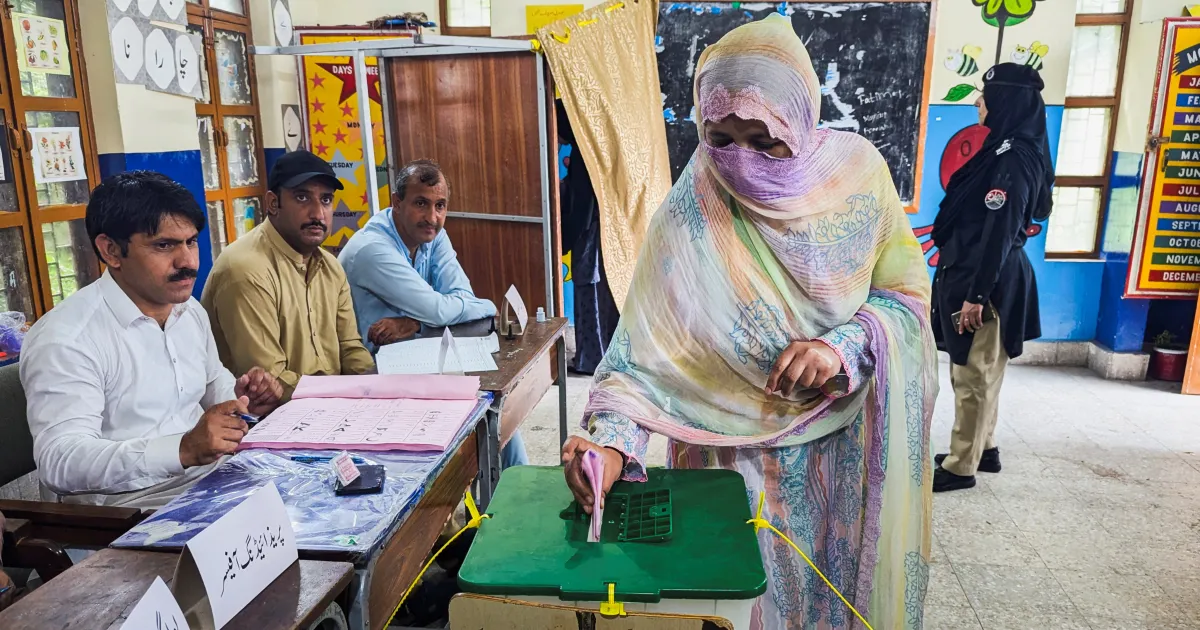
Voting in four constituencies of Pakistan-administered Kashmir has concluded, bringing the third phase of the region’s legislative elections to a close in Bagh and Haveli — but leaving seven other constituencies without a polling date amid continuing security concerns and months of unrest.
The scaled-back third phase highlights the deep tensions surrounding the election, which has unfolded against a backdrop of protests, clashes and a controversial campaign by the Jammu Kashmir Joint Awami Action Committee (JAAC).
Polling began at 8am and ended at 5pm on Monday across the four constituencies, with about 803 polling stations classified as sensitive or highly sensitive. Authorities deployed an additional 10,300 security personnel to protect voters and maintain order.
The remaining seven constituencies — five in Poonch district and two in Sudhnoti — were postponed last week after officials raised concerns about the security situation. The Election Commission has said a new timetable will be announced after conditions are reviewed.
The postponement means that Monday’s vote did not complete the election process as originally scheduled.
High-Profile Contests
Among the candidates facing voters was AJK Prime Minister Faisal Mumtaz Rathore, who was defending his seat in Haveli on the ticket of the Pakistan People’s Party.
Bagh also featured a closely watched contest between two former AJK prime ministers: Sardar Tanveer Ilyas of the Istehkam-e-Pakistan Party and Sardar Attique Ahmed Khan of the Muslim Conference.
The results could have limited impact on the broader balance of power, however, because Pakistan’s ruling Pakistan Muslim League-Nawaz (PML-N) has already established a commanding position after the first two phases.
The PML-N won nine of the 13 seats contested in the first phase on July 27 and another 15 seats in the second phase on August 2, giving it 24 seats so far. The Pakistan People’s Party has secured 10.
Election Under the Shadow of Protest
The election has been overshadowed by a sustained protest movement led by the JAAC, which has challenged the allocation of 12 seats reserved for Kashmiris displaced from Indian-administered Kashmir and living elsewhere in Pakistan.
The group has called for the abolition of those seats and has urged voters to boycott the elections. Pakistani authorities banned the JAAC in June under anti-terrorism legislation.
The protests have also produced sharply conflicting accounts of the human cost.
Al Jazeera reported that residents and rights groups say more than 50 people were killed during the unrest, while noting that the government has not released an official overall death toll and has acknowledged the deaths of at least seven police and paramilitary personnel.
Arab News cited the Jammu Kashmir Human Rights Observatory, which reported 89 civilian deaths between June 5 and August 5, a figure rejected by the AJK government, which has denied allegations that security forces were responsible for the deaths.
Those conflicting figures underscore the difficulty of independently verifying the scale of the violence amid restrictions on access and reporting.
Media Restrictions Add to Concerns
The political tensions have been compounded by restrictions on journalists. Al Jazeera reported that international media organisations were barred from reporting inside the region, with journalists instructed to leave and obtain government clearance before returning.
That has raised further questions about transparency at a time when opposition parties are already alleging electoral irregularities.
The Pakistan People’s Party has accused the PML-N of rigging and other malpractice during the polling process. The PML-N has rejected the allegations, while election officials say complaints are being addressed. Dawn reported that the PPP raised claims involving the removal of polling agents, delays at some stations and alleged interference with the voting process.
A Vote, but Not Yet the End
The completion of polling in Bagh and Haveli marks another step in an election that has been repeatedly disrupted by political confrontation and security concerns.
But with seven constituencies still awaiting a new polling date, the electoral process remains unfinished.
The central question now extends beyond who wins the remaining seats. It is whether the authorities can restore sufficient calm for the postponed constituencies to vote, while addressing the grievances that have fuelled months of protests.
For now, the election has produced an unusual picture: polling stations have closed in four constituencies, the PML-N holds a strong lead, but the wider electoral process remains suspended in parts of Poonch and Sudhnoti.
What was intended to be a three-phase election has therefore become a test not only of political strength, but also of whether a credible electoral process can proceed amid deep public unrest and competing claims over the future governance of Pakistan-administered Kashmir.