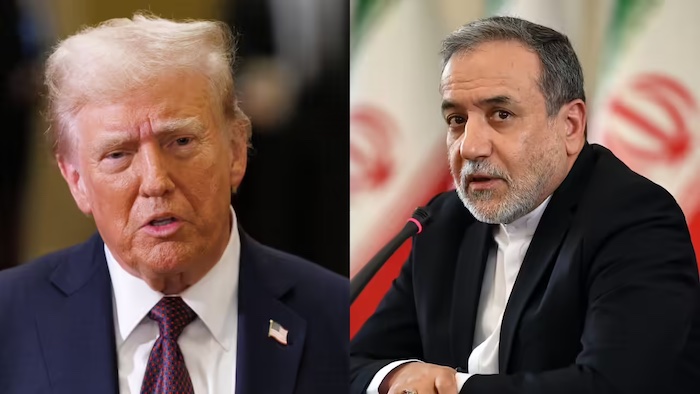
US President Donald Trump has said Iran can “call” if it wants to negotiate an end to the two-month war, as Tehran stepped up diplomatic efforts by sending its foreign minister to Russia for talks with Vladimir Putin.
Speaking in a briefing, Trump signalled openness to dialogue but insisted Washington’s remain unchanged.
“If they want to talk, they can come to us, or they can call us. You know, there is a telephone. We have nice, secure lines,” he said.
“They know what has to be in the agreement. It’s very simple: They cannot have a nuclear weapon; otherwise, there’s no reason to meet.”
Diplomatic hopes dimmed over the weekend after Trump cancelled a planned visit to Islamabad by his envoys, Steve Witkoff and Jared Kushner, citing concerns over the value of Iran’s предложения.
“Iran offered a lot, but not enough,” Trump said while speaking in Florida.
Meanwhile, Iran’s Foreign Minister Abbas Araqchi travelled between Pakistan and Oman — key mediators in the crisis — before arriving in Russia on Monday, where he is expected to seek Moscow’s support.
Iran’s envoy to Moscow, Kazem Jalali, said the visit was part of intensified diplomatic efforts.
“Araqchi will meet Putin in continuation of the diplomatic jihad to advance the country’s interests and amid external threats,” Jalali said in a post on X.
“Iran and Russia are present in a united front in the campaign of the world’s totalitarian forces against independent and justice-seeking countries, as well as countries that seek a world free from unilateralism and Western domination.”
Despite a ceasefire that has halted full-scale fighting, no agreement has been reached to end the conflict, which began on February 28 following U.S.-Israeli strikes on Iran. The war has killed thousands, disrupted global energy markets, and raised concerns over economic stability.
Oil prices rose and US stock futures slipped in early Asian trading on Monday after negotiations stalled, with shipping through the strategic Strait of Hormuz effectively blocked. The route typically carries about a fifth of global oil supplies, giving Tehran significant leverage.
According to Axios, Iran has submitted a new proposal through Pakistani mediators focused on reopening the strait and ending the conflict, while postponing nuclear negotiations. However, the White House and State Department have not commented on the report.
Iran has long insisted on its right to enrich uranium for civilian purposes — a position rejected by Washington and its allies, who fear it could lead to nuclear weapons development.
Iranian President Masoud Pezeshkian reiterated Tehran’s stance in a call with Pakistan’s Prime Minister Shehbaz Sharif.
He said Iran would not enter “imposed negotiations” under threats or blockade, according to an official statement, adding that the United States must first remove obstacles, including its maritime restrictions.
Beyond the nuclear issue, divisions between both countries remain wide. Washington is seeking limits on Iran’s support for regional groups such as Hezbollah and Hamas, as well as restrictions on its ballistic missile capabilities. Tehran, in turn, is demanding sanctions relief and an end to Israeli military actions in the region.
Violence has continued elsewhere. In Lebanon, Israeli airstrikes killed 14 people and wounded 37 on Sunday, according to the health ministry, as tensions spill across the region despite ceasefire efforts.
With negotiations stalled and positions hardened, the path to a comprehensive settlement remains uncertain, even as diplomatic engagements intensify.
Boluwatife Enome