The number of refugee status applicants who have gone missing is far greater than the number who have seen their appeals through to their conclusion.
The Department of Home Affairs’ Refugee Appeals Authority (RAA) made this admission while briefing the Portfolio Committee on Home Affairs on the status of its appeals backlog.
Tuesday’s committee meeting featured several presentations detailing the status of the refugee and asylum system.
Much of the information shared referred to Section 22 permits, which grant temporary asylum-seeker visas while the applications are evaluated.
“All asylum seekers – asylum and economic migrants – are considered as ‘presumptive refugees’ until their claims have been adjudicated,” a department presentation read.
Inactive refugee appeals
Chairperson of the RAA Zilpha Raphesu elaborated on the number of pending appeals.
Raphesu said there were 70 976 active refugee appeals recorded in the department’s Asylum Seeker Management System (ASMS) , that when cleared, would constitute a clearing of the backlog.
Raphesu showed a slide that broke down the number of active and inactive cases on the ASMS, with the inactive cases outnumbering active cases.
She explained that just over 90 000 refugees who had made appeals to the RAA were unaccounted for and “don’t know the whereabouts of”.
The chair said some may have died, others could have been given other permits, and others would have left the country “undetected”.
Among these inactive cases, 17 000 were Ethiopian, 17 000 were from DRC, 14 000 were Bangladeshi and 8 000 were Zimbabwean.
“The legal provisions that explains their inactiveness is called ‘abandonment’. It is a provision of the Geneva Convention whereby we say if for a longer period someone does not come through to extend their temporary visa, or they are not active on the system, the law will then deem them to have abandoned their cases.
“We are in the process of determining where some of these appellants are,” said Raphesu.
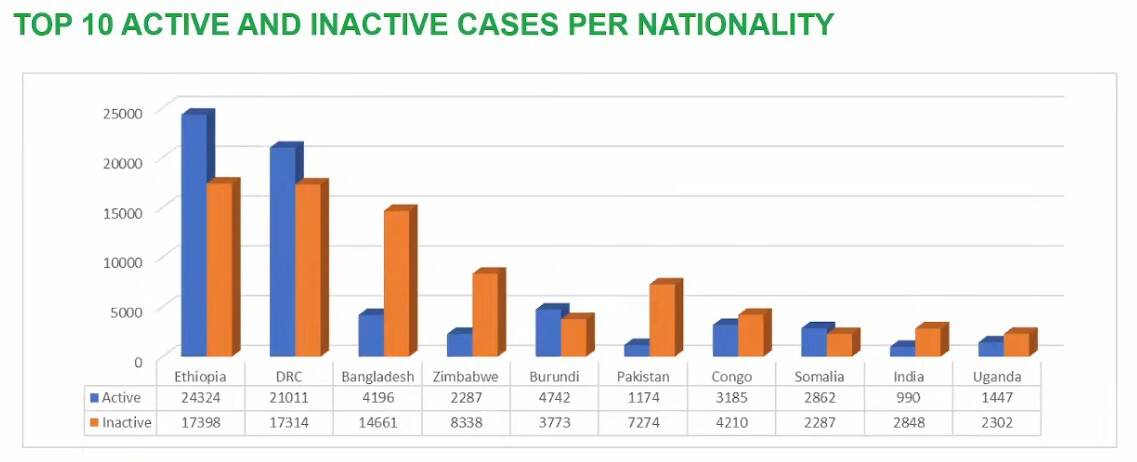
Above: A nationality-specific breakdown of the active and inactive refugee appeals. Source: Home Affairs
Immigration peaks
Deputy Director-General for Immigration and Chief Director of Asylum Seeker Management Mandla Madumisa stated 82 348 Section 22 applications were pending on the ASMS.
This number included the 70,000 before the RAA, as well as 475 cases being processed by a refugee status determination officer, 3 490 under judicial review and 7 407 before the Standing Committee for Refugee Affairs.
Madumisa showed that incoming foreign migration spiked in 2008, with Home Affairs processing more than 207 000 new applicants that year, as opposed to 45 000 the previous year.
In 2009, new applicants totalled over 223 000, but would drop to 124 000 in 2010, before falling every year thereafter until reaching 26 000 in 2019.
Other than 20 000 in 2023, the number of new applicants was under 10 000 between 2020 and 2025.
Between January and December 2025, 4 963 new applicants came from 10 specific countries.
Ethiopians accounted for 2 148 new applicants, with those from the Democratic Republic of Congo (DRC) and Somalia accounting for 905 and 680, respectively.
The majority of new applicants chose Durban as an entry point, with the city’s refugee reception centre accounting for 29% of new cases.
Officials said new applicants were choosing to bypass the Musina centre and head to the cities, with Gqeberha, Pretoria and Cape Town processing a combined 59% of new applicants.
He said the Musina refugee reception centre was becoming a “white elephant”, as it only processed 2% of 2025’s new applicants.
‘Administratively overwhelmed’
Committee members questioned the presentations, with ActionSA’s Lerato Ngobeni unconvinced whether it was an adequate barometer of illegal immigration.
“I am not sure whether we are measuring genuine refugees fleeing persecution or are we just measuring administrative activity?”, Ngobeni stated.
The DA’s Nicole Bollman highlighted the number of inactive appeal cases, stressing the need to adequately account for these cases, as 84% of those missing were between the ages of 25 and 49.
“We can’t just say ‘we’re sorry they are inactive’ and therefore we potential are not looking to see what has happened with those people. We need to know what has happened to those people,” said Bollman.
The ANC’s Sisipho Jama said the presentation was too focused on numbers and percentages, lamenting the absence of an action plan.
“We must interrogate whether this department actually has a coherent long-term strategy capable of balancing these constitutional obligations.
“If the state doesn’t appear to be certain, if it appears fragmented and administratively overwhelmed on migration issues, then we create fertile ground for misinformation, for the vigilantism that we are seeing,” Jama said.