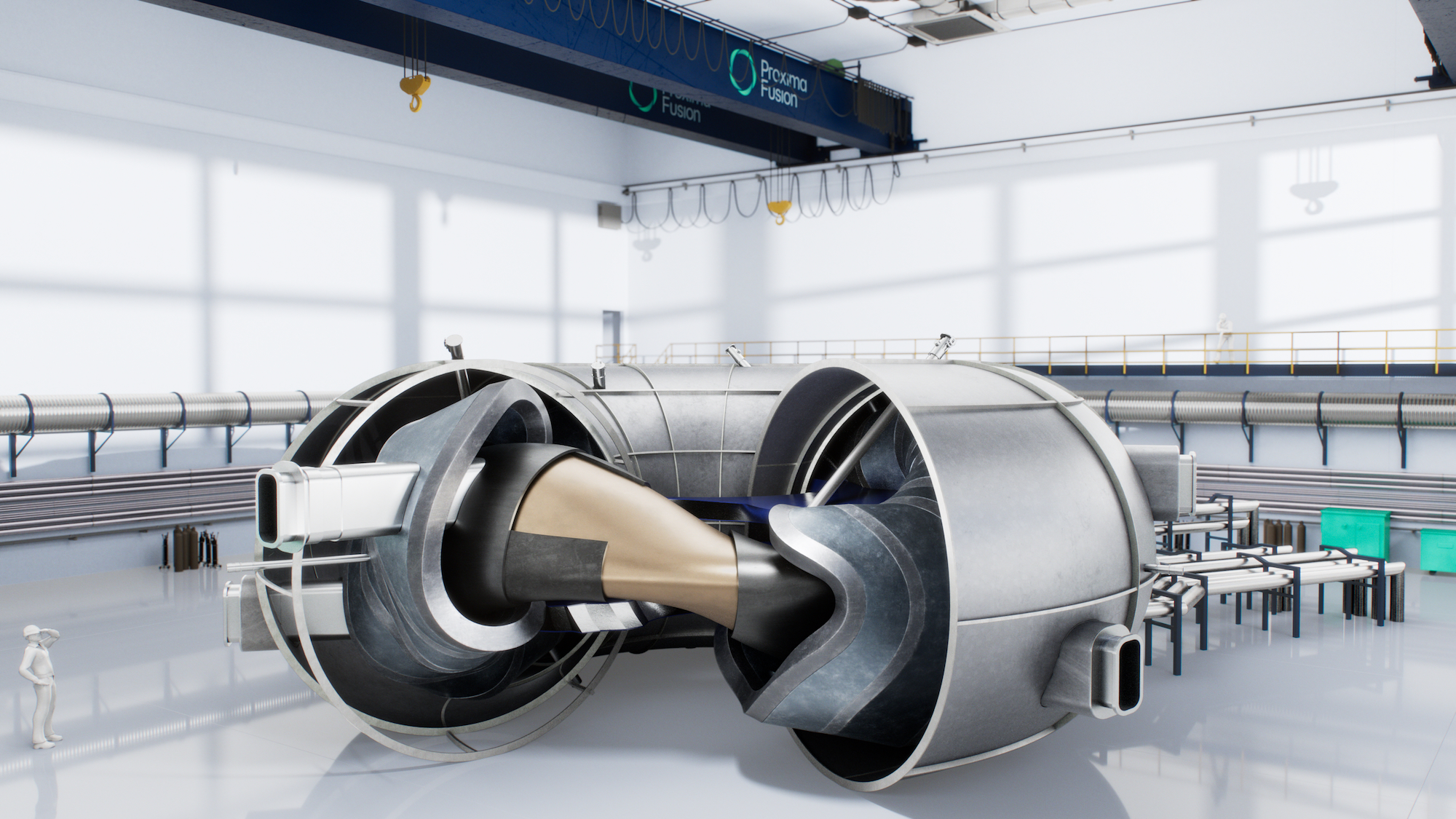
Google has joined a €411 million ($468 million) funding round for German startup Proxima Fusion, underscoring growing confidence in nuclear fusion as a long-term source of clean, reliable energy.
The investment, announced on Tuesday, values Proxima Fusion at €2.7 billion and strengthens Europe’s ambitions to build its first commercial fusion power plant amid intensifying competition with the United States and China.
The funding round was led by XTX Ventures and East X Ventures, with German energy company RWE and Google participating as strategic investors. Other investors included Plural, UVC Partners, Balderton and Cherry Ventures.
Nuclear fusion generates energy by combining two hydrogen atoms to form a helium atom, releasing vast amounts of energy. Unlike conventional nuclear power plants, which rely on nuclear fission by splitting atoms, fusion promises virtually limitless, carbon-free energy. However, the technology has yet to be commercialised because of significant scientific and engineering challenges.
Proxima said Google’s investment reflects the technology giant’s continued confidence in fusion as a potential source of abundant, carbon-free and dependable energy over the long term.
Commenting on the company’s latest fundraising, Proxima Fusion Co-founder and Chief Executive Officer, Francesco Sciortino, said Europe is determined to compete with global rivals in the race to commercialise fusion energy.
“Europe is racing with the United States and China to get to the first fusion power plant,” Sciortino said.
He added: “Proxima’s financing demonstrates that Europe can not only invent breakthrough technologies, but also build globally competitive companies around them.
“Investors recognise both the urgency and the opportunity of what we’re doing and are backing us to develop a generational energy technology company.”
Proxima is developing stellarator fusion technology, one of several competing approaches to achieving nuclear fusion. The company aims to build a fusion demonstrator—a proof-of-concept facility that will precede a commercial power plant—in the early 2030s.
Its first commercial fusion power plant is expected to come online later in the decade.
The company said the fresh capital will be used to expand production of high-temperature superconducting (HTS) cables and magnets while advancing the engineering and manufacturing systems required to build stellarators.
Proxima also plans to recruit more engineers, manufacturing specialists and operations personnel to accelerate development.
Although Proxima is now Europe’s best-funded fusion startup, it still trails several US competitors in total capital raised.
US-based Commonwealth Fusion Systems secured $863 million in August, bringing its total funding to $2.9 billion, while Sam Altman-backed Helion Energy raised $465 million last month, taking its cumulative funding to $1.5 billion.
Google has also invested in Commonwealth Fusion Systems and, in June 2025, signed an agreement to purchase electricity from the company’s first commercial fusion power plant once it begins operations.
In a blog post announcing that agreement, Google highlighted fusion’s long-term promise while acknowledging the challenges involved.
“Fusion holds huge potential as an energy source of the future: it’s clean, abundant and inherently safe, and it can be built just about anywhere,” the company said.
Google, however, cautioned that bringing fusion technology to commercial scale remains difficult, adding that although fusion has the potential to transform global energy production, commercialising the technology is “immensely challenging, and success is not guaranteed.”
Boluwatife Enome