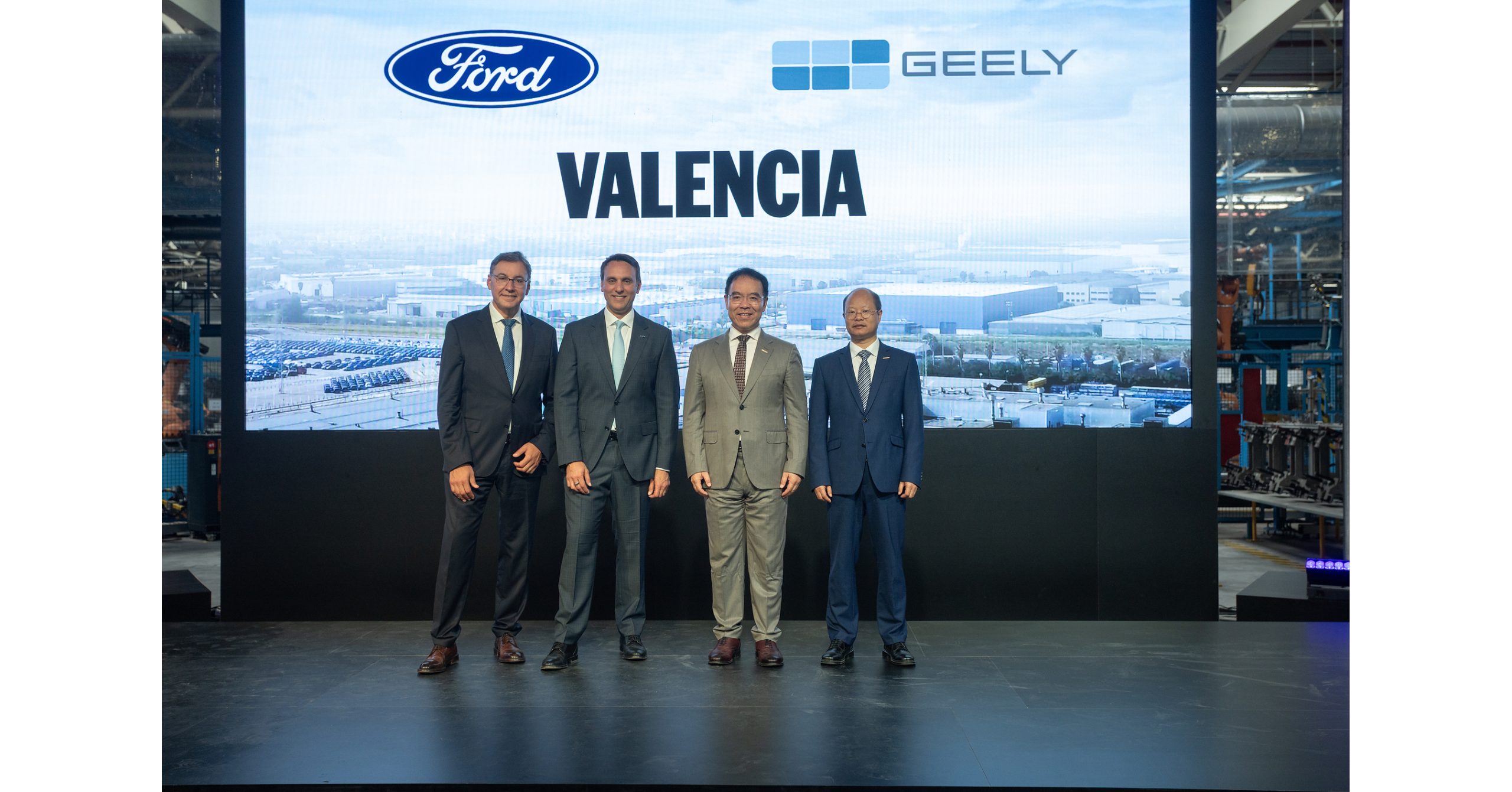
Chinese automaker Geely Auto and Ford have announced a strategic partnership to build electric sport utility vehicles (SUVs) at Ford’s Valencia plant in Spain, marking Geely’s first manufacturing base in Europe as both companies strengthen their presence in the continent’s fast-growing electric vehicle market.
The agreement, announced on Thursday, will establish a joint venture in which Ford will hold a 66% stake and Geely the remaining 33%. The first Geely-branded electric SUVs are expected to roll off the Valencia production line in 2028.
Ford’s President of Europe, Jim Baumbick, said the partnership would significantly increase activity at the Spanish facility, which has been operating far below its production capacity.
“We have the ability to really load up the facility. That’s the goal,” Baumbick told Reuters.
The deal follows months of negotiations between the two automakers and builds on a longstanding relationship that dates back to Geely’s acquisition of Volvo Cars from Ford in 2010.
Geely Senior Vice President Victor Yang said the first model to be produced in Valencia will be the EX5 electric SUV, which is already available in several European markets. A second Geely vehicle remains under development.
Yang said establishing a manufacturing presence in Europe is a key part of Geely’s international growth strategy, adding that working with an experienced partner like Ford would support the company’s localisation efforts.
In addition to producing Geely vehicles, the companies will jointly develop a new crossover model that will be offered with multiple powertrain options, including fully electric, plug-in hybrid and extended-range electric variants. Production of the new model is also scheduled to begin in 2028.
The partnership comes as Chinese electric vehicle manufacturers accelerate plans to establish production facilities in Europe ahead of proposed European Union rules requiring higher levels of locally sourced content in electric vehicles sold across the bloc.
Spain has become an increasingly attractive destination for Chinese automakers due to its well-established automotive industry, competitive labour costs and relatively lower energy prices compared with several other European countries.
Ford is also expected to benefit from the arrangement by making greater use of its underutilised Valencia factory, which currently produces the Kuga SUV and has an annual production capacity of about 500,000 vehicles. Industry data show the plant operated at only about 26% of its capacity in 2025.
The US automaker also plans to begin manufacturing its Bronco SUV in Valencia in 2028, with Baumbick saying Geely’s addition would improve economies of scale and help Ford compete more effectively in the European market.
Industry analysts say the partnership offers clear benefits for both companies, enabling Geely to establish its first European manufacturing base while allowing Ford to reduce fixed costs and maximise the use of excess production capacity.
The agreement underscores how Chinese automakers are increasingly turning to European production as they expand overseas, while established manufacturers seek new ways to utilise underused facilities and remain competitive in the rapidly evolving electric vehicle market.
Goodness Anunobi