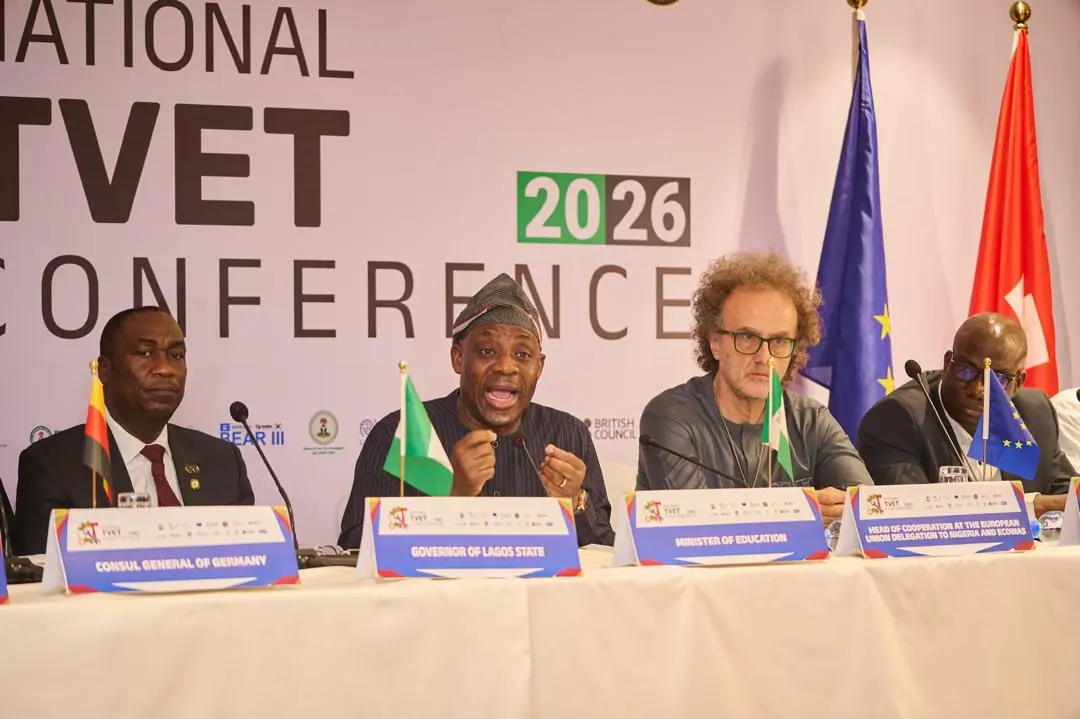
The Federal Government has reaffirmed its commitment to building a skills-based economy, positioning Technical and Vocational Education and Training (TVET) as a central strategy for boosting productivity, accelerating industrialisation and creating sustainable employment opportunities for Nigeria’s growing youth population.
Speaking at the National TVET Conference 2026 in Lagos, Minister of Education, Maruf Tunji Alausa, said the administration of Bola Ahmed Tinubu is implementing reforms under the Renewed Hope Agenda to transform the education sector into a platform for producing innovators, entrepreneurs, skilled technicians and employers of labour.
Alausa noted that Nigeria faces mounting pressure to equip its workforce with relevant skills, as nearly five million young people enter the labour market annually. He said the government is leveraging the Nigeria Education Sector Renewal Initiative to strengthen the National Skills Qualification Framework, improve quality assurance systems and expand access to competency-based training across the country.
According to the minister, more than 150,000 Nigerians are currently enrolled in skills acquisition programmes across over 1,600 accredited training centres nationwide. He added that the initiative is supported by thousands of instructors and quality assurance personnel tasked with maintaining training standards and improving graduates’ employability.
Looking ahead, Alausa said the next phase of the programme will focus on enhancing training quality, increasing private-sector participation and ensuring stronger alignment between skills development and labour market demands.
He identified emerging sectors such as artificial intelligence, robotics, renewable energy, cybersecurity and advanced manufacturing as key drivers of future employment opportunities, stressing the need for sustained investment in workforce development.
The conference also recognised the minister’s contributions to technical education reforms, presenting him with the TVET Champion of the Year Award for advancing skills development as a catalyst for national growth and transformation.
Representing Lagos State Governor Babajide Sanwo-Olu, Deputy Governor Kadri Obafemi Hamzat described TVET as a critical tool for employment generation, innovation and economic development. He emphasised the importance of equipping young Nigerians with practical, entrepreneurial and digital skills to remain competitive in a technology-driven global economy.
Hamzat highlighted Lagos State’s investments in technical colleges, industry partnerships and hands-on training programmes, while calling for stronger collaboration among government agencies, businesses and development organisations to strengthen Nigeria’s skills ecosystem.
In his remarks, Permanent Secretary of the Federal Ministry of Education, Abel Olumuyiwa Enitan, reiterated the government’s commitment to placing TVET at the heart of employment creation, social inclusion and sustainable economic growth.
He cited ongoing efforts to upgrade technical colleges, expand competency-based learning and deepen engagement with industry stakeholders and development partners. Enitan also urged stakeholders to ensure training programmes align with labour market needs and commended WorldSkills Nigeria for its role in youth empowerment.
International development partners attending the conference praised Nigeria’s progress in implementing TVET reforms.
Switzerland’s Consul General, Conny Cammezind, reaffirmed her country’s support for youth employment and entrepreneurship initiatives, while Germany’s Consul General in Nigeria, Daniel Krull, commended the Renewed Hope TVET Initiative and the SKYE II Programme, stressing the importance of industry-driven and demand-led training models.
Also speaking, Karen Jansen described the conference as a valuable platform for promoting employability, inclusion and green growth through improved policy coordination and the integration of digital and environmentally focused skills.
The three-day conference, themed “Harnessing TVET as a Pathway to Employment: Building a System for Employability, Inclusion and Green Growth in Nigeria,” brought together policymakers, industry leaders and development partners to explore strategies for advancing skills development and supporting Nigeria’s economic transformation.