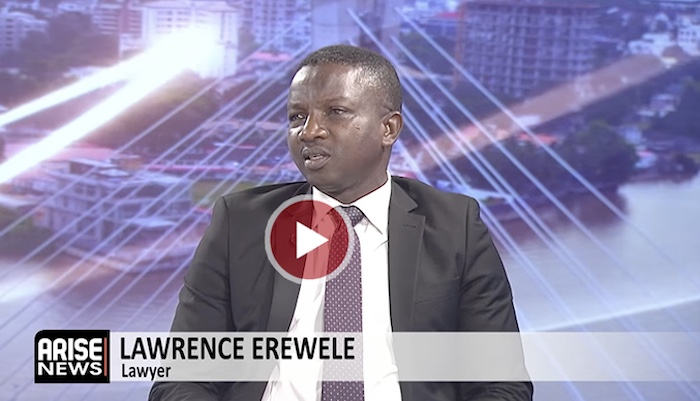

Lawrence Erewele, a lawyer representing members of the Itsekiri ethnic group involved in the Warri Federal Constituency delineation dispute, has accused some Ijaw and Urhobo groups of attempting to manipulate the ongoing electoral delineation process and create tension in the Niger Delta region ahead of future elections.
Speaking during an interview on ARISE News on Friday, Erewele defended the Independent National Electoral Commission (INEC), insisting that the electoral body had not disobeyed the Supreme Court judgment on the delineation of the Warri Federal Constituencies.
“The persons I represent are the people who are in court — honourable members of the Itsekiri extraction group,” Erewele said.
He accused opposing groups of making contradictory statements over the process.
“The Ijaws and the Urhobos recently told their people not to participate in the voter registration exercise, but they went behind and participated. So if they eventually come out to say there will be no election, I won’t be surprised. That is their stock in trade,” he said.
“They will certainly participate, but they just want to foment crisis in the Niger Delta region that has been very peaceful.”
Erewele also rejected claims that INEC had ignored the Supreme Court ruling, arguing that the commission had already begun steps toward implementing the judgment.
“INEC has started taking steps towards delineating the Warri Federal Constituencies, but a certain group of persons want INEC to do it in their own way,” he stated.
“If my friend, Eric Omare, said there was a preliminary report, that means INEC has started. That was how they got to the point of a preliminary report. So his position contradicted itself when he said there was disobedience to the Supreme Court judgment.”
According to him, the problem arose after allegations that parts of Edo State were being incorporated into the Warri Federal Constituencies to increase the electoral strength of certain groups.
“Some coordinates took part of Edo State to form the Warri Federal Constituencies. Udo Local Government, for instance, is not part of the Warri Federal Constituencies, yet some parts of Udo were allegedly being included to boost electoral power,” he alleged.
He said concerns over the situation prompted intervention from the Office of the National Security Adviser.
“They cried out to the National Security Adviser, and you know when there is a problem in Delta State, it affects the economic system of Nigeria. That was when the National Security Adviser stepped in and said, ‘Let us look at what has actually transpired over the years.’ They are still reviewing the situation,” Erewele said.
On the legal issues surrounding the delineation exercise, Erewele argued that INEC must strictly follow the Electoral Act in carrying out the process.
“What we are saying is that INEC is a creation of statute and must follow the law,” he said.
“The Supreme Court gave an order under the 2010 Electoral Act, but by 2022, when INEC wanted to commence the delineation, there was a new Electoral Act in place. Section 40 of that Act provides that once you have divided a local government into registration areas, you cannot again divide it into electoral areas.”
He insisted that the Itsekiri people were not threatening to boycott elections.
“The Itsekiris are not threatening to boycott elections. It is the other group that feels INEC should do it their own way. When they see that it is not going their way, they begin threatening to boycott elections,” he said.
Erewele further accused some groups of attempting to alter community identities through the delineation process.
“The Supreme Court had already said that Okere-Urhobo belongs to the Itsekiris, but during the delineation exercise, INEC officials allegedly renamed Okere-Urhobo as Okere-Koko, where the maritime unit is situated,” he claimed.
“If the Supreme Court judgment is to be obeyed, that locality should remain Okere-Urhobo and not Okere-Koko.”
Calling for calm and adherence to the rule of law, Erewele urged all parties to allow INEC complete its work without interference.
“All of us want free, fair and credible elections. The law is not for Itsekiris, the law is not for Urhobos, and the law is not for Ijaws. It is a process,” he said.
“Let INEC carry out its assignment. What we are saying is simple: let the law follow the letter.”
Boluwatife Enome