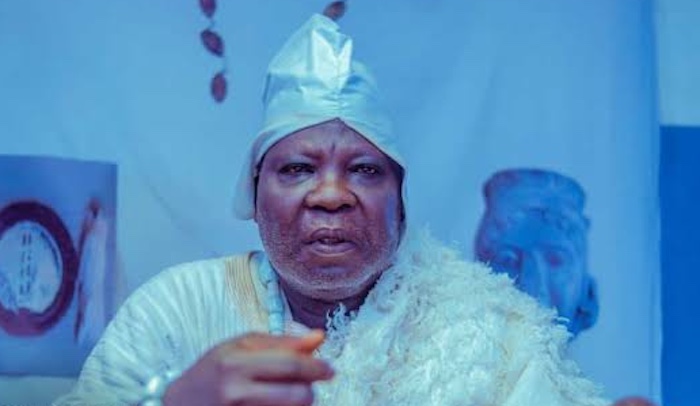
A chieftain of the Nigeria Democratic Congress (NDC), Buba Galadima, has warned that lawmakers and other political actors backing the proposed creation of state police may eventually become victims of the system, declaring that many of those supporting the initiative “will never have the chance to visit their states.”
Galadima also called for severe sanctions against judges who deliver controversial political judgments, insisting that some judicial officers were undermining Nigeria’s democracy and should not only be disciplined but prosecuted where necessary.
Speaking on ARISE News while reacting to the recent Federal High Court judgment in Lokoja, Kogi State, which set aside its earlier order directing the Independent National Electoral Commission (INEC) to register the Nigeria Democratic Congress (NDC), Galadima alleged that the ruling formed part of an attempt to weaken opposition parties ahead of the 2027 general election.
Galadima criticised the recent approval of state police, despite acknowledging that he had supported the idea for decades, saying the current political environment made its implementation dangerous.
He argued that many lawmakers backing the proposal lacked an understanding of how the former Native Authority Police had allegedly been abused before Nigeria’s First Republic.
“I assure the country that those who have a hand in this will pay dearly in the hands of state police,” he said. “I’m sure some of the members of the National Assembly, when this law is passed, will never have the chance to visit their states,” he predicted.
Explaining his opposition, Galadima alleged that state police would likely be deployed by governors and other political office holders to intimidate opponents during elections rather than address insecurity.
“Nobody ever conceived the idea of state police to sort out security,” he argued. “If the Nigerian Police and the Nigerian military cannot solve security situations in Nigeria, I wonder how the state police would be able to do that,” he emphasised.
He continued: “All that we know is that the president and the governors are looking for state police before the elections so that they use them as political thugs to attack the opposition and disrupt the election and kill democracy.”
Recalling his experiences during the era of the Native Authority Police, Galadima alleged that opposition politicians were routinely arrested and detained ahead of elections on frivolous allegations.
“When elections approach, three months to election, the Native Authority Police will gather all the opposition elements in their territorial jurisdiction and lock them up,” he claimed.
“Some of them, they will just say, ‘You abused the Emir,’ or ‘You abused the chief,’ or ‘You abused the judge,’ or that you were wearing shoes when your village head was seated on a chair. Then they would clamp all of them into detention,” he stressed.
He further claimed that abuses associated with the Native Authority Police contributed to migration from parts of northern Nigeria as many people fled political persecution.
Galadima also warned that state police could deepen ethnic and religious divisions if recruitment was dominated by indigenes of particular states, potentially making non-indigenes vulnerable.
On the NDC deregistration matter, Galadima described the judgment as a “rude shock,” saying its timing was carefully calculated to prevent the party from accessing INEC’s portal for the upload of candidates.
“I thought the judge was very strategic and deliberate in pronouncing that judgment on Friday, so that by Monday we would have been barred from accessing the code or the portal to which we would upload our candidates,” he said.
Although he disclosed that the party had since been given access to the portal and had approached the Court of Appeal, Galadima expressed confidence that the judgment would eventually be overturned.
“We as a political party are taking this calmly, and we presume that we will prevail at the end of the day because I don’t think this judgment can stand any test of time or judicial review by an upper court,” he stated.
The veteran politician, however, said the incident reflected deeper institutional problems, arguing that the judiciary and the electoral commission were sending dangerous signals capable of destabilising the country’s democracy.
According to him, the National Judicial Council (NJC) must undertake serious introspection over the conduct of some judges handling politically sensitive cases. “I think the judiciary needs to do a lot of soul-searching. Some bad eggs within the judiciary will tarnish the image of the judiciary,” he said. He added: “I think certain actions of certain judges must not go unpunished.”
Galadima went further, calling for criminal sanctions against judicial officers found to have deliberately compromised justice.
“I think the NJC, as an institution, should do soul-searching and really look at some of these judges in the face and deal with them. Not only punish them, but send them to jail, because they are destroying the country. Any country where there is no justice is in trouble,” he declared.
Stressing that there were disturbing developments within Nigeria’s democratic institutions, he argued that when citizens increasingly feel alienated and institutions lose public confidence, the country risks serious instability.
On the broader political environment, Galadima accused the ruling All Progressives Congress (APC) of pursuing a deliberate strategy to weaken opposition parties and entrench one-party dominance. According to him, Tinubu began focusing on politics immediately after assuming office instead of governance.
“From the day President Tinubu was inaugurated as Nigeria’s president, he started politicking, not delivering service and democracy dividends to the people of Nigeria,” he said.
Galadima alleged that the executive, legislature and judiciary were gradually becoming part of a coordinated effort to undermine opposition parties.
“He will try to destroy all opposition candidates, all opposition political parties, and he’s being actively supported by the National Assembly. Now they are dragging the judiciary into it as a complementary part of the larger picture that this APC and its government is trying to create for the people of Nigeria,” he alleged.
Nevertheless, he expressed confidence that democracy would outlive the present administration. “It doesn’t matter what they try to do, democracy must outlive them. It will survive, and it will outlive them,” he said.
Galadima also urged opposition parties to stop litigating against one another and instead build a united front against the ruling party. “What pains me is that the opposition political parties themselves are fighting themselves instead of fighting our common opponent, that is the APC and its government,” he said.
He reiterated his earlier proposal that opposition parties should cooperate strategically, arguing that even if some parties were weakened through litigation or other means, the remaining parties should rally behind a single presidential candidate ahead of the next general election.
Emmanuel Addeh