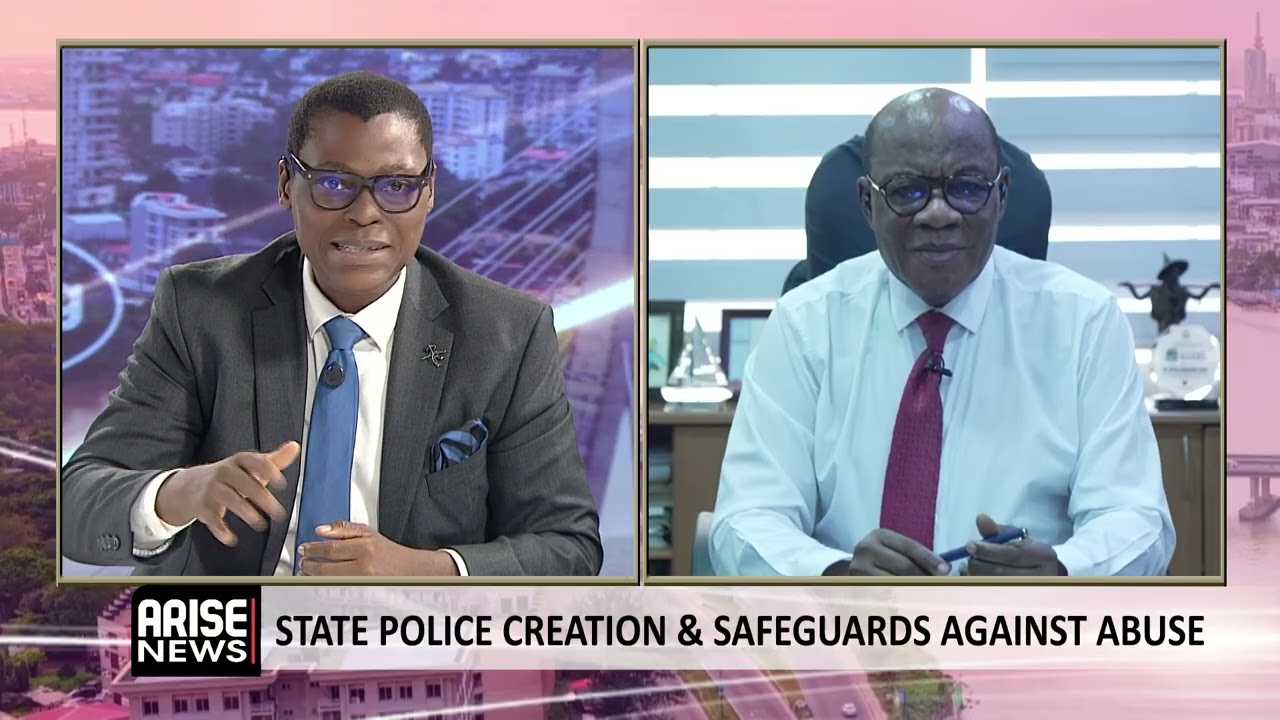
Senior Advocate of Nigeria (SAN), Dr Olisa Agbakoba, has endorsed the proposed establishment of state police but warned that the initiative would only succeed if state police commands are constitutionally insulated from the control of governors.
Speaking during an interview on ARISE NEWS on Wednesday, Agbakoba applauded President Bola Tinubu for introducing the executive bill on state police, describing it as a long-overdue step towards restructuring Nigeria. However, he cautioned that without strong constitutional safeguards, governors could abuse the system.
“I think the bill has been hurriedly put through for particular reasons. But for me, that’s okay, because I’ve been an advocate of political devolution of powers.
“So I’m happy that, in principle, at least finally, the bill is in the House. I can tell you that in 2003, I submitted a complete bill on devolution of powers across the Constitution. So you can see how far down we are.
“So let’s say, alright, there are a lot of things wrong with the bill, but it’s there. So let’s then be sure that the bill will achieve the purpose for which it has been passed. And the main concern I have is for the governors not to misuse it.”
Agbakoba explained that the solution lies in creating constitutional institutions that shield state police from executive interference.
“That’s why in my letter to the Secretary to the Government of the Federation, I recommended, as you rightly say, that there has to be constitutional institutions so that the governors will not be able to interfere, which is a big problem.
“I’ll just give an example of how the chief judges of the states operate. At least there’s a fair amount of independence. If we can use that architecture that protects this process, then I think that will be fine.
“So long as the governor cannot appoint, remove, sack, fund and do all those things that make the state police command an appendage of the governor’s office, I think that is okay, because we have to start somewhere.”
While supporting the bill, the former Nigerian Bar Association president argued that state police should only be one aspect of a broader constitutional restructuring aimed at creating a genuine federation.
“But having said that, as you know, Nigeria is overheated. So this is a good move. I applaud President Tinubu for proposing the executive bill on state police. But what about the other aspects of the Constitution?
“The country is overheated. That’s the problem. I would like to see a full repertoire of reforms that would make Nigeria strong.
“And those reforms simply mean that we need to have a federation that is, in truth, a federation. This struggle for power in Abuja is overheating the entire place. That’s the problem.
“So state police is good, but what about other things? That’s the point I’d like to make. We should now use this state police initiative to then look at other aspects of the Constitution that require power to be devolved from the Federal Government to the states.
“So we can have a proper federation. Let the regions or the states, whatever will be the federating unit—I personally go for six regions because the states are absolutely unviable—but whatever it is that is decided, let there be a systematic and massive devolution of powers to the components of Nigeria so that competition for power at the centre will stop.
“Look what’s happening to the National Assembly. Look what’s happening to INEC. Everywhere is in chaos. How are we going to have elections in 2027 under the present conditions of insecurity, violence, banditry, crime and everything?
“So this is an opportunity for President Tinubu to take advantage and slow Nigeria’s descent into chaos.”
Responding to concerns that state police could suffer the same fate as State Independent Electoral Commissions and local government councils, which many believe lack genuine independence, Agbakoba said Nigeria should borrow from South Africa’s constitutional model.
“That’s why I said what we should do is look at South Africa. Chapter Nine of the South African Constitution is titled ‘Institutions Supporting Democracy’ and it lists a number of institutions.
“So here I’d be listing the EFCC, the police, INEC, the judiciary, state police and other critical institutions. Insert them into our Constitution and create a situation in which they get funding outside the control of the executive. Their tenure of office, how they work, security of tenure and all those things will be absolutely guaranteed.
“The main point would be that the governor of the state cannot just go and pluck the state commander or appoint or remove him.
“Once we create that process—I may not be too clear about how the process will evolve—and if we had had a public forum to discuss this, I’m sure we would have come up with a very good format.
“The key point is this: let the state commander not be under the control of the governor.
“Right now, the Inspector-General of Police is under the control of the President of Nigeria. The President can remove the Inspector-General at will. But the President cannot remove the Chief Justice of Nigeria at will. So the format in which the Chief Justice is insulated is exactly what I’m recommending for the state police command.”
Agbakoba also criticised the speed with which the National Assembly handled the legislation, saying Nigerians were denied the opportunity to debate such an important constitutional amendment.
Asked whether strong safeguards would be enough given the conduct of some politicians, he admitted the fears were legitimate but insisted that Nigeria must move forward.
“This is a good example of how even the so-called safeguards didn’t work. But then what do we do?
“You remember that the late Chief Obafemi Awolowo asked two questions. The first was: ‘Do we want to be one country?’
“I think that question is something very important because that is exactly what I take from what you’re saying. Do we want to be one country? If the answer is yes—and this answer must come from Nigerians, not from the rulers—then the next question would be: what sort of political arrangement are we looking at?
“I don’t think we’ve answered it. That’s why we’ve been moving in circles.
“So yes, you are right. This proposal could be in place and yet we could still have anarchy. I agree entirely.
“But the point is we have to look for something that will move this country forward. The country is on its knees.
“So if we have to agree on one thing, it is that the federal police structure cannot deal with insecurity. That’s a given.
“Then what follows from that is: what can we do? That’s why you have state police.
“But the problem with the state police architecture is: what about the governors misusing that power?
“So the only way you can deal with that is to say: can we insulate the state police command from executive interference? Yes, by putting in place the suggestions that I made.
“But what if a governor recklessly disregards all of that? Those are questions we would have discussed if the process had been inclusive, if there had been a debate. There has been no debate.
“So, for me, to be pragmatic and move forward, I recognise the point you make, which is absolutely valid, but we have to do something. Otherwise we’re stuck.
“I’d rather have a weak state police command with the possibility of interference by the governor, but with the potential that he can also be checked by the federal authorities.
“So if you give me the choice, I will say let’s take the chance, establish the state police, put in the constitutional safeguards and hope for the best.
“I agree that the risks remain, but that tells you that Nigeria is a very fragile nation.”
Boluwatife Enome