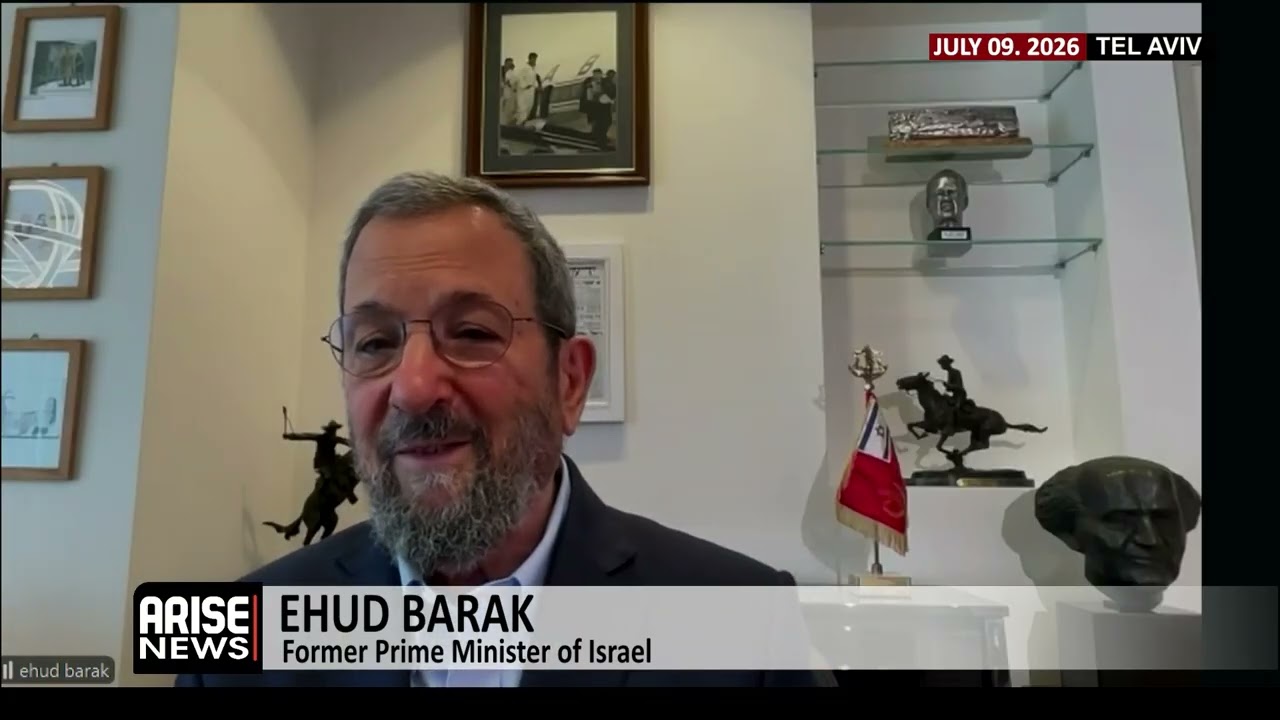
Former Israeli Prime Minister Ehud Barak has said concerns that governors could weaponise state police for political purposes are legitimate but can be effectively addressed through robust federal legislation that clearly defines oversight and limits the powers of state authorities.
Speaking during ARISE NEWS Townhall on State Police he argued that while decentralised policing would make law enforcement more responsive and better connected to local communities, Nigeria must build strong legal safeguards that allow the federal government to intervene whenever state police are misused for political ends. “The worry that someone might try to use the fact that he has a state police for his own political ambitions and so on is a real issue and should be addressed.”
Burak explained that recruiting police officers from within their own communities would improve intelligence gathering, cultural understanding and operational effectiveness. “When you mobilise and recruit the policemen from within the community, they will be much more sensitive. They will understand the norms and the practises, the religious space, and everything that relates to the people around them. It will be much more effective.”
He stressed that decentralisation must be accompanied by carefully drafted legislation that gives the federal government oversight powers capable of preventing political abuse by state governors. “I think that it is much easier to deal with such events through the very detailed legislation that gives certain authority to the president and to the federal government in Abuja over the governors and so on.”
Burak maintained that preventing abuse through legislation was far easier than attempting to police a vast country like Nigeria exclusively from the centre. “It’s much easier to correct this element than to activate through a vast country like Nigeria from a central place.”
According to him, state police would also deliver quicker emergency responses because officers would possess better knowledge of local terrain, customs and security dynamics. “Response is much faster when you’re talking about the state police. Response is much more calibrated to the nuances, subtleties of the arena in which it’s carried out.”
Barak also highlighted intelligence gathering as one of the strongest advantages of decentralised policing, saying local officers are naturally better positioned to generate human intelligence needed to combat terrorism and organised crime. “Intelligence is essential for running a fight against terror, against organised crime. But, you know, it’s mainly human intelligence.”
He warned that sophisticated intelligence capabilities, particularly signal intelligence, should remain under federal control because of both their cost and the dangers of misuse.
“Signal intelligence is extremely expensive, and if the capabilities of signal intelligence ended up in the hands of the wrong person or the wrong group, they can cause huge damage to the national structure and become a kind of a threat.”
Barak further recommended that Nigeria establish a centrally controlled rapid deployment police force that could reinforce state police. “There should be, to the best of my judgement, a central kind of rapid deployment police force under the command of Abuja that could be sent in any region to support them when a problem which is beyond their capabilities emerges.”
He emphasised that effective state policing would depend on constant information sharing between state police formations and the federal authorities. “The state should report there should be no secrets of what happens to the police And at the same time, the federal authorities should be sensitive to the needs.”
While acknowledging that implementing such a system would not be easy, Barak insisted that balancing local accountability with strong federal oversight. “It won’t be easy, but that’s the only way.”
Erizia Rubyjeana