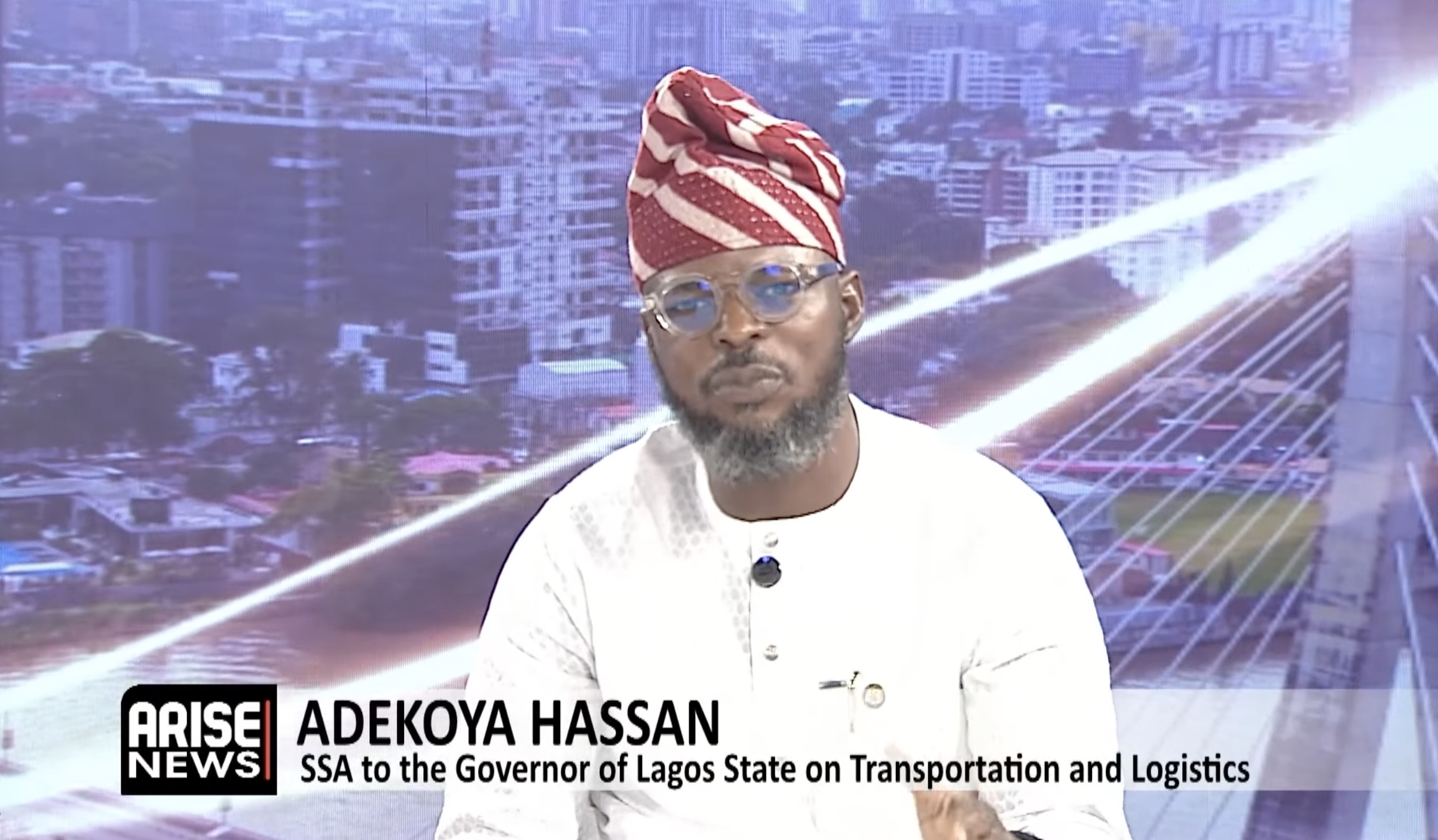
Screenshot
The Special Senior Assistant to the Lagos State Governor on Transportation and Logistics, Adekoya Hassan, has said that while the Lagos State Government has largely succeeded in easing traffic congestion along the Apapa port corridor, persistent extortion practices remain a major challenge that “cannot be stopped”.
Hassan made the remarks during an interview with ARISE News on Wednesday, where he defended ongoing interventions by the state government and the Presidential Enabling Business Environment Council (PEBEC)-supported efforts to improve logistics flow around the Apapa axis.
Hassan outlined his background and motivation for joining the Lagos State Government.
“I resigned to join the administration of the government of Babajide Olusola Sanwo-Olu to pursue my passion for good governance.
Responding to questions on whether the earlier improvements recorded along the Apapa port access roads had been sustained, Hassan said the intervention had significantly improved movement within the axis.
“For the intervention of PEBEC in Lagos Port, it is a beautiful initiative. Why? We were able to achieve a lot with the support of the Lagos State Government led by my Honourable Commissioner, Honourable Shola Giwa, and myself. We were fully involved.”
He explained that enforcement actions and coordination with security agencies helped restore order along the corridor.
“After dismantling, we also got the extortion power removed. The police have done a beautiful job in supporting the initiative to ensure a safe and sanitary way of doing business along this corridor.”
Hassan insisted that the once-notorious Apapa gridlock had been largely resolved, crediting the current administration’s reforms for improving traffic flow.
“I can tell you for free today that the gridlock is no more. You can travel from Apapa to the international airport in less than 20 minutes, from Apapa to VI in less than 20 minutes. All of these are for free.”
However, he warned that illegal collection of money from drivers and transport operators along the corridor continues despite enforcement efforts.
“But I will tell you for free today, the extortion at the corridor cannot stop. It has come to stay.”
He further argued that while government and security agencies have made progress in dismantling physical bottlenecks, the problem of extortion persists across key access points including the port terminals.
“For the bottleneck of extortion, let me give you a specific example. The former Honourable Minister for Transport, Rotimi Amaechi, travelled down. He was in this studio and stated, and I quote, that he was in Apapa a day before a presidential visit and said the place looked like Oshodi Market, comparing Lagos to Oshodi Market as a minister.”
Hassan maintained that successive administrations and stakeholders have struggled to eliminate extortion practices along the corridor despite multiple interventions.
“He further mentioned that he had a stakeholder meeting with all these stakeholders at the corridor. He wasn’t able to do anything. The extortion point, the bottleneck… today we have another minister. Thanks to what the current minister is doing, he has done a beautiful job.”
He added that improvements had been recorded at key exit points around the port, but insisted the extortion problem remains deeply rooted.
“All the bottleneck of extortion from Tin Can second gate, Tin Can port gate, and other exit points have been managed. But for the extortion, it is more than what they can do. It is more than what any minister or anybody can do. It has come to stay.”
“It didn’t take up to 24 hours for the extortion to return. So it is clearly a deeper problem.”
Boluwatife Enome