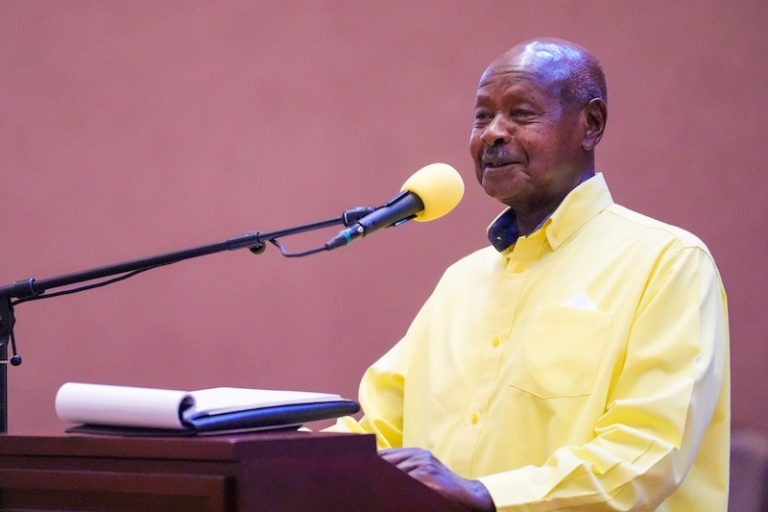
Rwanda, billionaire industrialist and founder of BUA Group, at the Africa CEO Forum in Kigali, Abdul Samad Rabiu, has called for urgent reforms to strengthen African integration, trade, and mobility, citing his personal experience of being denied entry into South Africa over an expired visa while European travellers were admitted without visas.
Speaking during a session themed “Africa at scale: Capital, policy, and the architecture of growth”, Rabiu said the incident, which occurred in February 2025 while he was travelling to Cape Town for the Mining Indaba, reflects broader contradictions in Africa’s approach to intra-continental movement and cooperation.
“I had a personal experience. Last year February, I was travelling to Cape Town for the Mining Indaba. And as we landed… I tendered my passport, and the immigration officer looked at it and was like, where is your visa, and I said, ‘My visa is there’,” he said.
“Unknown to me, my visa had expired the day before. Unfortunately, our crew did not check the visa… We were there for four hours, but at the end of the day, I had to turn back. I was turned back to Lagos.”
However, Rabiu said what troubled him most was not the enforcement of immigration rules, but the disparity in treatment between Africans and non-Africans at the same entry point.
“But the issue is, while we were waiting… there were like three international flights from Europe. All three flights were mostly Europeans,” he said.
“I was standing there by the immigration desk, and every passenger on those three flights went into Cape Town without any visa.”
The BUA Group chairman said while he accepted responsibility for the expired visa, the broader implication points to a deeper continental challenge that must be urgently addressed.
“I do not have a problem with the fact that I was there without the visa and I was returned. I took full responsibility of that,” he said.
“I had an issue with being an African in Africa, being turned away because I do not have a visa and foreigners from other continents were coming in and were allowed to enter without a visa. This must change.”
Rabiu warned that such barriers undermine the spirit of the African Continental Free Trade Area (AfCFTA), stressing that fragmentation continues to limit cross-border business expansion.
“At BUA Group, as we expanded our regional investment, we actively sought to supply several African markets under the AfCFTA framework,” he said.
“While some countries embraced the spirit of agreement, others were less supportive in practice… limiting our ability to participate fully in regional trade.”
He added that his experience reflects a wider implementation gap within AfCFTA, which he described as one of the world’s most ambitious economic integration frameworks.
“So really, AfCFTA is not working as it should… we were actually frustrated,” Rabiu said.
According to him, Africa’s transformation depends on five key pillars: capital, policy, infrastructure, value addition, and integration.
“Capital to finance ambition, policy to enable execution, infrastructure, the foundation of growth, value-addition to unlock the full value of our resources, and integration to unlock scale,” he said.
Rabiu stressed that Africa is not lacking capital, but coordination in deploying it effectively.
“The reality is clear: Africa is not short of capital, it is short of coordinated mobile capital deployed at scale,” he said, calling for harmonised investment frameworks and stronger cross-border financial systems.
He further emphasised that policy fragmentation remains a major constraint on investment and industrial growth across the continent.
“What is required is clear and transparent rules, predictable enforcement and coordinated industrial strategies across borders,” he said.
Rabiu also underscored the importance of infrastructure in driving industrialisation, noting that no economy can grow without reliable energy, transport networks, and digital connectivity.
“The 21st century will not reward detached brilliance, but coordinated execution,” he said, urging African leaders to move from policy declarations to implementation-driven development.
Boluwatife Enome