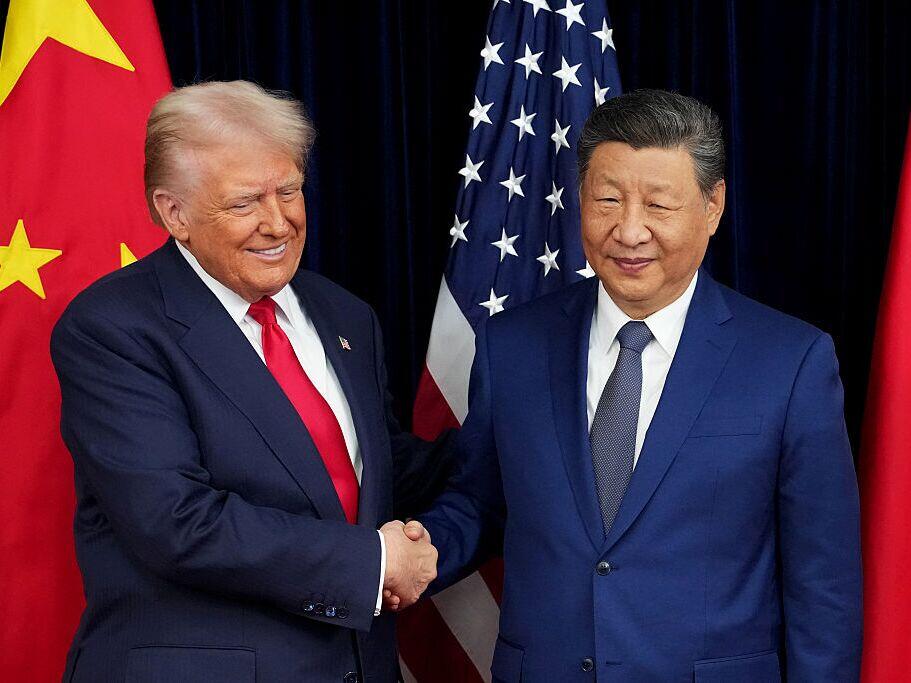
BUSAN, SOUTH KOREA - OCTOBER 30: U.S. President Donald Trump greets Chinese President Xi Jinping ahead of a bilateral meeting at Gimhae Air Base on October 30, 2025 in Busan, South Korea. Trump is meeting Xi for the first time since taking office for his second term, following months of growing tension between both countries. (Photo by Andrew Harnik/Getty Images)
Market participants say their main concern is not geopolitical friction, but whether the United States will ease restrictions on advanced chip exports that are central to China’s AI expansion.
This marks a sharp shift from previous years, when Chinese markets were heavily driven by swings in US-China trade relations.
Today, investor sentiment is largely anchored in optimism around China’s technology growth, particularly artificial intelligence.
China’s currency, the yuan, has steadily strengthened over the past year, reaching a three years high. At the same time, China’s benchmark Shanghai Composite Index has climbed to an 11 years peak, supported by strong export performance and rising AI-related demand.
Despite ongoing global flashpoints including conflicts in the Middle East, Taiwan related issues and rare earth competition investors appear increasingly focused on the AI race rather than political disputes.
“The tables have turned. There’s little China is eager to discuss with Trump,” said Yang Tingwu, vice general manager at Tongheng Investment, noting that market attention has shifted toward technology driven growth rather than trade confrontation.
The change in sentiment comes as Trump makes his first visit to China in nearly a decade, following a temporary pause in trade hostilities between Washington and Beijing earlier this year.
Some analysts say the easing of tariff pressures, combined with China’s expanding tech ecosystem, has reduced market sensitivity to political rhetoric. US court rulings have also weakened parts of earlier tariff measures, while trade flows have continued through alternative routes in Southeast Asia.
Investors are now heavily positioning around China’s AI ambitions, particularly in data infrastructure and semiconductor access. Firms such as China Mobile and China Telecom have attracted increased investment interest due to their exposure to data-centre expansion.
“The only thing worth monitoring is development around AI,” said Zeng Wanping, fund manager at Beijing Monolith Fund Management. “This is the market’s top focus, no other.”
Attention is also on whether the US will relax restrictions on advanced Nvidia chips, which remain crucial for AI development but are currently tightly controlled for export to China.
Analysts say that while diplomatic discussions may touch on trade, energy, and global conflicts, markets are largely betting that both leaders will avoid actions that could disrupt the momentum of the global AI boom.
For now, investor sentiment remains firmly tied to technology not politics as artificial intelligence continues to reshape global markets and investment priorities.
Goodness Anunobi