Colombia’s newly inaugurated president, Abelardo de la Espriella, has moved swiftly to make his campaign promise of a tougher war against the country’s armed groups a reality, with the military reporting the killing of an alleged dissident rebel commander in an operation in central Colombia.
The Colombian government identified the man as Hernando Forero Mosquera, also known as “El Ruso”, and said he was a senior figure in the dissident Frente 28, a faction that emerged from the former Revolutionary Armed Forces of Colombia (FARC).
President de la Espriella hailed the operation as a warning to armed and criminal organisations that his government intends to pursue them aggressively.
The president said the deaths of Forero and other alleged members of armed groups sent a “clear and powerful message” that there would be nowhere for criminal organisations to hide.
The reported military operation comes only days after de la Espriella was sworn in as Colombia’s president, marking an immediate shift in the country’s security policy.
A Sharp Break With Petro’s “Total Peace”
De la Espriella campaigned on a promise to dismantle what he calls Colombia’s “narco-terrorist” organisations through a much more aggressive use of state power, including military operations and, where necessary, air strikes.
His approach represents a decisive departure from former President Gustavo Petro, whose administration pursued a policy known as “Total Peace”, seeking negotiations and ceasefires with several armed groups.
That strategy produced some agreements and temporary reductions in fighting, but negotiations with several organisations eventually stalled or collapsed as ceasefires were repeatedly violated. Critics argued that armed groups used the pauses to strengthen their territorial and criminal networks.
De la Espriella has rejected that model, promising instead to restore state control through military pressure and a more uncompromising campaign against armed organisations.
His inauguration itself underscored the change. Rather than making his principal security address solely from Bogotá, the new president placed the fight against armed groups at the centre of his first days in office, including a speech before troops in Cali. The Associated Press and Financial Times both described his presidency as a significant shift to the political right and highlighted his pledge to abandon Petro’s negotiating approach.
Violence Shadows the New Administration
The new government’s tougher posture has already been met with violence.
A day after de la Espriella took office, authorities reported two separate attacks involving explosives.
In Cauca, a car bomb exploded at a tollbooth, injuring two security guards, while in Cesar, a police officer was killed in an attack involving explosives dropped from a drone.
The incidents underline the scale of the challenge facing the new president. Colombia continues to confront a complex network of armed organisations involved in drug trafficking, illegal mining, extortion and territorial control.
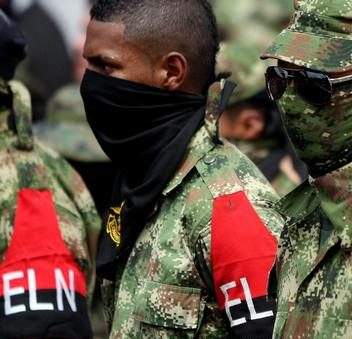
Among the most prominent are dissident factions of the former FARC, the National Liberation Army (ELN) and powerful criminal organisations.
The FARC Legacy
The original FARC signed a historic peace agreement with the Colombian government in 2016, formally ending more than five decades of insurgency by the country’s largest left-wing rebel movement.
But not all fighters accepted the agreement.
Several dissident factions rejected demobilisation and continued operating in remote parts of the country. Over time, many of these groups became increasingly involved in cocaine trafficking, illegal mining and other illicit activities.
Frente 28 is among the dissident structures that have remained active, particularly in eastern Colombia.
Colombian reporting has previously identified Forero, known as “El Ruso”, as a figure associated with the dissident network. Infobae also reported before de la Espriella’s inauguration that the president-elect had publicly identified armed-group commanders, including leaders associated with FARC dissidents, as targets of his proposed security campaign.
A Test of De la Espriella’s Security Strategy
The reported killing of Forero could become an early symbol of the new government’s determination to replace negotiation with military pressure.
But the operation also raises a broader question: can a more aggressive military strategy succeed where years of conflict and repeated peace initiatives have failed?
De la Espriella has promised Colombians a restoration of security and state authority. He has also warned armed groups that they must either surrender or face the full force of the state.
That message is already being tested.
The attacks that followed his inauguration suggest that Colombia’s armed groups have no intention of quietly accepting the new government’s approach. Instead, the country could be entering a new and potentially more confrontational phase of its long-running struggle with insurgent and criminal organisations.
For de la Espriella, the killing reported by the military is an early demonstration of his pledge to pursue Colombia’s armed groups relentlessly.
For the country’s armed organisations, it is likely to be viewed as a declaration of war.
And for millions of Colombians living in areas where the state has struggled to maintain control, the coming months will determine whether the president’s hard-line strategy can deliver what his campaign promised: security, territorial control and an end to the growing influence of armed groups.