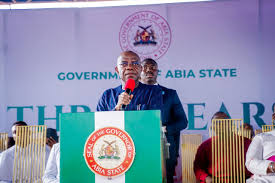
A new report on Nigeria’s governance performance has shown significant shifts in state rankings, with Abia State emerging as the most improved in the 2025 State Performance Index (pSPI) released by Phillips Consulting. The South-West climbed 26 places, moving from 36th position in 2024 to 10th in the latest assessment, making it the highest gainer in the ranking.
The report ranked Lagos as Nigeria’s best-performing state, followed by Ogun and Kaduna, while Adamawa and Niger completed the top five. Niger recorded a notable rise from 29th to fifth position, while Adamawa moved up from 26th to fourth.
Lagos retained its top position, driven by strong performance across governance and economic indicators, while Ogun and Kaduna also maintained their positions among the leading states.
Nasarawa (sixth), Gombe (seventh), Jigawa (eighth), Plateau (ninth) and Abia (10th) completed the top 10 in the 2025 index. In contrast, Bayelsa and Kano recorded the steepest declines in performance. Bayelsa dropped from sixth place in 2024 to 29th in 2025, while Kano fell from seventh to 30th position.
Phillips Consulting said the 2025 edition of the index adopted a revised methodology that places greater emphasis on measurable outcomes and objective performance indicators.
“The revised methodology places greater emphasis on measurable outcomes and transparency, rewarding states that demonstrate stronger fiscal health, governance, service delivery and economic performance”, the report said.
The firm explained that the pSPI is designed not only as a ranking tool but also as a framework for identifying governance gaps and guiding policy reforms.
“The pSPI is not merely a ranking exercise; it is a strategic tool for diagnosing performance gaps, identifying best practices, and guiding reforms that improve citizens’ quality of life”, it added.
The report also highlighted ongoing concerns around citizen engagement, noting that many respondents across several states were unaware of government projects and programmes at the local level.
In Kogi State, for instance, 82 percent of respondents said they were unaware of local government projects, while 83 percent reported no knowledge of socioeconomic programmes targeted at residents.