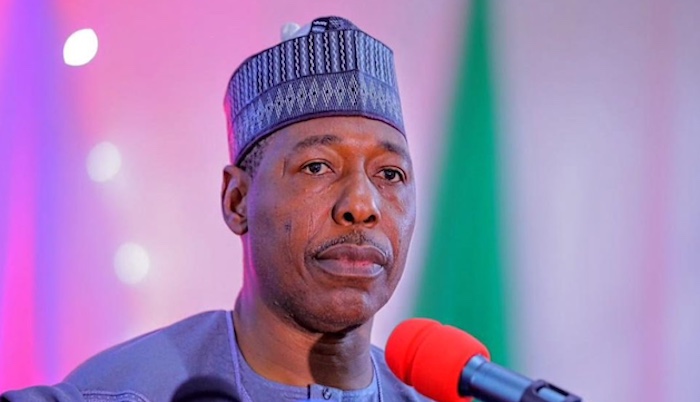
Borno State Governor, Prof. Babagana Zulum, has urged the Federal Government to protect critical assets belonging to the Chad Basin Development Authority (CBDA), warning that the alleged auction of serviceable equipment as scrap metal could cripple agricultural development and recovery efforts in the North-East.
Zulum’s appeal follows reports that some individuals are allegedly seeking to dispose of heavy equipment and facilities located at the CBDA headquarters and booster stations across northern Borno under the guise of scrap metal auctions.
The governor, in a statement issued by the Directorate of Information, Ministry of Information and Internal Security, described the reported move as counterproductive and capable of undermining the authority’s operations.
“It has come to the attention of the Borno State Government that some unscrupulous elements are attempting to cart away the heavy equipment domiciled at the CBDA premises and booster stations across Northern Borno in the name of scrap metal auctioning,” Zulum said.
According to him, the equipment was procured by the Federal Government at considerable cost and remains operational.
“There is no reason whatsoever to auction them, as doing so will decapitate the CBDA and cripple the agricultural value chain in our state,” he added.
Established to harness the agricultural and water resources of the Lake Chad Basin, the CBDA plays a key role in irrigation farming, livestock development, water supply and rural economic growth across the North-East.
Among the assets reportedly targeted for disposal are irrigation stations, booster plants, drilling machines, power-generation facilities, tractors, bulldozers, combined harvesters, pipelines and crop-processing equipment.
Zulum warned that removing such assets would amount to dismantling the agency and jeopardising ongoing efforts to revive agricultural production in communities recovering from years of insurgency.
The governor also linked illegal scrap metal activities to insecurity in the state, noting that such operations have often been associated with criminal networks operating in conflict-prone areas.
He cautioned that allowing strategic public assets to be dismantled and sold could inadvertently benefit terrorist groups operating around the Lake Chad Basin, Sambisa Forest and the Timbuktu Triangle.
While commending the Federal Government’s efforts to combat insurgency, facilitate the resettlement of displaced persons and revive economic activities, Zulum argued that the alleged disposal of strategic assets would undermine those gains.
“While the Federal Government of Nigeria is working assiduously to defeat the Boko Haram insurgency, fast-track the mass resettlement of internally displaced persons and revamp agriculture and rural livelihood, some unscrupulous elements and heartless vendors are working to frustrate the vision of the Federal Government,” he said.
The governor reiterated that Borno State’s ban on scrap metal activities remains in force, insisting that the trade has frequently served as a cover for the vandalisation and sale of valuable public infrastructure.
“We shall never allow any person or group to remove any metal from our state. We are recovering from a decade of insurgency, and we can service and recover our metals to serve as the agricultural and industrial backbone of our dear state,” he stated.
Zulum therefore appealed to the Presidency and the Federal Ministry of Water Resources to intervene and stop any plans to dispose of CBDA assets. He also called on the military and other security agencies to strengthen surveillance around the authority’s facilities and other strategic locations across the state.
He maintained that preserving the CBDA’s equipment is essential for agricultural recovery, food security, economic revitalisation and long-term peacebuilding efforts in Borno State.
Michael Olugbode