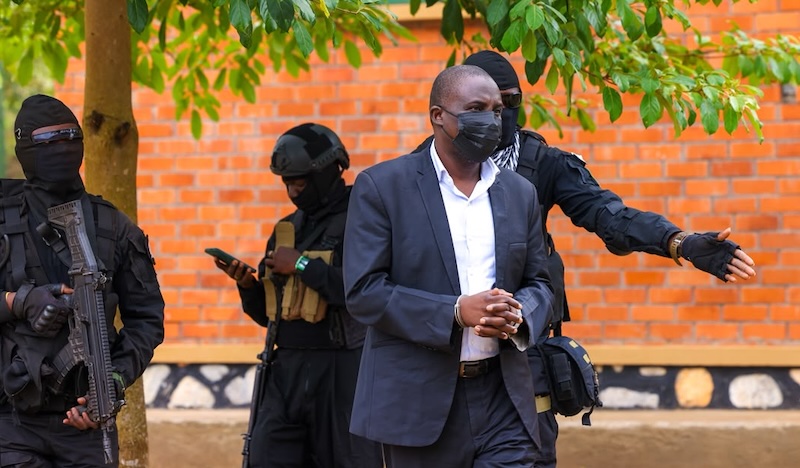
On the morning Muhammad Muwanga Kivumbi disappeared, he had been free for just one day. Supporters had only recently welcomed the former Butambala County MP and National Unity Platform (NUP) vice-president for Buganda back home after nearly six months on remand over terrorism charges.
He had promised to resume what he called the struggle for better governance in Uganda. Less than 24 hours later, that freedom came to an abrupt end.
Now, speaking from Kitalya Prison after reappearing in public 19 days later, Kivumbi has given his first detailed account of what he says happened during his disappearance, describing an alleged abduction, beatings, incommunicado detention and eventual return to the criminal justice system through fresh charges.
His account has renewed questions about due process, the treatment of detainees and the use of prolonged detention without access to lawyers or family members. The sequence of events began on July 10, shortly after Kivumbi had been granted bail by Justice Suzan Okalany.
He had been arrested on January 22, 2026, following deadly violence at his home in Butambala after the disputed January 15 presidential and parliamentary elections, in which seven people – though some accounts place the number at 13 – were killed.
He was subsequently charged with terrorism and remanded to Kitalya Prison alongside 22 others. His release was greeted by jubilant supporters in Butambala. Addressing them, Kivumbi criticised President Yoweri Museveni, First Lady Janet Museveni, Chief of Defence Forces Gen Muhoozi Kainerugaba and former Speaker Anita Among, whom he accused of contributing to the country’s governance problems.
He declared that prison had strengthened rather than weakened his resolve. The following day, after attending Juma prayers in Butambala, Kivumbi set off for Kampala. As his vehicle approached Mpigi Police Station, he encountered what he described as unusually heavy security deployment.
Security personnel ordered him to divert to the police station. Realising he was heavily outnumbered, Kivumbi said he stepped out of his vehicle to avoid confrontation. According to his account, he was immediately bundled into what Ugandans commonly refer to as a “drone”, a white Toyota Hiace van frequently associated with security operations.
Speaking to The Observer at Kitalya Prison, Kivumbi said the van carried both uniformed and plain-clothed operatives. He believed some of the uniforms resembled those worn by the Special Forces Command, the military unit responsible for protecting the President, senior government officials and strategic national installations.
He said a police patrol vehicle cleared traffic ahead as the van sped towards Kampala. Almost immediately, he said, a hood was pulled over his head.
“As soon as I was pushed into the drone, a hood was put over my head to disable me from knowing my location,” he recalled.
He alleges that throughout the journey, he was beaten while being questioned about remarks he had made concerning Gen Muhoozi and the First Family. “They told me they were going to teach me a lesson I will never forget,” he said.
According to Kivumbi, the officers repeatedly asked him who Uganda’s president was. “’Who is the President of Uganda?’ they asked me.
‘Is it Kyagulanyi or is it Museveni?’ Before I could answer, I was beaten again.” When another officer reportedly shouted “People Power.” Kivumbi responded, “Our power.”
He says that answer triggered another round of beatings. About 40 minutes later, he arrived at what he later concluded was a facility in Entebbe. His hood was removed, revealing what he described as a large building.
He was escorted into a small room measuring about eight feet wide, fitted with a toilet, bathroom and a single tinted window. He says there, the beatings intensified. According to Kivumbi, the officers took turns striking him with electric cables, locally known as solido, until he could no longer feel parts of his body. What eventually stopped the assault, he believes, was an injury to his head.
“They thought I was going to die and they stopped,” he said. Later, he said, a commandant arrived and rebuked the officers for the severity of the assault, asking why they were “behaving as peasants.”
Kivumbi says he suffered extensive bruising and severe pain. That evening, he was served posho and beans.
“The question then was; should I eat it or not? Not eating meant that I was going to starve yet I didn’t know how long I was going to stay. I decided to eat the food and deal with the consequences later,” he said.
The following day, Kivumbi said a doctor examined him, prescribed medication and personally returned with the medicines. He was also assigned two men to massage his swollen body.
“The doctor had prescribed warm water, but they brought steaming hot water, and the guy pressed me, I think harder than the kiboko they had given me. But I think it was for the better, because after five days, I was able to walk again,” he said.
Inside the room, he was provided with soap, toothpaste, a toothbrush, a three-inch mattress, a UPDF bedsheet and a small blanket. He says he wore the same clothes throughout the 19 days.
For the first 13 days, Kivumbi says nobody explained why he had been detained or how long he would remain there. Instead, what disturbed him most, he said, were the sounds that echoed through the building at night.
“You would hear people crying as they were being tortured throughout the night. But at least for me, after the initial beating, they did not beat me again,” he said.
On the fourteenth day, Kivumbi says the officer who had led his arrest visited him carrying three mobile phones. The officer reportedly showed him videos circulating on social media, including claims that he had died during detention.
“He told me (John) Nambeshe had been appointed acting party president. He showed me videos where people declared me dead. He then said, ‘You see, they are saying you are already dead, so we can now do anything we want with you,’” Kivumbi recalled.
During that conversation, the officer again questioned why Kivumbi criticised the First Family and Gen Muhoozi.
“I told him, I don’t abuse the First Family, but I talk about them because they are in public offices. I asked them whether they have ever heard me talk about Natasha, Patience or Diana or the President’s other children,” he said.
The officer eventually left without indicating what would happen next. Nineteen days after his disappearance, breakfast arrived earlier than usual. At about 7 a.m., Kivumbi says, officers entered his room, handed him his jacket and escorted him back into another Hiace van. His head was covered once again.
Judging by the speed of the journey, he believes they travelled along the Entebbe Expressway. Only after passing the Busega roundabout was the hood removed. That was when he realised he was at Nateete Police Station.
There, he was finally allowed to speak to his lawyer, Medard Lubega Sseggona. Police later transferred him to Butambala Chief Magistrate’s Court, where prosecutors brought fresh charges of managing an unlawful society and inciting violence.
He was remanded once more to Kitalya Prison and is expected to apply for bail on August 11. Back in prison, Kivumbi says life is markedly different from his previous period on remand.
“I was sleeping in a single, self-contained room. I would see my visitors in the boardroom. I somewhat didn’t feel the hardship of prison so much. But now, you see, I see my visitors in the same room just like every prisoner. I sleep in the same hall just like anybody else. In a room, I think we sleep like over 300 people. But this is okay, it is an experience we have to go through,” he said.
Despite everything he says he endured, Kivumbi insists he has no intention of retreating from politics.
“I heard some people say, maybe I had a deal with the system in order for me to get bail. I can tell you this, there was nothing, we just applied and the judge allowed our application. Don’t forget that we have not been committed to the High Court. We were just days away from the mandatory bail,” he said.
He also rejected suggestions that he should remain silent after regaining his freedom.
“We cannot keep quiet otherwise, we will have given these guys what they want. When you say at least keep quiet for two months, and what happens after that? I think we should not allow to give these people what they want. There is no better gift you can give them than keeping quiet. I’m not going to do that,” Kivumbi said.