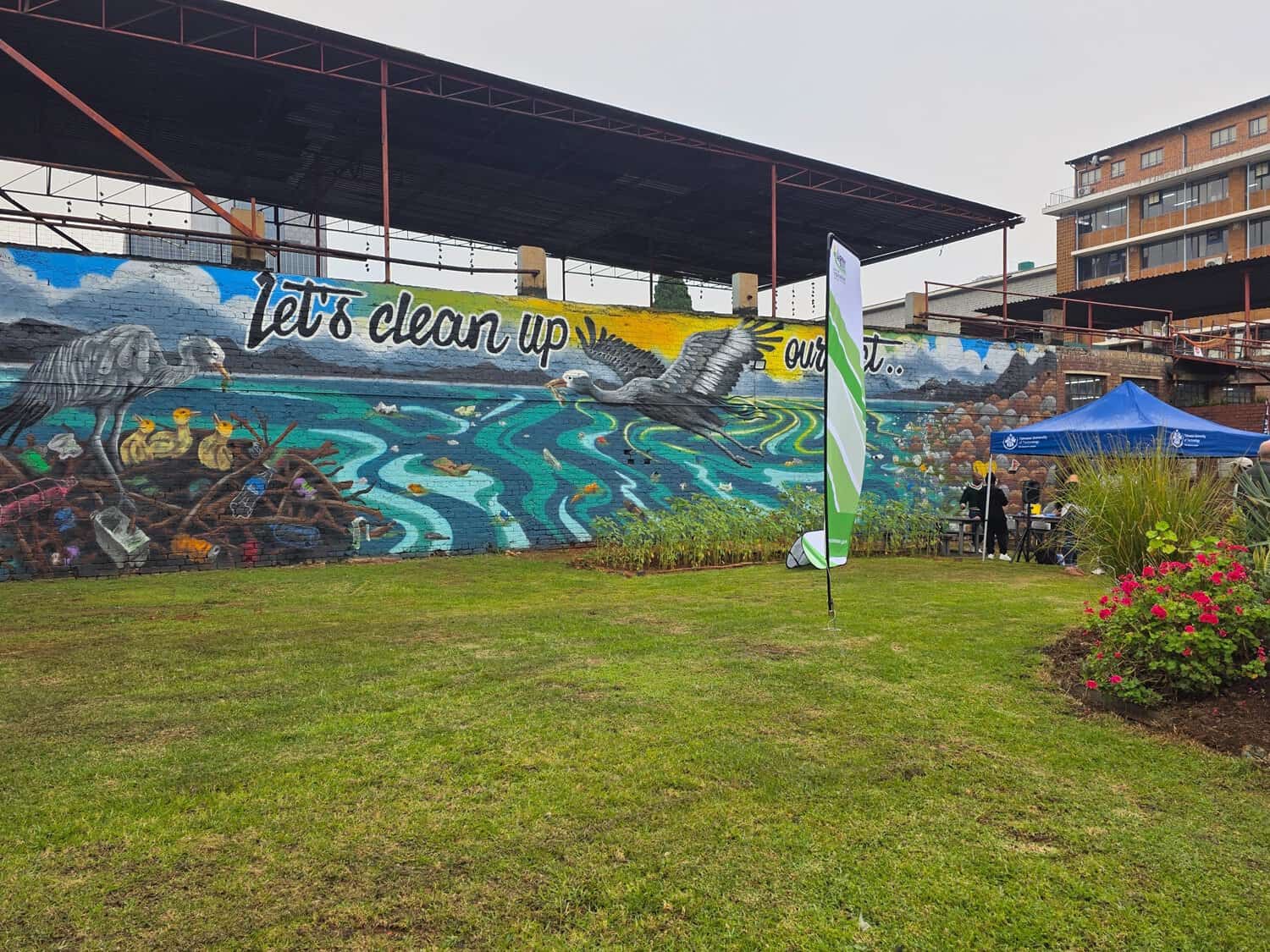
Clean up your act, is the message behind the colourful mural at the Tshwane University of Technology (TUT) science campus on the corner of Nelson Mandela Drive and Helen Joseph Street in the Pretoria CBD.
The mural forms part of TUT’s experimental garden where students explore sustainable planting methods and innovative urban drainage systems.
Colourful mural urges residents to clean up
It forms part of a collaboration between the City of Tshwane, TUT, the Danish embassy and the city of Aarhus, and serves as a visual reminder carrying the bold message, “Let’s clean up our act, calling on all residents to take responsibility for protecting natural ecosystems.
The Danish ambassador to South Africa, Karin Poulsen, said the mural isn’t just paint on the surface, it’s a conversation between art and science, between the university and Pretoria and between Denmark and SA.
Poulsen said it was the fourth mural sponsored in Pretoria.
“I started wondering if we came here to do diplomacy or if we just really like painting walls. But Pretoria is looking considering more colourful and I think that counts as a diplomatic success.”
Poulsen said the collaboration with Tshwane was one of six collaboration partnerships in South Africa focused on sustainability and collaboration.
Promoting water saving
“The theme of the mural is not abstract ideas. Ask anyone in Tshwane or Johannesburg about water; these are lived realities. This artwork puts it on the wall for the whole city to see,” she said.
Acting mayor Eugene Modiso thanked Denmark for its positive contribution to Pretoria and for helping to clean up the city’s act.
“It’s an honour to witness not only the work of art, but the symbol of collaboration and commitment to our environment.
“It demonstrates that environmental stewardship is not only a scientific or policy matter, but also a cultural and humane one.
“Art has the unique ability to speak across languages and disciplines and generations, and it inspires reflection, dialogue and action,” he said.
Art speaks across languages
Modise said it was time for people to clean up their act.
“Beauty is in the eye of the beholder. As we were passing here from time to time, we saw a horrible area. Now it’s attractive and wonderful. This initiative highlights the value of partnerships,” he added.
TUT student Tebogo Phoofolo said the mural needs to serve a purpose, a commitment and a responsibility.
“Young people are facing significant challenges and living in a stressful time.
“As young people, we should not only focus on education but on entrepreneurship, and come up with problems to solve,” he said.
Student says artwork demands commitment beyond education
Phoofolo said the mural represents innovative and game-changing solutions to inspire the youth to do something fresh.
WaterCAN’s Ferrial Adam said initiatives like these are important because they bring together academia, artists and communities in creative and accessible ways that help spark conversations, build awareness and inspire action.
“Art has the power to make complex issues visible and personal. That is exactly what we need if we are going to build a culture of water stewardship in South Africa.
However, we urgently need greater public awareness and stronger collective action to save our water,” she said.