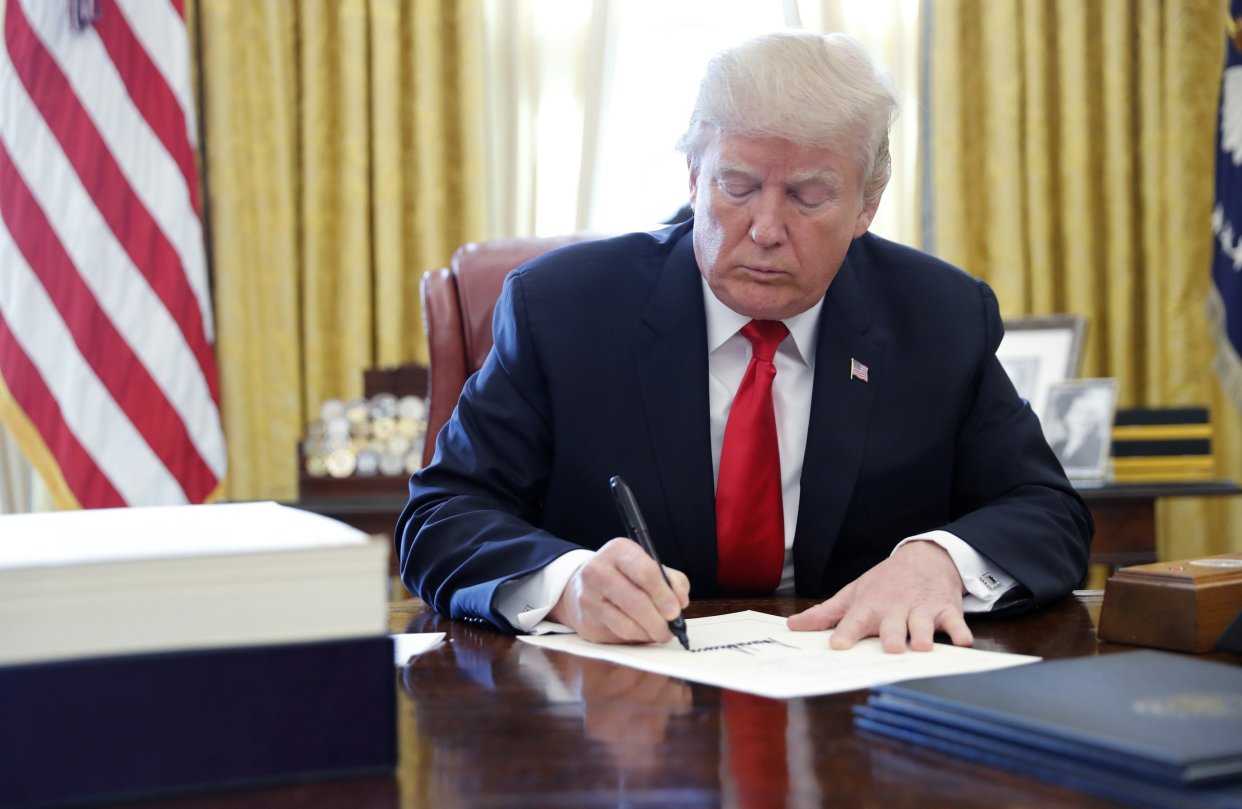
US President Donald Trump has signed an executive order calling for fewer childhood vaccines and recommending that measles, mumps and rubella (MMR) vaccinations be given separately.
Trump said the US should reduce the number of vaccines recommended for children from 18 to 11.
Speaking in the Oval Office on Monday, Trump said his administration “is recognising gold standard childhood vaccine recommendations for only 11 core vaccinations against the most serious and dangerous diseases”.
The 11 vaccines cover measles, mumps, rubella, diphtheria, tetanus, pertussis, polio, Haemophilus influenzae type B, pneumococcal disease, human papillomavirus and varicella, or chickenpox.
“We’re reducing them,” Trump said. “It’s not only that you’re doing fewer vaccines, or jabs, as they say, but you’re doing them in a series of visits to the doctor.”
Trump also backed separating the combined MMR vaccine into three individual shots, suggesting the combined vaccine could be “quite lethal” if administered at once.
When asked by a reporter for evidence supporting the claim, Trump said: “What I’ve heard is that there are some people that say it is that way.”
However, the Centers for Disease Control and Prevention (CDC) says there is “no published scientific evidence that shows any benefit in separating the combination MMR vaccine into three individual shots”.
The CDC says most people who receive the MMR vaccine do not experience serious problems and that vaccination is safer than contracting measles, mumps or rubella.
The agency says the MMR vaccine carries a very small risk of febrile seizures in young children, while people with certain health conditions are advised to consult healthcare providers before vaccination.
Trump has repeatedly questioned the safety of MMR vaccines, despite multiple studies finding no link between the vaccine and autism.
A 2019 study in Denmark involving 657,461 children found no evidence that the MMR vaccine causes or triggers autism.
Trump’s order is guidance rather than a federal mandate because vaccination requirements for school attendance are determined at state level.
Health and Human Services Secretary Robert F Kennedy Jr said the changes were intended to give parents greater choice rather than prevent access to childhood vaccines.
The American Academy of Pediatrics, however, criticised the order. Its president, Dr Andrew Racine, called it “dangerous” and said it was not based on “gold-standard science”.
“Delaying or skipping shots is risky, especially as measles continues to spread and children go back to school,” Racine said.
Republican Senator Bill Cassidy, a physician who was the deciding Senate vote in Kennedy’s confirmation as health secretary, also criticised the order.
“The President does not have the expertise to make these changes,” Cassidy wrote on X. “Vaccines are overwhelmingly safe. Vaccines are effective. Vaccines DO NOT cause autism.”
The AAP says there is no medical reason to delay or skip recommended immunisations, while experts warn that lower vaccination rates could allow diseases such as measles to return.
Trump’s order also calls for research into alternatives to aluminium used in some vaccines and testing to determine whether they are safer and more effective.
The AAP says studies have found no significant health risks from the small amounts of aluminium salts used in vaccines to strengthen the body’s immune response.
Faridah Abdulkadiri