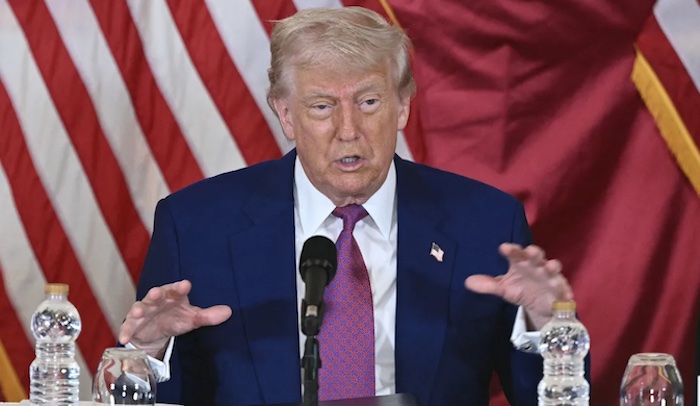
US President Donald Trump has announced that fresh negotiations between the United States and Iran will begin on Monday after he halted what he described as “massive” planned military strikes against Tehran.
Speaking to reporters aboard Air Force One on Sunday, Trump said diplomacy had been given another opportunity after requests from Iran and key US allies in the Middle East.
“They knew the extent of the attack because they saw it forming, we’re talking to them in the form of a negotiation. It begins tomorrow afternoon.”
Earlier on his Truth Social platform, the US president claimed Iran and several regional allies had asked him to delay military action because the framework of an agreement had already been established.
According to Trump, Saudi Arabia’s Crown Prince Mohammed bin Salman, alongside leaders from the United Arab Emirates and Qatar, urged Washington to avoid military action.
“We were all set to go,” he said. “The reason they asked is that they think there’s a deal. There’s a deal on Hormuz, and there will be a deal on the nuclear.”
However, Iran quickly rejected Trump’s account. The country’s Foreign Ministry said there were no plans to receive a US delegation or send Iranian officials to Washington, noting that previous negotiations had been conducted through mediators.
Iran’s semi-official Mehr News Agency also dismissed Trump’s claim that Tehran had requested a postponement of military action, describing it as “nothing but a new lie.”
Despite the conflicting positions, Iranian Foreign Minister Abbas Araghchi reportedly said negotiations with Oman over the Strait of Hormuz were “on track for finalisation,”according to Iranian media.
Trump declined to disclose where Monday’s talks would take place or who would participate, saying only that the United States remained prepared for either diplomacy or military action.
“We’ll just see how it is. We’re ready to go anytime we want… I’m not looking to kill people,”he said.
The US president also revealed that the cancelled military operation would have been “the biggest attack since World War II,” warning that such action could have derailed prospects for a negotiated settlement to the months-long conflict.
He declined to answer questions on whether the proposed strikes would have targeted Iran’s energy infrastructure, an action some international law experts have argued could amount to a war crime.
Iran’s acting Defence Minister, Majid Ibn al-Reza, said the country continued to treat every military threat from its adversaries as credible.
“We will neither be caught off guard nor remain passive,” he said.
Trump has repeatedly predicted that a diplomatic breakthrough with Tehran is imminent, although previous rounds of negotiations have failed to halt continued exchanges of military strikes between both sides.
In April, he warned that “a whole civilisation will die tonight” if Iran refused to negotiate, while also threatening attacks on civilian infrastructure. Although those threats eventually gave way to high-level talks led by US Vice President JD Vance, no agreement was reached.
The latest announcement had an immediate impact on global energy markets, with oil prices falling on Monday amid expectations that renewed diplomacy could ease tensions around the Strait of Hormuz.
Brent crude dropped about 4.5 per cent to $83.98 per barrel, while US benchmark crude declined 4.6 per cent to $80.74.
The Strait of Hormuz remains one of the world’s most strategic maritime routes, carrying roughly one-fifth of global crude oil and liquefied natural gas exports. Disruptions to shipping through the waterway since the conflict erupted on February 28 have contributed to heightened volatility in global energy markets.
Trump’s latest diplomatic push also comes as opinion polls indicate growing public concern in the United States over the economic and political costs of the conflict, with some Republican strategists warning that the issue could become a factor ahead of the November midterm elections.
Erizia Rubyjeana