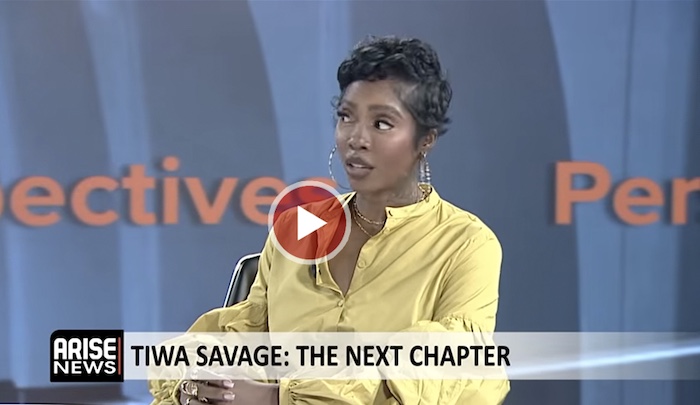

Afrobeats singer, songwriter and actress Tiwa Savage has reflected on her rise from backup singer to one of Africa’s most influential music exports, describing her career path as a mix of timing, instinct, and opportunity rather than a calculated leap.
Speaking during an interview with ARISE NEWS on Saturday,Savage recalled how a conversation with legendary producer Babyface in Los Angeles helped redirect her career.
She said, “I was doing backup vocals when I met Babyface in LA. He asked my name and where I was from. I told him Nigeria, and he said African music was going to be the next big wave.”
“At the time, I only wanted to do R&B. He told me I needed to go back home. I started paying attention to Mo’Hits, Mavin Records, and others, and I realized there weren’t many female artists. That felt like an opportunity, so I decided to go back. I didn’t know how big it would become ,I was just going with the flow.”
Reflecting on her early career, she revealed the global artists she worked with before launching solo.
“I worked with a lot of people Mary J. Blige, I toured with Luke Cantrell, Emma Bunton from the Spice Girls, and George Michael. I also did backup vocals on Whitney Houston’s final album,” she highlighted.
When asked who she would most like to collaborate with again, Savage pointed to R&B icon Brandy.
“I’ve already worked with most of them in some capacity, but if I could choose again, it would be Brandy.”
Discussing her transition into Afrobeats and street-influenced sounds, she credited producer Don Jazzy and her time at Mavin Records for reshaping her artistic direction.
She said, “It wasn’t easy. But being under Don Jazzy really helped. He made me see that talent isn’t limited.”
“He pushed me to try different things sing in Yoruba, Igbo, Pidgin. He even pushed me to do ‘Eminado,’ which I didn’t like at first. I thought, ‘This isn’t me.’ But that became one of my biggest Pan-African records. I learned to trust the process.”
On advice for younger artists, Savage described the entertainment industry as demanding but ultimately rewarding through perseverance.
“Entertainment is tough there’s good, bad, and ugly. I don’t even know how I’ve lasted over 10 years, almost 15 now. It’s really grace,” she said.
“I started in my 30s, which is rare in music. People see me as a mother with a child in this industry, but I don’t see those things as limitations. I don’t feel restricted by age or labels. It shows women that it’s never too late.”
Addressing why fewer female artists reach the same global level as men, Savage pointed to broader societal inequalities.
“The industry reflects society. Women are often marginalized not just in music, but in politics, education, everywhere,” she said.
“In many parts of Africa, women are still fighting for equal space. There are also industry challenges being boxed in, lack of opportunities, and sometimes exploitation.”
On her creative ambitions beyond music, she revealed plans to move into filmmaking from a leadership position.
“Yes, but more behind the camera as a producer or director. Acting was my first love before music,” she said.
Savage also reflected on her relationship with fans, saying real-life interactions differ greatly from online perception.
“In real life, I’ve never had negative encounters. It’s always love. Social media can distort reality. I never take those moments for granted.”
Speaking on her son’s perception of her fame, she shared a personal story about belief and determination.
“He does now understand. At first, he thought everyone lived like we do. There was a moment he wanted to meet a major streamer visiting Nigeria, and he was so convinced I could make it happen and eventually, it did.”
Turning to legacy, Savage announced the creation of the Tiwa Savage Music Foundation, designed to strengthen Africa’s creative ecosystem beyond artists alone.
She said “It’s not a record label it’s something different. I want to build the ecosystem behind artists.”
“We need sound engineers, producers, music technologists, even music therapists. People who support the industry but are often forgotten.”
She added that Africa also needs world class infrastructure for live performances.
“We still don’t have venues like the O2 Arena or Madison Square Garden here. Artists still have to go abroad to perform at that level.”
Explaining the foundation’s impact, she said the scale of its scholarship programme.
“We had nearly 3,000 applications. We selected 100 for training, then awarded 18 students scholarships worth $2.2 million to study music at Berklee.”
On support received, she acknowledged contributions from key institutions and partners.
“We had support from organizations like Zenith Bank, Flutterwave, Lagos State, and several others. It wasn’t easy, but we made it happen.”
Concluding on her future in music, Savage dismissed any suggestion of slowing down.
“People think because I’m doing philanthropy I’ll stop singing but no. I’m singing till I’m 80 or 90,” she said.
“My next project is called Energy, and it features three amazing artists. It’s coming soon.”
Goodness Anunobi