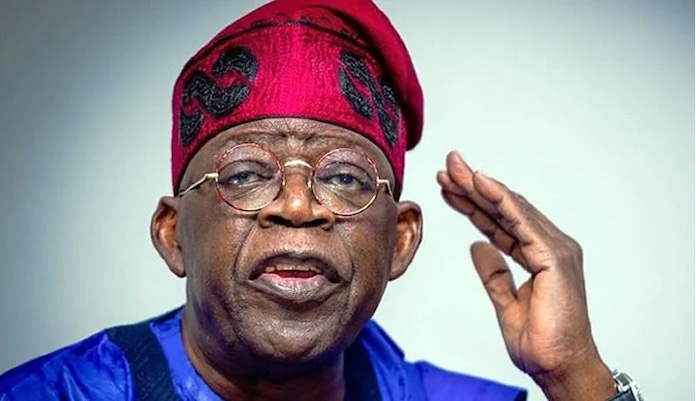
President Bola Tinubu has vowed that his administration will not relent in its determination to restore peace and stability across Nigeria.
Tinubu spoke on Sunday in Abuja while delivering his acceptance speech after receiving his Certificate of Return as the presidential candidate of the All Progressives Congress for the 2027 general election.
The President acknowledged the security challenges facing parts of the country and assured Nigerians that his government would continue to prioritise the protection of lives and property.
“Our government has intensified efforts to strengthen our security architecture, support our brave armed forces and the police, and forge stronger partnerships with local communities.
“We have invested in intelligence, surveillance and modern equipment, and we are addressing the root causes of insecurity. We also expect the National Assembly to amend the Constitution to allow the creation of state police as a matter of national emergency.
“We will not rest until we restore peace and stability to every corner of our country. Our resolve is unwavering, and our goal is clear: a Nigeria where every citizen can live, work and aspire without fear,” he said.
Addressing APC stakeholders, governors, National Assembly members and members of the National Working Committee led by the party’s National Chairman, Nentawe Yilwatda, Tinubu listed achievements of his administration across different sectors since assuming office on May 29, 2023.
He acknowledged the sacrifices and support of Nigerians, saying the country was beginning to witness the gains of ongoing reforms.
“Since that night in June 2022, a lot has changed. The political landscape has evolved. Electoral reforms have strengthened the credibility of our democratic process.
“We promised to remove the financial barriers to higher education for our youth. Today, we have established the Nigerian Education Loan Fund, with over N282 billion disbursed and more than 1.5 million beneficiaries,” he stated.
Tinubu also highlighted improvements in the power sector, noting that his administration had closed the metering gap by supplying 2.5 million meters through the Presidential Metering Initiative.
According to him, the government had established a N4 trillion bond programme to settle verified legacy debts owed to generation and gas companies, while power generation had peaked at 6,000 megawatts under his administration.
The President further defended the removal of fuel subsidy and exchange rate reforms, saying the policies were beginning to yield positive economic results.
“We moved away from wasteful fuel subsidies, unstable exchange rates and weak infrastructure. Today, we are witnessing a turnaround: the naira is strengthening, foreign reserves are rising and our economic outlook is positive,” he said.
Tinubu also extended a hand of friendship to political opponents and critics, calling for dialogue, cooperation and unity in nation-building.
“To those who may disagree with us politically, we extend a hand of partnership in nation-building. To those who differ with our philosophy, we offer dialogue and engagement,” he said.
The President stressed that the 2027 election should represent a reaffirmation of Nigeria’s democratic maturity rather than merely a contest among political parties.
“This next election must not merely be a contest of parties or ideas, but a reaffirmation of Nigeria’s democratic maturity,” he added.
Tinubu defeated his lone challenger, Stanley Osifo, to secure the APC presidential ticket.
Statistics released by the party showed that Tinubu polled 10.9 million votes, while Osifo secured 16,504 votes nationwide.
Speaking earlier, APC National Chairman, Yilwatda, described the turnout during the direct primaries conducted across 8,809 wards as a sign of the party’s growing popularity nationwide.
He said the APC remained the preferred platform for politicians and Nigerians ahead of the 2027 elections.
Also speaking, Chairman of the APC Presidential Primary Election Committee, Anyim Pius Anyim, said the adoption of direct primaries was aimed at deepening internal democracy and broadening political participation.
Deji Elumoye and Adedayo Akinwale