President Bola Ahmed Tinubu has said Nigeria’s large youth population remains the country’s strongest asset, assuring global investors that the nation’s young workforce is tech-savvy, adaptable, and ready to integrate into the global digital economy.
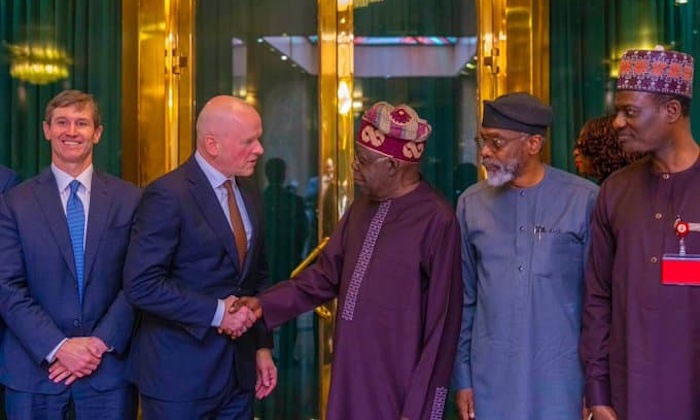
Tinubu made the remarks on Tuesday in Abuja when he received a delegation from Mastercard led by its Global Chief Executive Officer, Michael Miebach, at the State House.
According to a statement posted on the official X handle of the President’s Spokesperson, Bayo Onanuga the President welcomed Mastercard’s proposal to train five million businesses and provide them with digital skills, describing it as aligned with Nigeria’s economic transformation agenda.
President Tinubu said Nigeria’s economy had been repositioned to compete effectively in the global system, with a strong emphasis on empowering youths and small businesses through digital tools and innovation.
He noted that the ongoing formalisation of the country’s large informal sector would unlock opportunities for investment, job creation, and digital inclusion.
“I am glad that you are very familiar with the terrain. I can classify you as a Nigerian. MasterCard has a very big reputation in financial management, and opportunities are spreading in Nigeria,” Tinubu said.
He stressed that Nigeria’s youth remain central to the country’s development priorities.
“The most important asset is our youth. I missed one thing in your remark: whether you met with the Bank of Industry (BOI). BOI has a database of Micro, Small, and Medium Enterprises,” he said.
“Payment plans and platforms are very necessary for the inclusion of small and medium-scale businesses,” the President added.
“What you have been doing with our young population is commendable, and we will continue to support that in every form. As the host country, the agreements we have with you are valid, and I want you to see us as partners.”
He also observed that Nigeria’s business environment was undergoing a shift towards formalisation and digital adoption.
President Tinubu assured the delegation of government support for youth empowerment through digital skills development.
Minister of Finance and Coordinating Minister of the Economy, Wale Edun, in his remarks, said ongoing reforms were creating opportunities for digital and financial inclusion across the economy.
“You do more than payments, and that includes the work which you are doing in Nigeria through the Mastercard Foundation to support and strengthen small businesses and the informal sector,” Edun said.
“This aligns well with the reforms of Mr President in different areas, cutting across the public and private sectors, including the ongoing efforts to digitise government services. We aim to enhance and empower at least 3 million youths in Nigeria.”
He added that reforms were also accelerating formalisation of the informal sector.
“We are creating opportunities for work within the digital economy, the formalisation of the very large informal sector that we have in Nigeria. One of the major reforms by Mr President in fiscal and tax matters has led to more than 10,000 informal businesses applying for registration every day over the past few months,” he said.
Edun further highlighted expansion in Nigeria’s credit economy.
“The President’s policy also cuts across the credit economy, including mortgages, personal loans, consumer credit, auto loans, small-business credit, and student loans,” he said.
He noted opportunities in payment systems innovation, including naira-based swaps and fintech expansion, adding that “five of the nine fintech unicorns are in Nigeria.”
In his remarks, Mastercard CEO Michael Miebach assured President Tinubu of the company’s commitment to supporting Nigeria’s reforms and expanding its digital footprint in the country.
“We have a business here since 2011, and we have seen the country grow, and we have seen the country lead. We have seen your obviously clear alignment of fiscal and monetary policy that you have driven. In our world systems, there is a lot of momentum in Nigeria,” he said.
“A little anecdote: I was the one who set up the Master Card business in Nigeria in 2011. I was in Lagos, and hired the employee number one. So it’s a little bit like coming home.”
He said Mastercard’s operations in Nigeria were already contributing significantly to economic development.
“It’s been a long-standing history, and today we facilitate a big aspect of the economy. In Nigeria, we are preventing $200 million in fraud and bringing in $2 billion in foreign exchange. We are helping the SME sector thrive and, of course, partner with your banks.”
Miebach said the company had engaged with key financial stakeholders in Nigeria, including the Central Bank of Nigeria and commercial banks.
“We recognise the moment that we are in. We spent time with the CBN Governor and had an opportunity to meet the leading bankers yesterday in Lagos, to see where everything is going and the opportunity here to unlock the power of the 40 million SMEs in Nigeria,” he said.
He added that Mastercard was committed to building a broader digital ecosystem for small businesses.
“Many small businesses would like to have a digital part of their business, and they don’t know how to do that. Capacity building of small businesses vis-a-vis just opening a shop and keeping them safe in a cyber-world.”
“We have a three-year programme for small businesses. A technical workshop has been planned for this, so it is not just talk but action and impact,” he added.
Miebach also announced plans for deeper investments in digital inclusion and cybersecurity infrastructure.
“We want to drive inclusivity, participation, trust, and resilience in a digital world, as well as a Cyber Centre of Excellence that captures and shares threat intelligence, incident response, AI risks, and other emerging risks.”
Boluwatife Enome