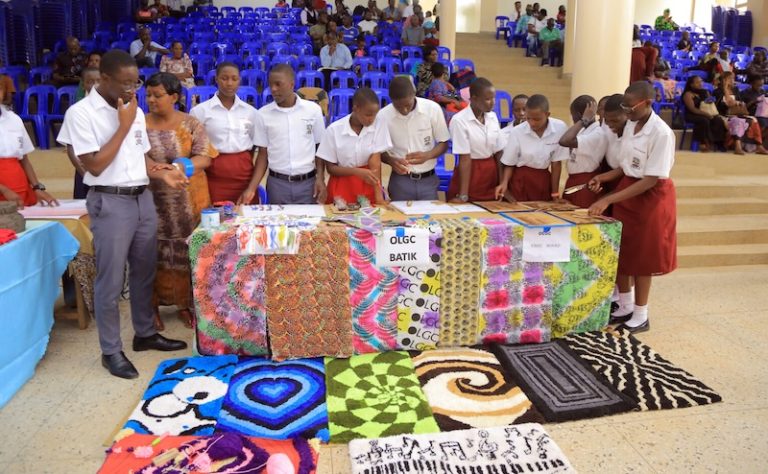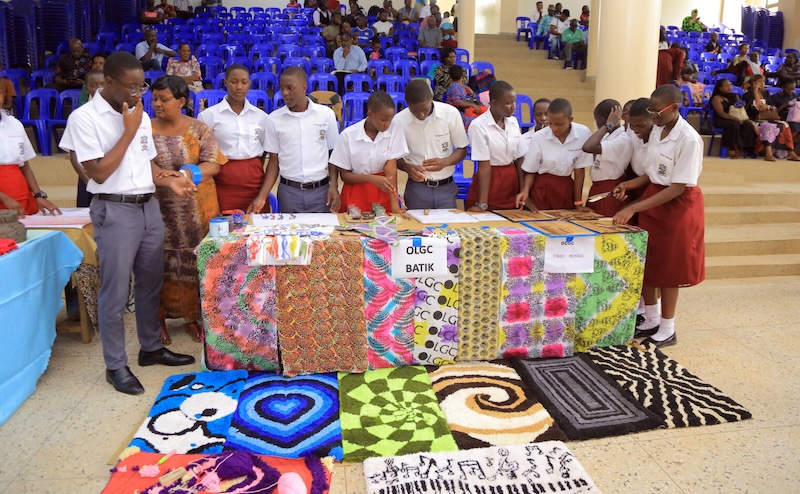
Students at Our Lady of Good Counsel Secondary School in Gayaza showcased a range of practical innovations on Saturday, demonstrating how classroom learning is increasingly being applied to solve everyday challenges facing communities and the environment.
The school’s annual science and innovation exhibition featured projects in agriculture, renewable energy, recycling, food processing, baking, value addition, tile making, fashion and design, performing arts and juice production.
The displays reflected the goals of Uganda’s Competency-Based Curriculum, which encourages students to develop practical skills, critical thinking and problem-solving abilities alongside academic knowledge.
Among the most notable projects was a biogas production system developed by Senior Four students Margret Mulungi Basoga, Joash Kaboyo and Davis Ariho. Using locally available materials such as plastic jerrycans and pipes, the team built a working model that converts human and animal waste into biogas for cooking while producing organic manure as a by-product.
“Our intention is to preserve the environment by reducing pollution,” Mulungi said.
“We wanted to demonstrate that cow dung from our school farm can be used as the main raw material to produce biogas so that the school kitchen relies less on firewood.”
The project highlights a growing emphasis on affordable technologies that address local problems. By reducing dependence on firewood, the system could help lower fuel costs while promoting cleaner waste management and environmental conservation.
Headmistress Agnes Namulema Ssebayiga said the exhibition demonstrated how students have embraced research-based and practical learning, with teachers helping them transform classroom lessons into workable innovations.
“To our students, you are the change- makers the world wants to see for a better life,” she said.
She added that the school recognises achievement beyond traditional academics by awarding certificates in practical disciplines such as performing arts, computer studies and bakery.
Learners also gain hands-on experience through the school’s maize gardens and animal farm, which support both agricultural training and the staff feeding programme. Henry Ssemakula, a senior official at the Ministry of Education and Sports and chief guest at the exhibition, praised the students’ creativity and urged them to take their ideas beyond the classroom.
“This is a very good exhibition with remarkable innovations, especially in environmental conservation,” he said.
“You need to move these ideas into practice because this curriculum prepares you to apply what you are learning immediately. It is encouraging to see such enthusiasm for practical science because it increases your chances of employment.”
He singled out a drone-assisted farm supervision project for special recognition, with the team receiving a Shs 500,000 cash award from the school. He also praised another group that developed fertiliser from human hair, describing it as another example of how science can provide practical solutions to everyday challenges.
The exhibition offered a glimpse of how Uganda’s education reforms are reshaping learning by encouraging students to move beyond theory and develop innovations that could benefit their communities long after they leave the classroom.