Uganda’s new national budget is bigger than ever. At Shs 84.39 trillion for the 2026/27 financial year, it represents a Shs 12 trillion jump from the current Shs 72.3 trillion spending plan.
But beneath the headline figure lies a more difficult story, one about debt, priorities and the growing tension between state spending and everyday public need. Parliament passed the budget last week, approving a financing structure heavily reliant on borrowing.
According to the Budget Committee report, Shs 39.903 trillion is expected from taxes and other revenues, Shs 1.4 trillion from non-tax revenue, Shs 339.8 billion from local government revenue, Shs 1.216 trillion from budget support, Shs 11.270 trillion from external borrowing and Shs 25.7 trillion from domestic borrowing.
That last figure has drawn particular concern. Uganda’s public debt stock rose to Shs126.18 trillion, or USD 34.86 billion, in the second half of FY2025/26, up from Shs115.89 trillion, or USD 32.24 billion, the previous year.
The increase was driven largely by domestic borrowing, according to the report. The cost of that strategy is becoming harder to ignore. Principal repayments on domestically borrowed funds due next financial year are projected at Shs 13.9 trillion.
“Government’s heavy borrowing from the domestic market has serious ramifications for economic growth, as it keeps interest rates high and crowds out the private sector, which relies on commercial banks for credit,” the committee report noted.
The numbers illustrate the imbalance. As of January 2026, Bank of Uganda figures showed banks had lent Shs 25.4 trillion to the private sector, compared with Shs 67 trillion to the government.
In practical terms, the state is absorbing far more available credit than businesses that create jobs, expand factories or finance trade. Yet the sharpest political debate was not over debt, but overspending at the centre of power.
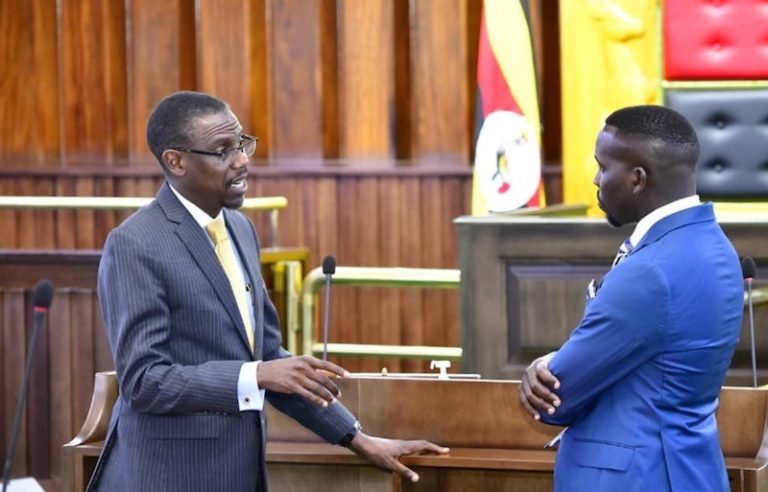
A minority report tabled by Kira Municipality MP Ibrahim Ssemujju Nganda scrutinised allocations linked to President Yoweri Museveni’s budget and State House.
“Welfare and entertainment—Shs 214 billion; special meals and drinks—Shs 536 billion; inland travel—Shs 1 trillion; foreign travel—Shs 207 billion; fuel—Shs 514 billion; and donations—Shs 196 billion,” Ssemujju told Parliament.
“There is even money allocated to purchase a musical instrument—Shs800 million. We are also going to spend Shs14 billion on gas, firewood, and charcoal. Perhaps we are going to burn the whole country,” he added.
For the coming financial year, Shs479 billion has been allocated to State House. But critics say the approved figure often tells only part of the story. State House had an initial budget of Shs 508 billion this financial year, later increased to Shs 967 billion through supplementary requests.
“State House has mastered the art of under-budgeting and then seeking supplementary funding. I have serious doubts because it is not even complying with the Public Finance Management Act,” Ssemujju said.
He also claimed required reports on vehicle utilisation and staffing details had not been fully provided. The opposition lawmaker drew a direct comparison with one of government’s flagship anti-poverty programmes, the Parish Development Model.
“In the last five years, we have spent more on State House than on the Parish Development Model,” he said. The government has budgeted an additional Shs 1 trillion for PDM. The Auditor General’s December report said Shs 3.2 trillion had already been spent by the close of the financial year, bringing total expenditure to Shs 4.2 trillion when combined with the new allocation.
The programme is intended to move 39 per cent of Uganda’s households from subsistence into the money economy. Ssemujju argued that with about 10.6 million households and an average of four people each, the scheme is expected to benefit around 14.8 million Ugandans, making comparisons with central administrative spending politically potent.
He also questioned whether resources were being directed where they matter most. The Ministry of Health requested Shs60 billion for ambulances but received Shs40 billion. It sought Shs20 billion for maintenance but received only Shs 10 billion.
That shortfall, he warned, could leave several constituencies without functioning ambulances. He proposed shifting Shs 30 billion from State House, particularly the donation budget, to ambulance procurement and maintenance.
Education faced similar gaps. The National Curriculum Development Centre requested Shs 6 billion to develop A-level syllabuses, assessment guidelines and teacher training, but received Shs 2.5 billion.
The Uganda National Examinations Board requested Shs 8 billion to train examiners on the new curriculum and received nothing.
“This is scandalous. Our children are being taught through guesswork because the A-level curriculum has not been fully developed,” Ssemujju said.
Then there are unpaid bills across the system. As of December 31, 2025, major arrears included Mulago Hospital at Shs 17.78 billion, Jinja Regional Referral Hospital at Shs 5.27 billion, Uganda Heart Institute at Shs 2.29 billion and Arua Regional Referral Hospital at Shs 3.17 billion.
Other hospitals across Mbale, Gulu, Soroti, Kawempe and Mulago Specialised Women and Neonatal Hospital also carried significant outstanding balances. These are more than accounting entries.
They can mean delayed supplies, unpaid contractors, broken equipment and slower care for patients. Uganda’s budget therefore, tells two stories at once. One is of a state expanding its ambitions through record spending.
The other is of a country still wrestling with where scarce money should go first. For households facing school fees, hospital delays and high living costs, that second story may feel more real than the first.