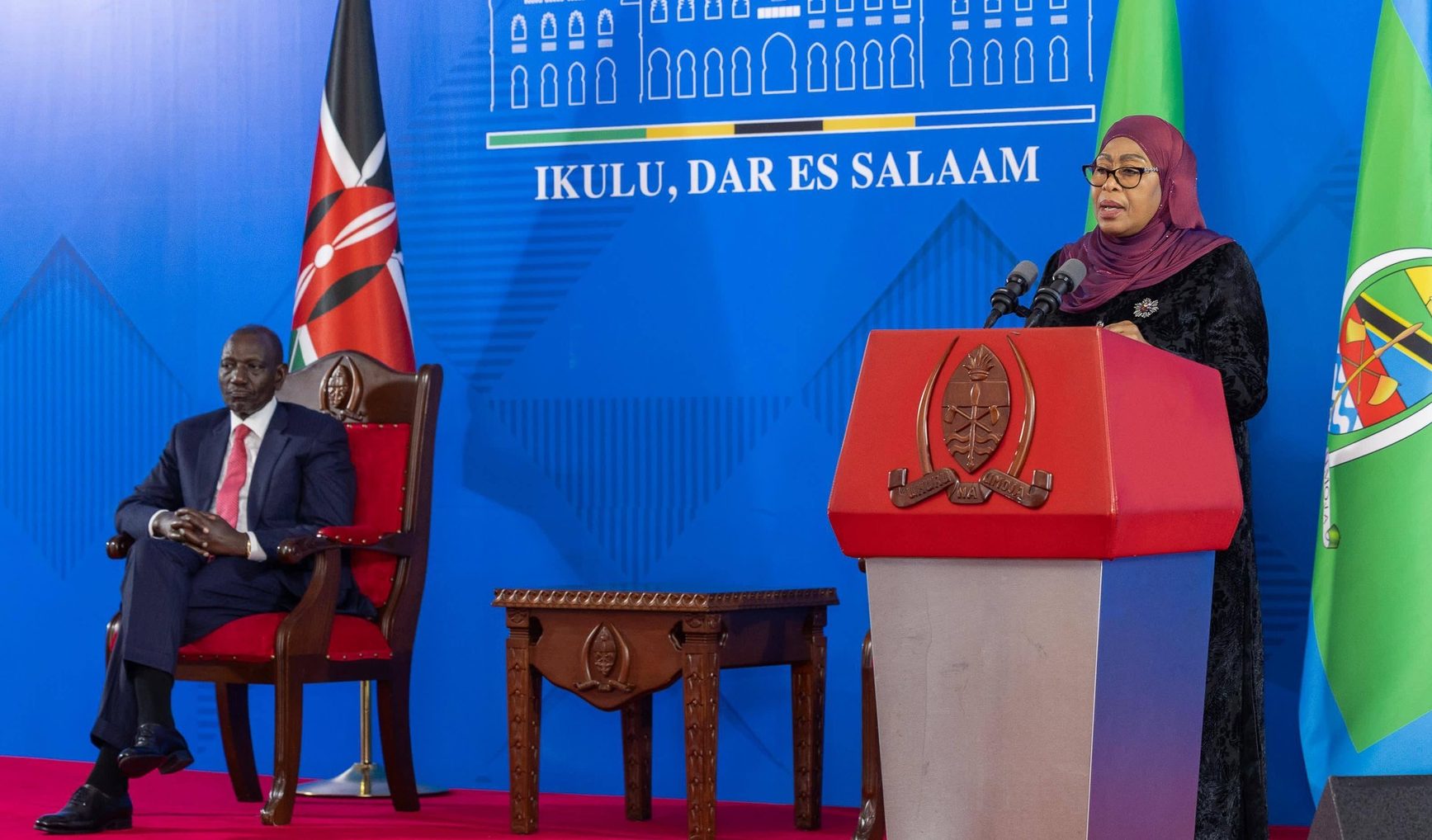
Kenya’s president, William Ruto, arrived in Dar es Salaam on Monday, May 4, for a state visit intended to improve relations with neighbouring Tanzania. However, he probably did not expect to be reprimanded.
At a business forum, the Tanzanian president, Samia Suluhu Hassan, said that Ruto had arrived late.
At a joint press conference, Samia revealed that she had reprimanded her Kenyan counterpart for announcing plans for the Tanga refinery without consulting her first.
She said that she had no knowledge of the joint Tanga Oil Refinery that President Ruto had announced two weeks earlier at an infrastructure forum in Nairobi.
The dispute arose from a speech that President Ruto made at the opening of the Africa Infrastructure Summit, which was hosted by the Africa Finance Corporation in Nairobi, Kenya.
In it, he disclosed plans for a joint oil refinery in Tanga that would benefit Tanzania, Uganda, South Sudan and Kenya.
“While we were speaking inside, I pressed Ruto and asked him, ‘You went ahead and announced a refinery in Tanga, which I wasn’t aware of?’ He will explain himself why he made that announcement,” President Suluhu said.
In response, Ruto said the proposal was not a unilateral decision but part of wider regional discussions on industrialisation with Ugandan President Yoweri Museveni, focusing on the use of local resources to develop the East African region.
“Allow me to explain our discussion on Tanga as a place of refinery. I have been informed that my decision to announce the building of a refinery in Tanga has not sat well with you, Tanzanians. If I knew, I would have announced that a refinery would be built in Mombasa,” Ruto said.
He explained that the idea of a refinery in Tanga emerged from consultations with regional leaders on how East Africa can jointly develop its oil, mineral, and agricultural resources to drive industrial growth and job creation.
“Because the building of a refinery is a big opportunity, it is a big opportunity for business, for industrialisation, for petrochemical industries, fertiliser, plastics industries,” Ruto said.
“It is my belief, and that of the leaders in our region, that whatever raw materials we have, whether natural resources or energy, should be used for the industrialisation of our region so that we can create wealth here,” he added.
“The good people of Tanzania, you are lucky that we are discussing constructing an oil refinery in Tanga.”
President Samia, for her part, called for brotherly relations with her neighbours, including Kenya, saying Kenya’s problems should be viewed as Tanzania’s problems, to create an enabling environment to resolve conflicts as brothers.
The two neighbours and founders of the EAC renewed their pledge to cultivate closer ties as they seek to accelerate economic growth and deepen regional integration by signing eight new agreements and setting a 30 June 2026 deadline to eliminate all remaining non-tariff barriers that have long frustrated cross-border commerce.
President Ruto witnessed the signing of the eight Memoranda of Understanding.
The MoUs cover energy, legal cooperation, agriculture, railway development, public service capacity building, maritime cooperation, certification standards for seafarers, and harmonisation of standards between the Kenya Bureau of Standards (KEBS) and Shirika la Viwango Tanzania.
The two leaders said the standards harmonisation deal is critical as it creates a joint technical committee to align testing and certification, meaning a product cleared in Dar will no longer face repeat inspection by KEBS at Namanga or Holili.
The railway MoU commits both governments to revive the Voi, Mwatate, Taveta line, linking it to the Standard Gauge Railway and cutting freight time to Moshi and Arusha.
The energy agreement advances the Isinya- Singida transmission line and sets up a working group on joint renewable projects.
President Ruto said the two countries will continue to actively engage, noting that the two nations are bound by destiny.
“This visit reflects the deep-rooted and enduring friendship that binds our two nations, a relationship enriched by vibrant people-to-people connections, shared heritage, and a common destiny.”
Bilateral trade between the two countries reached $860.3 million (Sh111.13 billion) in 2025, accounting for nearly 40 percent of all intra-East African Community commerce.
That makes Kenya and Tanzania the bloc’s strongest trading pair, yet both leaders were clear that the ceiling remains far higher.
The two leaders set a deadline of June 30, 2026 for removing non-tariff barriers, as directed by the 25th East African Community Summit.
These barriers have affected shipments of dairy products, maize, eggs, steel and confectionery for years, with trucks often being detained at border crossings due to paperwork, standards or ad hoc levies.
President Samia said that the two countries could significantly boost trade and investment by resolving issues that hinder the movement of goods.