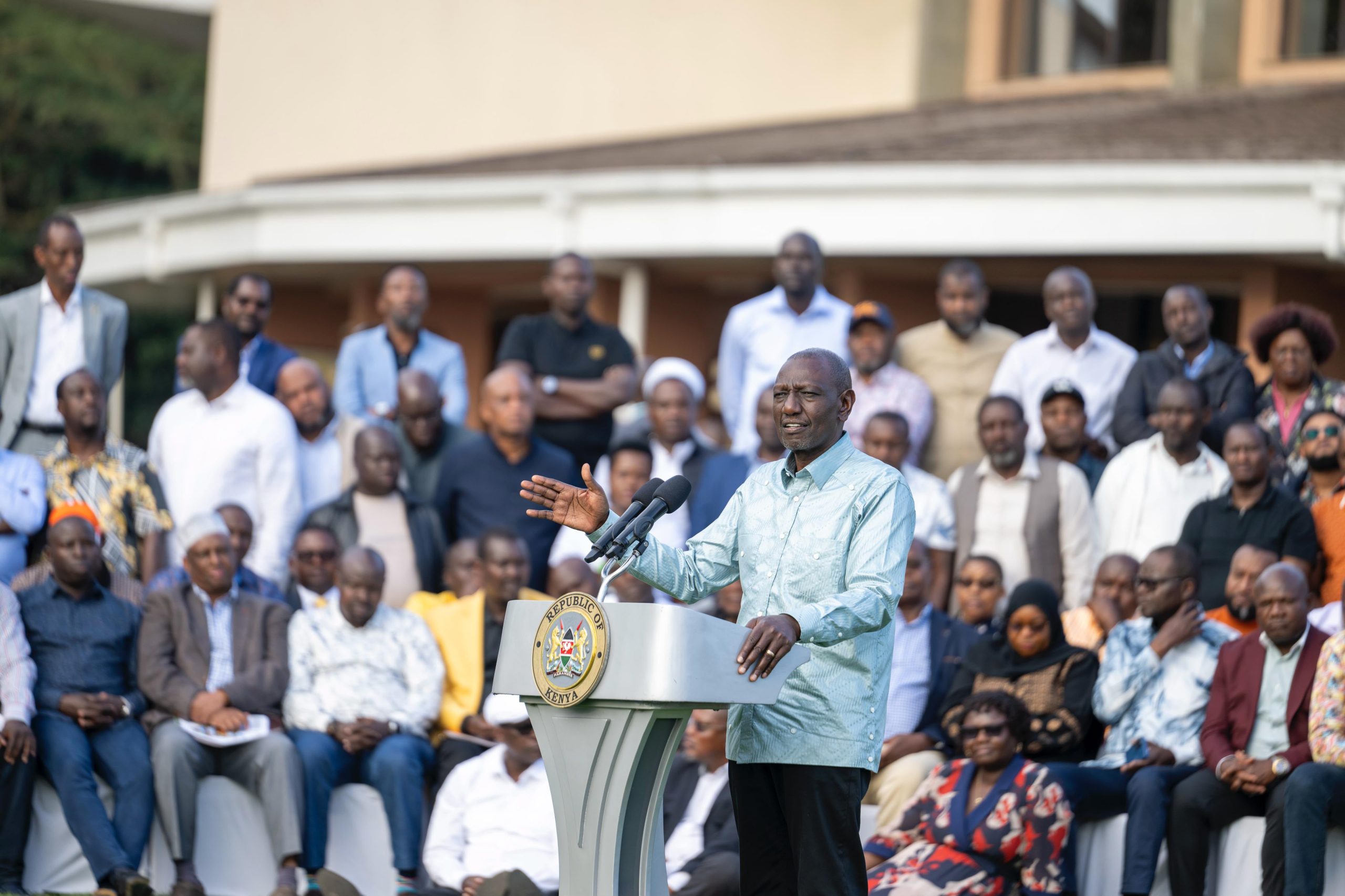
President William Ruto has told leaders of the broad-based government that winning the 2027 General Election is their only option, as UDA and ODM move closer to formalising their political partnership ahead of the polls.
Speaking on Monday at a three-day retreat for leaders of the broad-based coalition in Naivasha, Nakuru County, President Ruto said the emerging alliance was not merely about securing power but about determining the country’s future, warning that an opposition victory would jeopardise the gains his administration claims to have made.
The President urged leaders of the two political formations to work together and sell their record to voters, portraying the opposition as disorganised and lacking a clear agenda.
“In the coming election we must win, by God’s grace, because we do not have an option. The alternative is difficult to fathom. Inshallah, we must win the next election not for your sake but for the sake of Kenya,” he said.
‘Alternative is difficult to fathom’
President Ruto said the broad-based government had a clear development agenda and a record to defend, unlike the opposition, which he accused of lacking both a vision and a track record.
“When I look at the alternative I shudder. A group of individuals without vision and agenda is dangerous for the country. The alternative is difficult to fathom. That side is in chaos and all they do is fumble and mumble when asked for a track record,” Dr Ruto said.
The remarks came as the President signalled that the working relationship between his United Democratic Alliance (UDA) and the Orange Democratic Movement (ODM) could evolve into a formal pre-election coalition ahead of the 2027 contest.
Kenya Kwanza and ODM have resolved to form coalition ahead of the 2027 poll, with the two sides nominating 5 members each to come up with a joint manifesto.
The President said the coalition’s roadmap and campaign agenda would be anchored in a document expected to emerge from the Naivasha retreat.
The meeting brought together 250 members of the National Assembly, 46 senators, 20 governors, 20 deputy governors and Cabinet secretaries, including Deputy President Kithure Kindiki, Prime Cabinet Secretary Musalia Mudavadi, National Assembly Majority Leader Kimani Ichung’wah and Senate Majority Leader Aaron Cheruiyot.
President Ruto described the gathering as one of the largest meetings of elected leaders in the country’s history, second only to the grand coalition meeting convened by former President Mwai Kibaki and then Prime Minister Raila Odinga.
“It is not easy to put together 250 MPs, 46 senators and other senior government officials like we have done today. This proves that these are the two largest political formations in the country, and I have the privilege of being a leader of one of them,” he said.
The President said his decision to reach out to the late Raila Odinga after the 2022 election was driven by a desire to end political divisions and find areas of convergence between the two formations. He said the two sides had discovered common ground on programmes including affordable housing, universal healthcare and economic empowerment.
“I started engaging Raila immediately after the elections with the sole intention of ironing out our differences in order to work together. I had felt that our manifestos converged at some point, so there was a need to implement them jointly,” he said.
The President said the entry of ODM officials into government had helped accelerate implementation of his administration’s agenda, singling out Treasury Cabinet Secretary John Mbadi for praise.
“Since the elections in 2026 we have had two CSs for Treasury, but Mbadi has distinguished himself as one who has understood what we were doing better than any other CS who joined the government,” he said.
He listed health, agriculture, housing, infrastructure and social services among the areas where the broad-based government had made progress, saying this record would form the basis of the coalition’s campaign for another mandate.
President Ruto also announced plans for a national conversation on the country’s development agenda, saying Kenyans would be given an opportunity to contribute to the government’s priorities.
The emerging political arrangement draws on Kenya’s long history of coalition politics, including the Grand Coalition Government formed after the disputed 2007 election and subsequent alliances involving ODM and other political parties.
President Ruto said the country’s political class had sufficient experience building coalitions to make the current arrangement work.
“You must understand that we have been here before. The grand coalition government, the Kenya Kwanza Alliance and Azimio were all coalitions. So having a broad-based coalition will not be a miracle,” he said. “We are the architects of these coalitions and we have enough experience in forming them. We will form this coalition and will agree on how to move forward towards the 2027 poll.”
ODM leader Oburu Oginga, who co-chaired the retreat with President Ruto, defended the party’s decision to work with the government, saying it was necessary to stabilise the country and advance its development agenda.
Mr Oburu said ODM had previously entered into political arrangements with governments but argued that the current broad-based partnership had given the party a greater role in government.
“Before joining the broad-based government, we had a handshake with former President Uhuru Kenyatta. However, in that arrangement we did not get a single government position, apart from being promised support for the presidency in 2022,” he said.
Mr Oburu said ODM had subsequently returned to the opposition before joining the broad-based government, where several party members were appointed to Cabinet. He said the party was prepared to support President Ruto’s ambition of transforming Kenya into a first-world economy.
He also challenged leaders unhappy with the coalition to openly declare their position rather than remain on the fence.
“Let people raise issues with honesty, but do not be a fence sitter. You must decide where you stand, as we want to know who is with us and who is not,” he said.
Mr Oburu said the coalition was working on policies that would guide the partnership towards the 2027 election.
“In the next two days, we are going to look into the issues of our country which will catapult this coalition to power in 2027,” he said.
The coalition’s challenge will now be to translate the broad-based government arrangement into a formal political alliance capable of presenting a united front in 2027, while managing competing ambitions within the two formations.
Deputy President Kithure Kindiki commended the teamwork displayed by the broad-based government, saying the partnership had helped accelerate implementation of the government’s development agenda.
The three-day retreat, which began on Sunday, is scheduled to end on Wednesday.