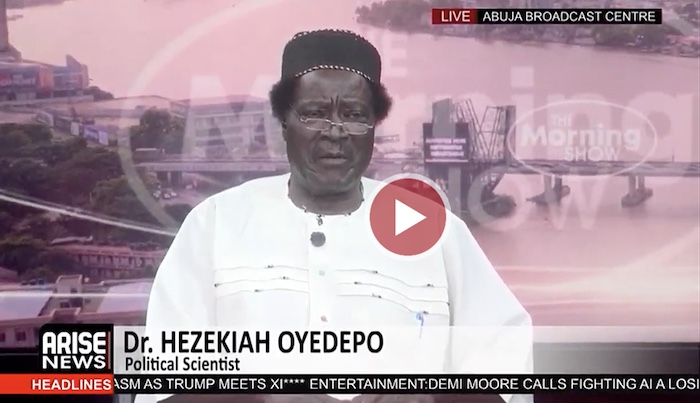
A political scientist, Dr Hezekiah Oyedepo, has alleged that the wave of insecurity in parts of Kwara State, particularly Kwara South, may be politically motivated and linked to attempts to reshape voter distribution ahead of the 2027 general elections.
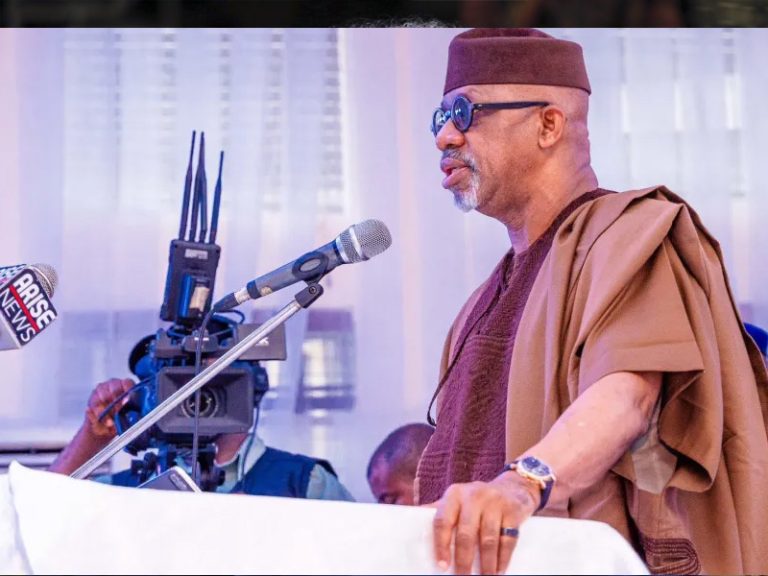
Speaking in an interview with ARISE NEWS on Thursday, Oyedepo also weighed in on claims of ethnic tension and the electoral significance of Kwara South, while arguing that recent violence has emptied several communities and disrupted population patterns.
Responding to concerns that kidnappings and attacks in parts of Kwara South have reduced the region’s voter base, he said:
“Kwara State, particularly along the axis of Ifelodun, they are empty. Almost all of them have vacated the Yoruba axis. Almost everybody has returned to Omu-Aran. And I believe personally that it is political too, by some people, to make sure that the population is reduced so much that when the election comes, they have advantage.”
Oyedepo further alleged that the establishment of forest guards in the state had raised questions about recruitment transparency and ethnic balance.
“We are told that Kwara State has employed about 1,000 forest guards. And I keep wondering, in my town Omu-Aran, we don’t know a single person that is employed. And Omu-Aran is one of the largest towns in Kwara State. So if we can boast of not even one person, then who are the people employed?”
He suggested that many of those recruited may belong to a particular ethnic group, and referenced a past security incident to support his claim.
“I am not saying they are not employed, but most of them, if not all of them, might be Fulanis. And I will prove it by one incident. Some of them were captured in Ifelodun, their hands tied back, beaten by soldiers guarding the place. Eventually, we discovered that those sent there were recruited by officials. And those ones confessed.”
Addressing concerns that his comments were generalising ethnic dynamics, he insisted the situation was more complex than it appeared.
“The issue is deeper than you are thinking. Fulani elements in Kwara are not up to 10 percent of the population. But those involved in this matter are Kwara apologists. And without a statement from the Fulanis themselves, they should address this issue.”
On claims of ethnic violence and political manipulation, Oyedepo maintained that insecurity in the state was being misinterpreted but still insisted on a political dimension.
“These are not isolated incidents. To generalise from recorded events may be difficult, but there is a political undertone to what is happening in Kwara State.”
Shifting to the debate on electoral strength in Kwara State, Oyedepo argued that Kwara South remains highly significant in voter strength, disputing claims that Kwara Central dominates the electorate.
“The electoral value of Kwara South is very high. In the 2023 registration figures, Kwara Central had about 6.2, Kwara South about 5.7, and Kwara North about 300-something thousand voters. So when people say Kwara Central has 48 or 49 percent of the votes, I don’t know where that comes from. The figures do not support that.”
He also argued that population intermixing within Ilorin affects electoral calculations.
“Besides, one-third of the people in Kwara Central come from Kwara South. In Ilorin, there are areas predominantly occupied by people from Kwara South. So when you add all of that together, Kwara South has significant electoral weight.”
Oyedepo concluded that Kwara South’s numerical strength, combined with allied voters in other zones, makes it a decisive factor in state-level politics.
“When it comes to calculations, there is no doubt Kwara South has the numbers.”
Boluwatife Enome