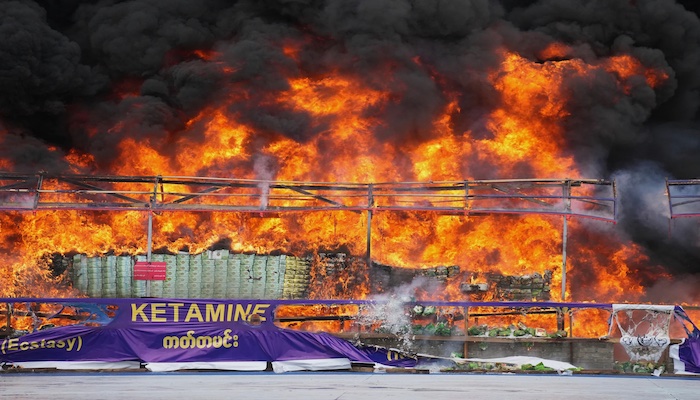
Myanmar has destroyed more than $600 million worth of seized heroin, methamphetamine, opium, ketamine, marijuana and other illegal drugs in a nationwide operation marking the United Nations’ International Day Against Drug Abuse and Illicit Trafficking.
Thick black smoke filled the skies over the outskirts of Yangon on Friday as authorities burned more than 50 tonnes of confiscated narcotics in one of the country’s largest public drug destruction exercises.
According to Police Lt. Col. Aung Myat Soe of Yangon’s Anti-Narcotics Police Force, the total street value of the drugs destroyed nationwide exceeded $600 million, more than double the value of drugs destroyed during the same exercise last year.
“In Yangon alone, about $321 million worth of 31 different types of drugs were destroyed,” Aung Myat Soe told reporters at a bus station compound on the edge of the city where the drugs were set ablaze.
Similar destruction ceremonies were held in Mandalay and Taunggyi, the capital of Shan State, regions closer to the country’s major drug production hubs.
Myanmar, also known as Burma, has for decades remained one of the world’s largest producers of heroin and methamphetamine, supplying illicit drugs across East and Southeast Asia.
The country’s prolonged political instability and armed conflicts have continued to fuel illegal drug production despite repeated anti-narcotics operations.
Experts say the military takeover in 2021, which triggered a civil war between the ruling junta, pro-democracy forces and ethnic armed groups, has contributed to a surge in narcotics production and trafficking.
Earlier this year, Myanmar’s military government announced what it described as the country’s largest-ever seizure of illicit drugs and drug-manufacturing equipment following coordinated raids on 12 drug production sites in northern Shan State.
Large parts of Myanmar remain under the control of ethnic armed organisations, many of which are engaged in fighting government forces. The military authorities have accused some of these groups of financing their insurgencies through the illegal drug trade and resisting peace negotiations to protect the lucrative business.
While some armed groups have previously been linked to narcotics trafficking, others have launched anti-drug campaigns in territories under their control.
On Thursday, the Ta’ang National Liberation Army (TNLA), which recently agreed to a ceasefire with the military after capturing significant areas of northern Shan State, announced plans to destroy about $5.5 million worth of seized illegal drugs within areas under its control.
Erizia Rubyjeana