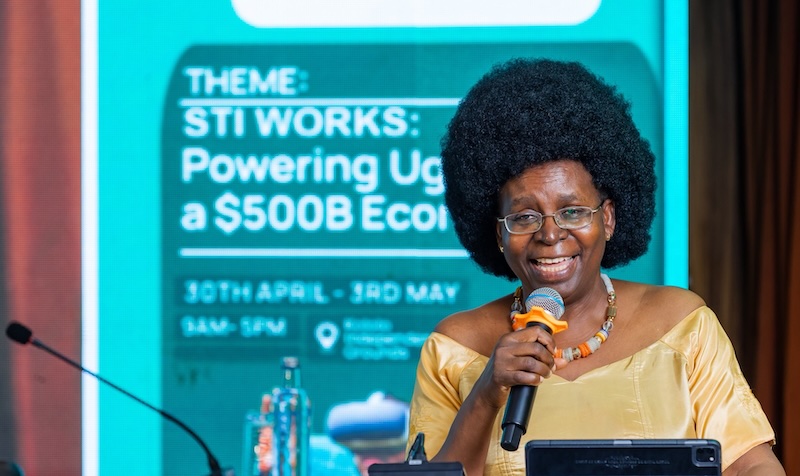
Literally and figuratively beating her chest in pride, the minister for Science, Technology and Innovation, Dr Monica Musenero Musanza, says Ugandans should stop questioning the controversial Shs 8 million research mice.
She now has results, she argues, results she says have yielded billion-dollar drugs at Dei Biopharma. Speaking at the media launch of National Science Week 2026, scheduled to run from April 30 to May 3 at Kololo Ceremonial Grounds, Musenero said the Science, Technology and Innovation (STI) Secretariat is ready to account for years of public investment.
More than that, she said, it is ready to demonstrate how science can move Uganda from a peasant economy to a value-creating $500 billion one. Musenero, who has previously faced parliamentary and public scrutiny over the alleged misuse of Shs 31 billion earmarked for Covid-19 vaccine development, including the purchase of four laboratory mice at Shs 8 million each, which have reportedly multiplied to over 160, said she can now “walk with her head held high” after delivering visible results.
“Over the past five years, your questions have been, ‘What are you doing at STI?’ Come to Science Week at Kololo and see. The story will speak for itself. No longer will you ask me about the Shs 8 million mice, because I will be exhibiting a $1 billion drug that has come as a result of your support,” she said.
She acknowledged that she previously lacked clear answers to critics, but said the outcomes are now tangible and accessible to the public.
“You will be able to see and even touch the results. I didn’t have the answers then, I have them now,” she said.
Unlike previous editions that ran for seven days, this year’s Science Week will take place over four days. Musenero said the event will not only celebrate achievements but also “open the black box,” a metaphor she used to describe the knowledge and skills gaps that once hindered Uganda’s ability to monetise science, technology, and innovation.
She expressed confidence that Uganda is now firmly on the path toward building a $500 billion economy by 2040.
“Talking alone, without tools that build trust, would not have worked. But now we are ready to fulfil Africa’s expectations. Ugandans can now see and touch STI,” she said.

Throughout the week, attendees will interact with scientists, engineers, and entrepreneurs developing home-grown solutions. Musenero said the public will witness innovations that have moved from ideas to industry, transforming sectors such as agriculture, manufacturing, and health.
“We invite you not just to observe, but to interrogate, understand, and tell this story,” she said. Looking ahead, Musenero said that in the next five years, STI will demonstrate both qualitative and quantitative impact, triggering what she described as “elbow- bend growth” for Uganda’s economy.
She explained that the STI sector once appeared quiet because it lacked structured innovation pipelines. That, she said, has changed. Uganda now has ventures that have completed the journey from laboratory to market, with new industries emerging and anchoring broader economic ecosystems.
Ugandan scientists are now designing satellites, developing vaccine platforms, building vehicles, and entering global markets with confidence, she added. Reflecting on the past, Musenero said that while there was passion, there was limited clarity on how to monetise science.
Since 2021, STI has focused on understanding how innovation builds an economy, from idea to market, covering institutions, funding structures, human capital, and entrepreneurship.
She outlined a progression in focus: 2022 emphasised future-casting and value chain development, while subsequent years have strengthened STI as a central engine of socio-economic transformation.
After years of uncertainty, she said, the country is now ready for take-off, supported by a functioning innovation pipeline. Musenero added that ongoing innovations are part of a coordinated system, moving from research to commercialisation and economic impact.
“Before, global partners would say, ‘We are here to help you.’ Now the conversation has changed to, ‘How can we partner?’” she noted.
She emphasised that productivity, innovation, and value creation—especially from intangible assets like ideas—are critical to economic transformation. Among the innovations highlighted were student-led collaborations, including a climate-monitoring camera developed by Ugandan university students in partnership with peers from Kenya and Egypt.
Carthy Muwumuza, Superintendent for Support Services at STI and Chairperson of National Science Week, said the event will feature a hackathon where teams of three to five members will compete for project funding ranging from Shs 300 million to Shs 400 million.
He added that the week will be structured around key themes: accountability and reporting, investment and pitching, scaling innovations, and a final family-oriented day aimed at making science more accessible and engaging.
Muwumuza said STI’s impact is already visible through initiatives such as the Made in Uganda online marketplace, which supports local vendors, and the upcoming Packaging Centre of Excellence, which will help entrepreneurs improve product presentation. Other highlights include Café 256, which will celebrate Ugandan cuisine, and efforts to modernise traditional games such as kwepena and duulu.
During the media launch, the STI Secretariat also showcased local innovators, including Standard Waves Uganda Limited, which manufactures automotive components such as air filters, brake pads, and wipers, and Uga Brush, which produces brushes using cow-tail hair as a substitute for imported materials.
Undersecretary Peter Oryem urged Ugandan investors to embrace science- driven enterprises, arguing that they generate more sustainable economic value than investments in malls and apartments.