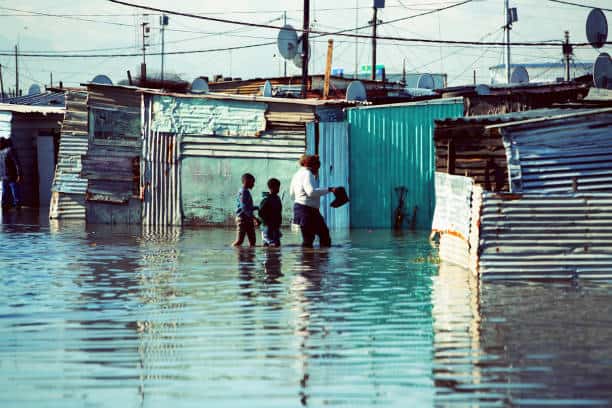
Langa Township, Cape Town, South Africa. 15 June 2022. Residents of Langa township near Cape Town had their shack homes flooded during days of heavy rainfall. Many residents had to evacuate homes.
The North West province has received a total of R2.19 billion that was shared between the local municipalities.
Based on the latest March expenditure report for 2025/26 financial year, local municipalities have collectively spent R1.3 billion, translating to 64% expenditure of the total allocation.
Despite this, learners from the Disaneng village still struggle to get to school because of flooding that was caused by heavy rainfall and deteriorated infrastructure that requires repairs.
The Harsh Reality
However, as funds slowly start to run dry, the state of infrastructure that requires repairs and attention is left overflowing and unmaintained in communities.
There have been reports that local scholars in the Disaneng village near Mahikeng in the North West are unable to get to school to receive an education because a nearby riverbank has overflowed due to heavy rainfall, causing flooding in the area.
The flooding has reportedly prevented pupils from being able to safely access their school, leaving hundreds of learners stranded.
Between a rock and a hard place
Without a bridge or reliable transport, students are either forced to miss class or to walk long distances to avoid flooded paths to get to school. The schools that have been affected include Ipeleng Primary and Jan Masibi Secondary.
Community representative Kelapile Mohujane said this is a recurring nightmare for the village.
“Our children are often unable to attend school because there is no transport and no bridge for them to safely cross,” said Mohujane
Residents are urgently calling on the North West provincial government to prioritise infrastructure upgrades, specifically a safe bridge that would ensure heavy rains no longer rob their children of the right to receive an education.
According to reports, authorities have not yet provided a timeline for when access will be restored.
Municipal Infrastructure Grant (MIG) Expenditure
Despite this, government reports show that over 60% of these funds were allocated. The R2.19 billion fund is allocated to the Municipal Infrastructure Grant (MIG), allowing the necessary departments to implement infrastructure repairs and improve infrastructure delivery in areas.
According to government reports, the North West Department of Cooperative Governance and Traditional Affairs (CoGTA) continues to progress the expenditure and implementation of the MIG with “notable achievements recorded in infrastructure delivery across the province.”
‘We remain on course,’
The MEC for Cooperative Governance, Human Settlements and Traditional Affairs (CoGHSTA), Gaoage Molapisi, is impressed with the expenditure performance of municipalities.
“The expenditure reflects ongoing investments in critical infrastructure such as water and sanitation, roads, stormwater systems, waste management, and community social facilities, which remain central to improving service delivery and the quality of life for residents across the province,”
“The progress recorded demonstrates that municipalities are increasingly improving their capacity to deliver critical infrastructure.”
“We remain on course to ensure 100% expenditure of funds allocated after achieving 99% last financial year,” said MEC Molapisi.
Fund Allocations
According to reports, several municipalities have demonstrated a strong performance in infrastructure spending and project implementation.
Particularly in districts like Dr Ruth Segomotsi Mompati (Dr RSM), where expenditure reached 82% of allocated funds, which signalled improved planning and execution capacity.
Additionally, six municipalities have been allocated additional funds in the financial year to further implement infrastructure projects in their localities.
These include: Kgetleng Rivier Local Municipality with R15 million, Maquassi Hills with R16 million, Ditsobotla – R37 million, Ratlou – R17 million, Lekwa Teemane – R12 million, Greater Taung – R19 million and Dr RSM with R50 million.
Fund Relocations
However, Molapisi said that some municipalities have lost portions of their allocation to other municipalities due to slow performance.
“In situations where problems persist, swift action is required to protect public monies.”
“The lost portions will have an impact on the ongoing infrastructure projects implemented by the affected municipalities.”
“Planned completion dates will now be prolonged into the new financial year.”
Molapisi added that these actions are not intended to penalise municipalities, but rather improve performance.
“The relocation is to ensure 100% expenditure of the grant.”
“When funds are reallocated, it is done to maximise impact and ensure that infrastructure delivery continues without delays,” said Molapisi
July Workshop
In preparation for the 2026/27 Municipal Financial Year, commencing in July 2026, the department continues to assess the Draft 2026/27 Implementation Plans to ensure they align with grant conditions, infrastructure priorities, and the Division of Revenue Act (DoRA).
A provincial MIG Workshop is set to take place before the start of the next Municipal Financial Year to assess the state of readiness for implementing MIG-funded infrastructure projects.
“The aim is to ensure that municipalities finalise the appointment by the end of June 2026 so that construction can commence at the beginning of the financial year in July 2026.”
Based on government reports, this process aims to strengthen long-term infrastructure planning, address stalled projects, and ensure sustainable service delivery.