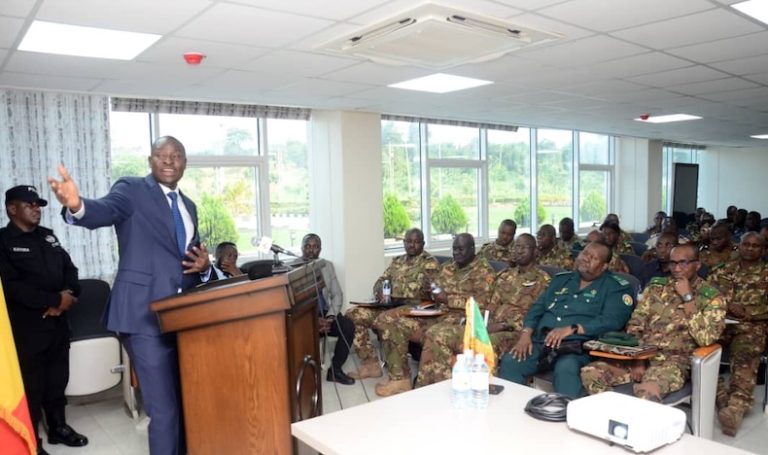
When military officers from nine African countries walked through a sprawling pharmaceutical complex on the outskirts of Kampala, they were not there to inspect weapons or military hardware.
Instead, they came to examine something they believe could prove just as important to Africa’s security: the ability to manufacture its own medicines and vaccines.
The visit by 36 senior military scholars from the Malian Army War College to the Dei BioPharma manufacturing campus in Matugga highlighted a growing recognition that health security and national security are increasingly intertwined.
Countries that depend heavily on imported medicines are more vulnerable to supply disruptions during pandemics, conflicts and other global crises.
The delegation, led by Brig. Gen. Moussa Yoro Kante, Director of Education of the Mali Defence Forces, was in Uganda as part of a week-long strategic study tour hosted by the Uganda People’s Defence Forces (UPDF) from July 13 to 17.
The programme was designed to strengthen military cooperation between Uganda and Mali while exposing participants to institutions considered strategically important to Uganda’s development.
The multinational group included officers from Mali, Guinea-Conakry, Burkina Faso, Niger, Morocco, Togo, Chad, Senegal and Cameroon. Dei BioPharma was selected as one of the sites because of its role in Uganda’s efforts to build a domestic pharmaceutical manufacturing industry.
After touring the facility, Kante said what the officers had seen left a lasting impression.
“The visit this evening allowed us to see beautiful things. I want to congratulate Dr. Magoola for everything he is doing in the field of biotechnology,” he said. “What the members of the fifth cohort and I have seen here inspires us in more ways than one. The work here is mesmerizing.”
He said the officers would share what they had observed when they returned to their respective countries.
“I hope that each of these trainees, upon returning home, will be able to bear witness to what we have seen here at Dei BioPharma,” Kante said. “What we are going to take home is the example we saw here.”
Responding to remarks by the company’s founder and managing director, Dr. Matthias Magoola, about expanding across Africa, Kante extended an invitation for the company to explore opportunities elsewhere on the continent.
“As Dr. Magoola said, he wants to go everywhere in Africa. We will be very happy to receive him very soon,” he said.
The visit comes at a time when African countries are seeking to reduce their dependence on imported medicines. According to Magoola, the continent imports about 85 per cent of the drugs it uses, largely because many countries lack the technology needed to manufacture complex medicines locally.
He said building that technological capacity is essential if Africa is to improve access to affordable medicines and strengthen its economies.
“The problem is a lack of technology. Africa currently imports 85 per cent of its medicine. Whether in South Africa, Morocco, or Egypt, we all face this dependency because we have lacked the necessary technology,” Magoola said.
He added that Dei BioPharma has developed its own technologies, secured patents in the United States and established the technical capability to manufacture medicines and vaccines in Uganda.
Magoola also linked the company’s ambitions to President Yoweri Museveni’s vision of greater African cooperation. He said Uganda is willing to share pharmaceutical formulas with other African countries free of charge, provided formal requests are made through the President.
“This is the president’s vision. As a true Pan-Africanist, he believes that we must ensure Africa can afford these drugs. By offering this, we are inviting other nations to collaborate with us,” he said. “Africa does not need to depend on others for vaccine and drug manufacturing.”
The company says its long-term goal is to make expensive biological medicines, including treatments for cancer and other serious illnesses, more affordable by producing them within Africa instead of importing them.
“We believe that, for the first time, real parity is going to come from Africa,” Magoola said. “Our ultimate vision is to make these biological drugs, which 90 percent of our population currently cannot afford, accessible and affordable.”
Dr. Chetna Jain, the company’s chief executive officer, said the visit demonstrated growing continental interest in Uganda’s pharmaceutical sector.
“It shows that what we are doing here is being recognized across Africa. People are aware of Dei BioPharma, and they are willing to come here and collaborate with us after seeing what we have developed,” she said.
Founded in 2014, Dei BioPharma operates a pharmaceutical manufacturing complex covering more than 250 acres in Matugga. The facility is designed to produce medicines for diseases including malaria, HIV and cancer, as well as insulin, monoclonal antibodies and mRNA-based medicines through about 30 manufacturing units.
The pharmaceutical tour concluded a broader programme of military engagements between Uganda and Mali. Earlier in the visit, Kante thanked President Museveni for supporting the training of Malian armed forces, while UPDF Chief of Joint Staff Lt. Gen. Jack Bakasumba said the two countries continue to strengthen defence cooperation under a military training agreement.
Uganda has trained 58 Malian officer cadets under the arrangement, while Mali has offered the UPDF 23 training positions, including one place at the Mali War College.