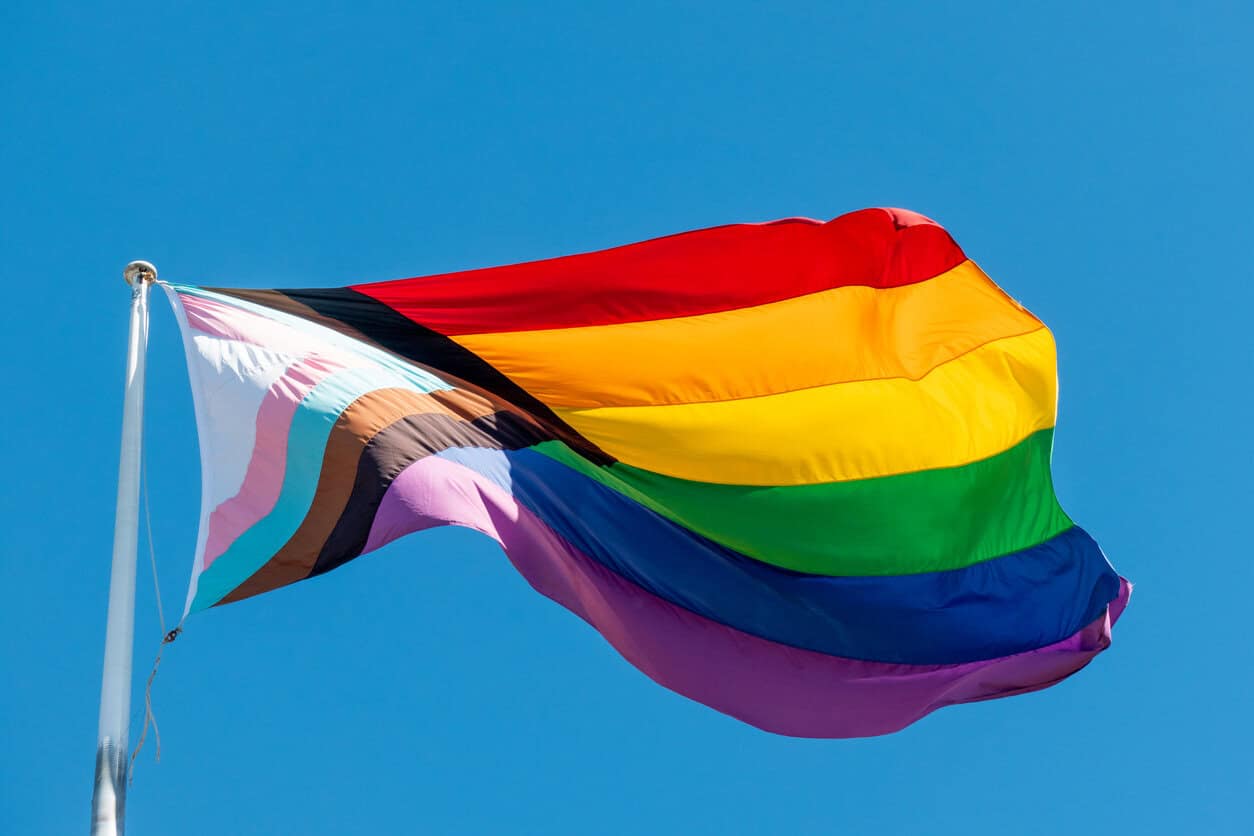
A large Progress Pride Flag flies on a flagpole in Taylor Square, Oxford Street, Darlinghurst, Sydney. This image was taken on a sunny and windy afternoon on 5 April 2025.
The EU’s top court ruled Tuesday that anti-LGBTQ legislation in Hungary breached the bloc’s rules, in a move hailed as a “landmark” victory by Brussels.
The European Commission, 16 of 27 member states and the European Parliament took Hungary to the European Court of Justice (ECJ) over the law, in what has been billed as the largest human rights case in the bloc’s history.
Originally aimed at toughening punishments for child abuse, the law was amended by nationalist prime minister Viktor Orban’s ruling coalition to ban the “promotion of homosexuality” to under-18s.
Incoming leader Peter Magyar has pledged to reset Hungary’s ties with the EU, and is desperate to unblock some 18 billion euros in funds that were frozen by Brussels under Orban’s rule, in part over the LGBTQ law.
Controversial law sparks widespread criticism
Enacted in 2021, the legislation outraged activists and leaders across the EU who criticised it for stigmatising LGBTQ people and equating same-sex relations to paedophilia.
The ECJ found that Hungary has acted in breach of EU law “on a number of separate levels”.
The court found for the first time that Article 2 of the Treaty on European Union (TEU) was infringed, including the rights of transgender and non-heterosexual individuals, “as well as the values of respect for human dignity, equality and respect for human rights, including the rights of persons belonging to minorities”.
The “law is contrary to the very identity of the Union as a common legal order in a society in which pluralism prevails”, the ECJ said in a statement.
“Hungary cannot validly rely on its national identity as justification for adopting a law which is in breach of the values referred to above”, it added.
‘No one is stigmatised’
Hungarian human rights groups called the ruling “historic“.
The European Commission in Brussels welcomed it as a “landmark” and said it was now up to the Hungarian government to implement the decision.
Magyar, a pro-EU conservative who ousted Orban after 16 years in the elections over a week ago, regularly said he supports equality, but long avoided taking a clear stance on LGBTQ rights.
But in his victory speech he said Hungary has decided it wants to be a country where “no one is stigmatised for loving differently or in a different way than the majority”.
It would be for Hungary’s new parliament set to take oath in early May to repeal the law, which also served as a basis for the police banning Pride marches last year.
The EU sent a delegation of officials to Budapest last week to kick off talks with the incoming government in a bid to hit the ground running once they take power next month.