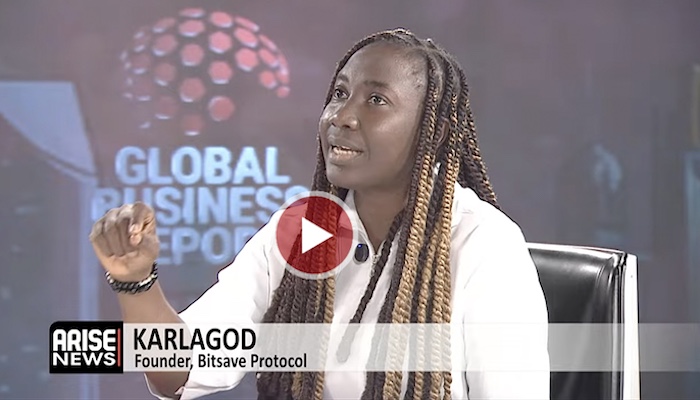

Karla God, has said that Bitcoin’s recent price decline does not undermine its long-term use case, arguing that volatility is central to how the crypto market operates.
Speaking during an interview with ARISE NEWS on Friday ,she noted that Bitcoin, which is currently trading around $79,000 down about 36% from its October 2025 peak of $125,000 remains fundamentally unchanged in its utility.
“We’re not worried. We make our money through volatility,” she said.
KarlaGod explained that price swings are a natural part of crypto markets, adding that periods of correction are necessary for sustainability.
“The crypto market has cycles bear markets and bull markets. It can’t just go up forever,” she said, adding that long-term investors are typically unfazed by short-term losses
On concerns about investors being down significantly from peak prices, she argued that risk is inherent in all investments.
“If I bought at $125,000, I’m down 36%. Yes, you are. But investments come with risk. You can dollar-cost average and hold for the long term,” she said.
She further described Bitcoin as an asset and commodity rather than a transactional currency.
“Bitcoin is best treated like an asset or commodity. You don’t really use it to buy toothpaste,” she said , adding that stablecoins are more practical for everyday payments.
Turning to stablecoins, KarlaGod highlighted their rapid global growth, pointing to rising transaction volumes, particularly in Africa and Nigeria, where adoption is accelerating due to inefficiencies in traditional payment systems.
She said stablecoins are increasingly used for cross-border payments because they reduce delays and transaction costs compared to conventional banking channels.
“Our traditional systems already have problems. Stablecoins help make payments faster and cheaper,” she said.
She also pointed to emerging applications beyond payments, including what she described as “reward assets,” where real-world value is tokenised and represented on-chain.
She referenced her own stablecoin initiative, CNGN, explaining that it is designed so that one token maintains a one to one value with the naira in real life.
“The idea is simple: one naira on-chain equals one naira off-chain,” she explained.
She added that tokenisation enables businesses to raise capital by converting revenue streams into digital assets that investors can earn from.
“We are able to send value across borders without the high fees or long settlement delays,” she said.
Introducing her broader model, BeesFi, she said the concept focuses on “business finance” rather than traditional decentralised finance.
“We tokenize a business and its revenue. Investors can earn yield from a portion of that revenue over a set period,” she explained.
Using airlines as an example, she said businesses facing operational pressures such as rising jet fuel costs could allocate a percentage of future revenue to token holders in exchange for upfront financing.
“Rather than tokenising equity, we tokenize revenue. People fund the business and earn from its earnings,” she said.
KarlaGod concluded that stablecoins and tokenised assets represent the next phase of financial infrastructure, particularly for emerging markets where access to capital and efficient payment systems remains limited.
Goodness Anunobi