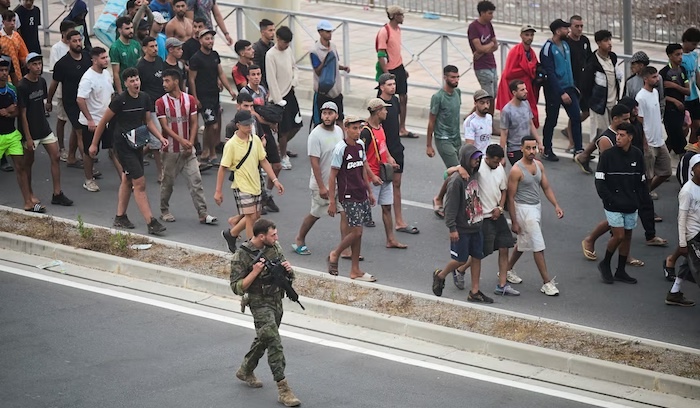
Italy has temporarily suspended the Schengen free movement regime with Spain and ordered the closure of its sea and air borders following a surge of migrants into the Spanish North African enclave of Ceuta, triggering diplomatic tensions and renewed debate over migration within the European Union.
The decision was announced on Thursday evening by Prime Minister Giorgia Meloni alongside Deputy Prime Ministers Antonio Tajani and Matteo Salvini, who described the move as necessary to safeguard national security and protect the EU’s external borders.
Italy’s Interior Ministry formally approved the measure on Friday after a meeting chaired by Interior Minister Matteo Piantedosi, acting on assessments by the country’s Committee for Migration Analysis and Border Security.
Explaining the government’s position, Tajani wrote on X: “The temporary suspension of Schengen with Spain is a necessary choice to safeguard the security of our citizens and defend the European borders. A measure provided for by the treaties and made unavoidable today.”
“The migrant crisis in Ceuta reminds us that the management of the Union’s borders is a shared responsibility among our countries, one toward the other. We must work together to prevent uncontrolled migrant flows from entering EU territory, with all the consequent risks and the threat of terrorism, which must be countered without hesitation.”
France also announced tighter controls along its land border with Spain. French President Emmanuel Macron said the measures were intended to support Spanish authorities in managing the migration emergency in Ceuta.
Spain, however, strongly criticised Italy’s decision.
Prime Minister Pedro Sánchez, in a post on X, insisted that migration challenges should not undermine European solidarity. “Solidarity and empathy are optional. Respect for European treaties and the facts is not,” Sánchez wrote, citing Frontex data which, according to him, showed that Italy had recorded more irregular migrant entries than Spain between 2021 and 2026. He called instead for “a strong and united European Union.”
Spain’s Foreign Minister, José Manuel Albares, also condemned Tajani’s call to suspend the Schengen agreement and summoned Italy’s ambassador to Madrid to seek explanations over the decision.
According to Italy’s ANSA news agency, Spain’s Foreign Ministry maintained that the crisis in Ceuta was unrelated to the country’s migrant regularisation policy. It said the influx followed interpretations of a recent Spanish Supreme Court ruling concerning migrants who entered Ceuta by swimming, arguing that the situation had been exploited by criminal networks and human trafficking groups.
The development has also prompted reactions from across Europe.
By Friday, Finland, the Netherlands, Denmark, the Czech Republic and Sweden had publicly aligned themselves with Italy’s position on strengthening border controls.
Finnish Interior Minister Mari Rantanen wrote on X: “Spain has completely failed to protect the external border of the Schengen area from incursions. This cannot continue.”
European Commissioner for Home Affairs Magnus Brunner acknowledged the seriousness of the situation but stressed that there was no indication migrants were moving beyond Ceuta into mainland Europe. “The situation in Ceuta is unacceptable and I am in close contact with the Spanish authorities. I reiterate that there are no movements towards mainland Europe or other member states.”
He further noted that “the Schengen Borders Code contains special provisions that apply to Ceuta and Melilla, and checks on people departing from Ceuta remain in force.”
Erizia Rubyjeana