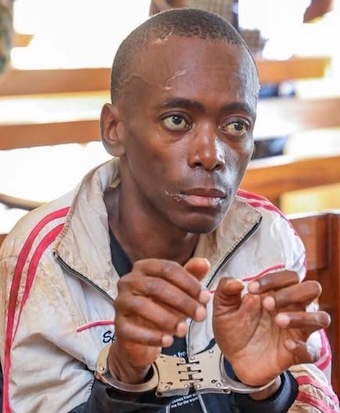

The courtroom fell silent as the trial of Christopher Okello Onyum entered its first full week, the weight of what had happened at Ggaba hanging heavily in the air.
It had begun days earlier on a charged note. When Okello stood before Justice Alice Komuhangi Khaukha at the High Court and pleaded not guilty to four counts of murder, the reaction from the packed gallery was immediate and loud.
Murmurs rose into audible anger. The judge had to intervene, calling for order before proceedings could continue. At the centre of the case are the killings of four toddlers at Ggaba Early Childhood Development Centre on April 2, a crime that has shaken communities far beyond the courtroom.
As the prosecution began laying out its case, Chief State Attorney Jonathan Muwaganya, alongside Ms Anna Kiiza, introduced key evidence, including postmortem reports confirming the causes of death.
The documents, clinical in tone, established the facts. But it was the testimony that followed that began to give those facts a human shape. Phoebe Namutebi, a caretaker at the centre for five years, took the stand as the sixth prosecution witness. Her account was steady, but the details were chilling. Her first encounter with Okello, she told court, had come a day before the killings.
“He stood outside and looked like someone who needed help. I asked him what he wanted,” she said, recalling the morning of April 1 at around 11:00 am.
According to her testimony, Okello told her he had been directed to the centre to bring a child. When she asked the child’s age, he said about three years old. That raised an issue. The centre catered for younger children, and she advised him to try another nursery school. But he persisted.
“He said the child does not talk much and struggles to mix with others, and that being around many children would help,” she told the court.
He asked about fees. She explained the requirements, Shs180,000, covering registration and a uniform. He left, saying he would return. The following day, he did. At around the same time, Namutebi said, he arrived carrying a child’s bag. This time, he said he had come to complete the process and make a payment.
“He told me he had come to complete the process and make payment, so I opened for him,” she said.
She escorted him to the centre’s coordinator, Annet Odong. There, Okello gave a different explanation about the child. He was not the father, he said, but a Good Samaritan helping a mother who had been abandoned.
“He said he would pay and later send the mother,” Namutebi recalled. The payment was agreed, Shs180,000. Okello sent the money via mobile money, even covering the withdrawal charges. Namutebi was asked to prepare a receipt.
“I was asked to bring a receipt book and write the receipt,” she said. When she asked for the child’s name, he spelt it out: Zuriel Onyum. Moments later, everything changed. As she put away the receipt book, something caught her eye through a window.
“I thought he was beating the child,” she told the court.
She rushed outside. What she found, she said, was Keisha Agenorwoth Otim lying in blood. Then she saw him again, this time holding a knife. Another child was attacked moments later. In the chaos that followed, Namutebi tried to intervene. She grabbed a bicycle and threw it at him. It was a desperate act, she said, but it did not stop him.
“He left the child and started chasing me. I ran while shouting for help but fell,” she said.
She described falling more than once as she tried to escape, panic overtaking her movements. By the time she regained her footing, more children had been attacked. The courtroom remained still as she spoke. Outside the centre, she said, help began to arrive.
Staff members and members of the public rushed in. Together, they managed to restrain Okello and lock him in a security room.
“He threw the knife outside the fence, and two more knives were later found in his socks,” she said.
Police arrived soon after, securing the scene and attempting to assist the injured children. But by then, Namutebi told the court, none showed signs of life. Throughout the attack, she said, there had been something unsettling about Okello’s demeanour.
“He did not say anything during the attack; he was just breathing heavily, and the bag remained on his back.” The prosecution later presented the receipt she had written—recovered from the accused.
“This is the receipt I wrote. It has my signature and the daycare stamp,” she confirmed. As the trial progressed, attention turned to Okello’s mental state.
Dr Emmanuel Nuwamaya, Deputy Director of Police Health Services, testified about an examination conducted on April 7. During that assessment, he said, Okello gave a chilling explanation for his actions.
“He was able to explain the reasons for killing the children as fortune hunting and enrichment,” Dr Nuwamaya told the court.
According to the doctor, Okello claimed he believed in acquiring wealth through human sacrifice. Yet, despite those statements, Dr Nuwamaya said the accused appeared mentally stable during the examination.
“He had normal behaviour, he was calm and cooperative, his speech was coherent, his memory was intact, and he exhibited good judgment,” he testified.
However, he added that Okello reported a history of mental illness, including hallucinations and a past suicide attempt, dating back to treatment received between 2016 and 2025.
That history, the court heard, was based solely on Okello’s own account and had not been independently verified. A second medical perspective came from Dr Rogers Agenda, who had examined Okello months earlier, in December, as part of a psychiatric evaluation related to citizenship.
“I established that Okello had no mental disorder at the time he presented to me,” Dr Agenda said.
“I therefore affirmed that at that time Okello was sane and mentally stable to live and work in Uganda,” he added.
By the end of the week, the trial had begun to sketch out two parallel narratives, one of events, described in stark, painful detail by those who were there, and another of intent and state of mind, still being contested.
In the courtroom, those threads now sit side by side, awaiting the court’s judgment. For the families of the children, and for a public still grappling with the shock of what happened in Ggaba, the proceedings are more than a legal process. They are an attempt—slow, methodical, and often difficult—to make sense of the unimaginable.