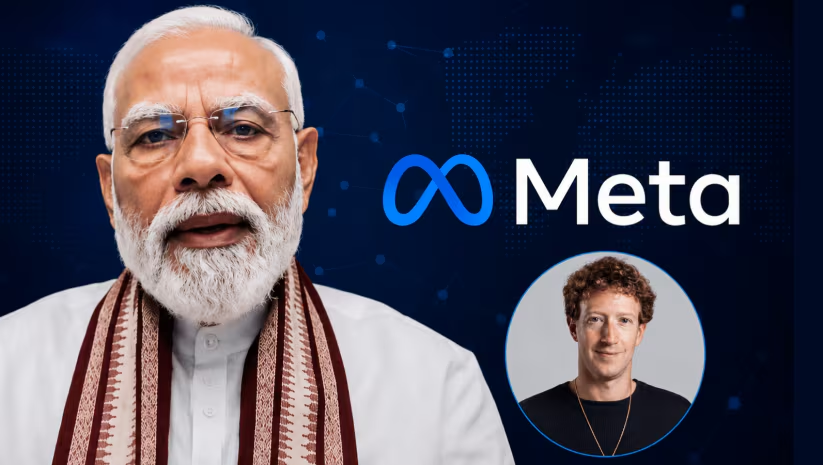
An Indian parliamentary committee has called on Meta Chief Executive Officer Mark Zuckerberg to apologise after a video of Prime Minister Narendra Modi was briefly removed from Facebook and Instagram, despite the company attributing the incident to a technical error.
The demand was made on Wednesday by Nishikant Dubey, chairman of Parliament’s Standing Committee on Communications and Information Technology and a lawmaker from Modi’s ruling Bharatiya Janata Party (BJP).
The controversy stems from a video posted by Modi on July 23, in which he addressed students amid nationwide youth-led protests. The video was temporarily taken down from Meta-owned Facebook and Instagram before being restored.
Meta has maintained that the removal resulted from a technical glitch and was not a deliberate moderation decision.
However, Dubey rejected that explanation, arguing that the removal amounted to an editorial action rather than the role of a neutral intermediary.
“Deleting the Prime Minister’s video was not the work of an intermediary, but that of a publisher,” Dubey told reporters. “Zuckerberg will have to apologise within three days.”
Dubey said the parliamentary panel has written to India’s Ministry of Home Affairs and the Ministry of Electronics and Information Technology, urging them to investigate the incident and consider appropriate action.
He also warned that if Meta fails to apologise, the company should risk losing the “safe harbour” protections that shield digital platforms from liability for user-generated content under Indian law.
Under India’s parliamentary system, standing committees are empowered to examine government policies and summon public officials or company executives to provide explanations. However, they cannot impose penalties or revoke legal protections, with any enforcement action requiring intervention by the government or the courts.
Indian media reported that Meta representatives have been summoned to explain the temporary removal of the video. As of Wednesday, the company had not publicly responded to the committee’s latest demands.
India is Meta’s largest market by user base, with hundreds of millions of people relying on Facebook, Instagram and WhatsApp, making the country one of the company’s most strategically important markets.
The disputed video was published at the height of student-led protests that began over alleged examination irregularities before expanding into broader demonstrations over youth employment, educational reforms and governance. Critics have described the movement as reflecting wider dissatisfaction with the government’s policies, while officials have defended their response.
In the video, Modi sought to reassure students by pledging stronger legislation and tougher penalties against examination paper leaks, while also highlighting his government’s commitment to protecting the integrity of the country’s education system.
The incident has renewed debate in India over the responsibilities of global social media platforms, content moderation practices and the balance between technological errors and accountability on digital platforms.