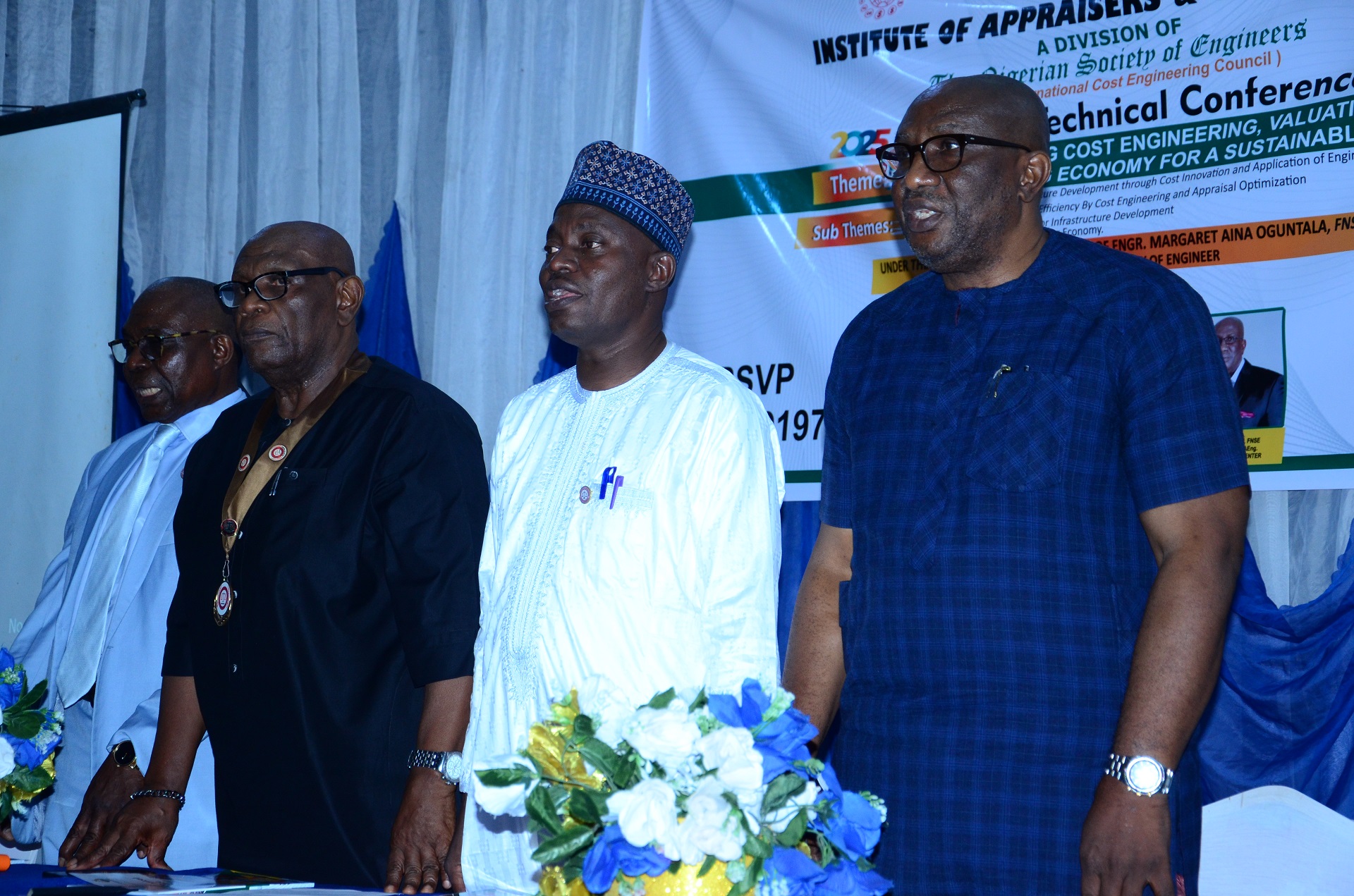
The Institute of Appraisers and Cost Engineers (IACE) has renewed its advocacy for the wider application of engineering valuation, cost engineering and engineering economy in project delivery in the private and public sectors.
The organisation also inaugurated Muhammad Kwalli as its new National Chairman at the 2026 National Technical Conference in Abuja, themed: “Engineering Valuation, Cost Engineering and Engineering Economy Solutions in Emerging Economies”.
The event brought together engineering professionals to examine how the disciplines can improve project outcomes, enhance value for money and support sustainable national development.
Outgoing National Chairman of IACE, Ike Iwenofu, said the conference was designed to advance practical solutions for improving engineering project outcomes through engineering valuation, cost engineering and engineering economy.
He said the combination of the three disciplines provides a structured framework for promoting efficiency, reducing waste, maintaining tighter control over project budgets and timelines, ensuring strategic alignment and delivering long-term value from infrastructure investments.
Iwenofu noted that the institute, established in 2003 as a division of the Nigerian Society of Engineers (NSE) and admitted into the International Cost Engineering Council in 2008, had continued to expand its membership while investing in capacity building, mentoring, networking opportunities and strategic partnerships in line with relevant laws, regulations and standards.
He added that the conference would also witness the induction of new Fellows, Accredited Senior Engineering Valuers and Cost Engineers, as well as Accredited Engineering Valuers, Cost Engineers and Engineering Economists.
Accepting the mantle of leadership, Kwalli described his emergence as National Chairman as a collective achievement for members of the institute and pledged to strengthen its visibility, deepen stakeholder engagement and position it as a strategic partner in Nigeria’s economic development.
He noted that the institute has more than 700 accredited members with expertise spanning engineering valuation, cost engineering and engineering economy, including the valuation of property, plant and equipment, infrastructure, intangible and biological assets, mergers and acquisitions, government privatisation, taxation and insurance.
While acknowledging the institute’s achievements, Kwalli identified visibility, funding and patronage from both the public and private sectors as major challenges requiring urgent attention.
He added that the institute would strengthen collaboration with the Council for the Regulation of Engineering (COREN), the Nigerian Society of Engineers (NSE), the Industrial Inspectorate Department of the Federal Ministry of Industry, Trade and Investment, business valuation accountants, surveyors and other stakeholders to enhance professional standards and reinforce the credibility of engineering valuation practice.
Presenting the lead paper, Dr. Zamani D. Ishaya-Waidung of the Department of Mechanical Engineering, Ahmadu Bello University, argued that engineering valuation, cost engineering and engineering economy are fundamental pillars of Nigeria’s infrastructure development agenda.
Drawing on case studies including the Zungeru Hydropower Project, Lekki Deep Sea Port, the Standard Gauge Railway and the Dangote Refinery, he said cost overruns, valuation distortions and suboptimal investment decisions were often linked to the inadequate application of the three disciplines.
He proposed an Integrated Engineering Value Management Framework to embed rigorous economic analysis throughout the project life cycle, stressing that achieving Nigeria’s ambition of becoming a $1 trillion economy would require disciplined management of every naira and dollar invested in infrastructure.
Also speaking, the President of the NSE, Ali Rabiu, who was represented by an Executive Committee member, Dauda Musa, described the conference theme as timely, saying engineering valuation, cost optimisation and sound economic analysis had become indispensable to ensuring that limited resources deliver sustainable infrastructure and economic outcomes.
He commended the institute for promoting accountability, transparency and efficient resource management, urging participants to leverage the conference to develop practical recommendations.
Emmanuel Addeh