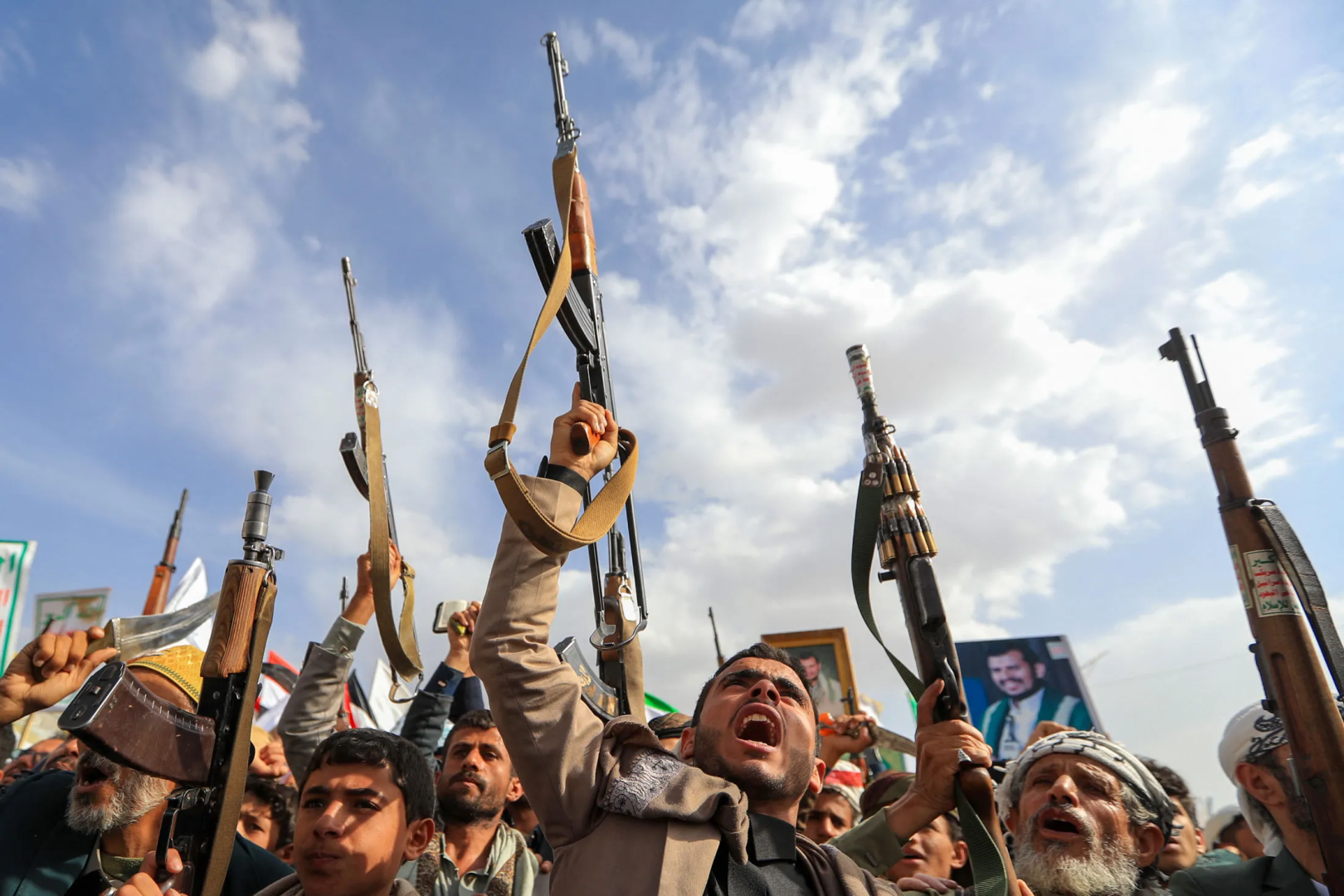
Yemen’s Iran-aligned Houthis said on Monday they would impose a naval blockade on Saudi Arabia, opening a potential new front in the conflict involving the US and Iran while raising concerns over global energy supplies and international trade.
The announcement came after one of the deadliest periods for US troops in the conflict. The Pentagon identified two US soldiers killed when Iran attacked an American base in Jordan on Friday. It also said unidentified remains believed to be those of a third missing soldier had been recovered. Separately, a fourth service member was killed in northern Iraq during the “controlled detonation of unexploded ordnance from a downed Iranian one-way attack drone.”
Following the Houthi announcement, the Saudi-led coalition in Yemen said it would respond with force. It also announced measures to protect ships passing through the Bab el-Mandeb Strait, a key route for Saudi oil exports following the effective closure of the Strait of Hormuz.
The blockade was announced despite indications that Tehran and Washington are exploring diplomatic efforts to halt the conflict. Iran’s Foreign Ministry said mediators had presented “proposals” to Tehran but gave no further details.
Oil prices briefly rose after the Houthi statement before easing as traders held out hope for diplomatic progress. Shipping insurance costs through the Red Sea also increased because of the growing security risks.
Iran has been pressing the Houthis to close the Bab el-Mandeb Strait if the US continues attacks on Iranian power infrastructure.
A full closure of the waterway would cut global oil supply by about seven per cent, leaving most Saudi oil exports unable to leave the region. It would add to existing disruptions that have already reduced global oil shipments by about 10 per cent.
In a statement, the Houthis’ armed forces said they were declaring “a maritime embargo against the criminal Saudi enemy, based on the equation of ‘an eye for an eye’, effective immediately” in response to what they described as “an unjust and oppressive siege” imposed on Yemen by Saudi Arabia.
A senior Iranian official told Reuters that Tehran had received a proposal from mediators for a 10-day ceasefire aimed at preserving the interim agreement reached last month and creating a path towards ending the war that began on February 28 with US-Israeli attacks on Iran.
Neither Iran’s Foreign Ministry nor the official disclosed details of the proposed ceasefire.
Two Pakistani government sources also told Reuters that Iranian Interior Minister Eskandar Momeni had asked Pakistan to resume its mediation role. He later arrived in Islamabad for further talks.
The diplomatic efforts followed another night of US strikes on Iranian cities and attacks by Iran’s Revolutionary Guards on US military assets across the region. US Central Command later confirmed it had launched another round of strikes on Iran.
President Donald Trump defended the latest military action, saying it was in response to the deaths of American service members.
“Every time Iran kills an American Soldier they will pay for that killing many times over! This directive has been passed on to Secretary of War, Pete Hegseth, Chairman of the Joint Chiefs of Staff, Daniel Caine, and every Leader in the Military,” Trump wrote on Truth Social on Monday.
The conflict has killed thousands of people, mostly in Iran and Lebanon, where Israeli forces remain deployed following attacks by Hezbollah fighters.
Lebanese President Joseph Aoun is expected to meet Trump at the White House on Tuesday to present a proposal to disarm Hezbollah and secure an Israeli military withdrawal.
Israel also continues military operations in Gaza following the war triggered by Hamas’ October 7, 2023 attack on southern Israel. Hamas announced on Monday that it had appointed top negotiator Khalil Al-Hayya as its overall leader, a move analysts said could signal a tougher position on calls for the group to disarm.
Faridah Abdulkadiri