Germany and South Africa have urged renewed US-Iran negotiations to secure a peaceful settlement, after talks in Pakistan collapsed over the weekend.
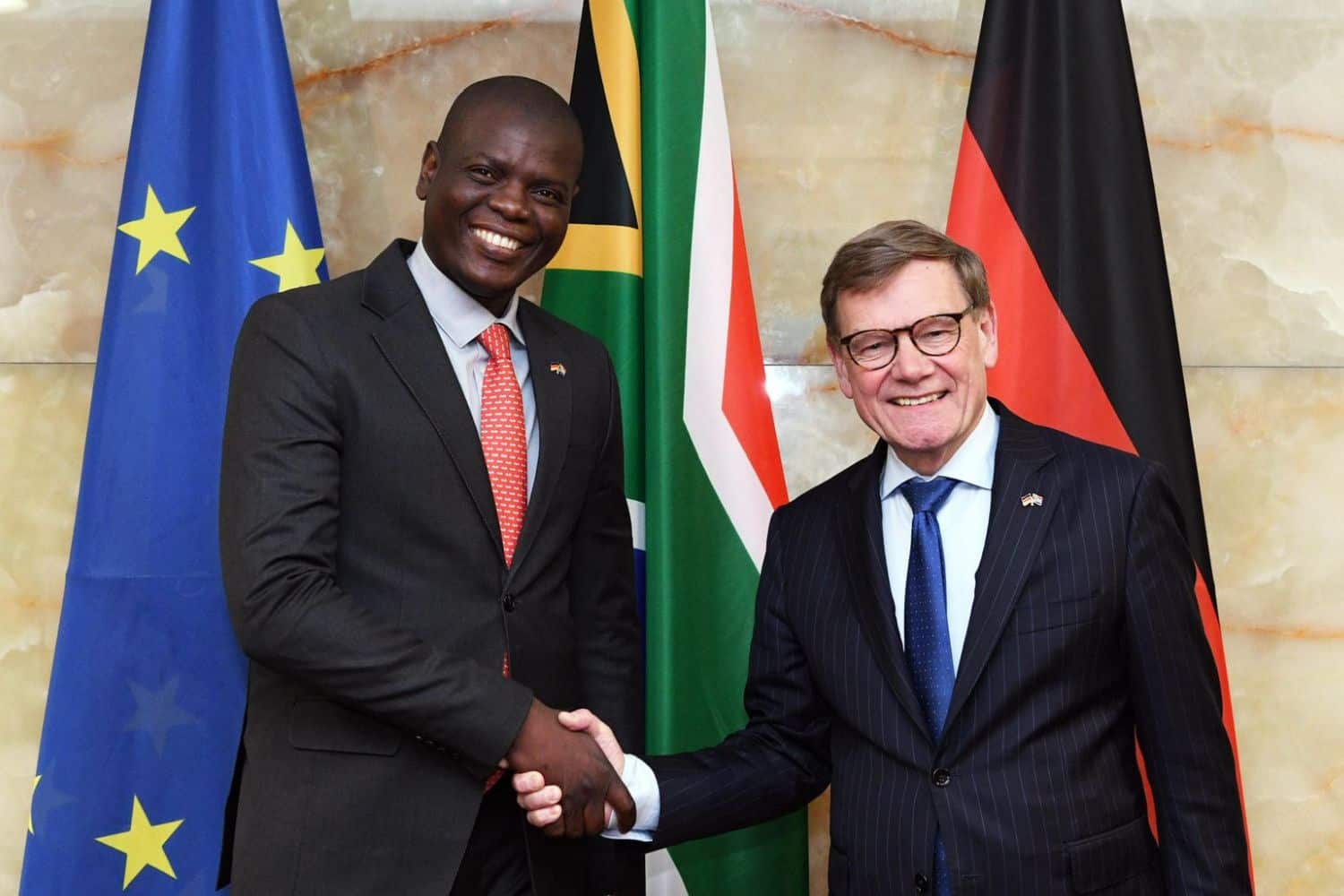
Meeting in Berlin on Monday, Foreign Ministers Johann Wadephul and Ronald Lamola stressed the importance of sustaining the fragile ceasefire agreed on 6 April 2026, warning that renewed hostilities would undermine international stability.
Meeting
Germany and South Africa held the 12th Meeting of the German-South African Bi-National Commission (BNC), the key instrument for the development of the German-South African bilateral relationship
German Foreign Minister Johann Wadephul met his counterpart Ronald Lamola in Berlin on Monday.
Ceasefire
Wadephul was optimistic about the US-Iran ceasefire.
“We believe it to be of the utmost importance that negotiations continue… The ceasefire is holding. And I can only urge both sides to continue to make use of this time, this is the interest of the international community.”
The US and Iran agreed to a two-week ceasefire on Tuesday, 6 April 2026, in an 11th-hour bid to avert all-out destruction, with President Donald Trump threatening to wipe out a “whole civilisation.”
SA condemn Iran attacks
Lamola said Pretoria had condemned the US-Israeli attacks on Iran as a violation of international law, just as it had condemned Iran’s attacks on its neighbours.
He expressed disappointment that the negotiations had been abruptly ended over the weekend.
As South Africa, we believe in diplomacy, we are anti-war, and if negotiations are at an advanced stage, almost to find a solution, we believe there was no need for the strike by the US and Israel against Iran.
“We’ve similarly condemned Iran’s retaliatory attacks on the Gulf countries, in particular where there was no evidence that the attacks emanated from those Gulf countries as a violation, too, of international law.”
Negotiations
Lamola said South Africa agrees with Germany that negotiations must continue, and dialogue deepened.
“It is clear to us that the parties need to build confidence measures that will lead them to a peaceful solution.”
Lamola described a blockade as unhelpful, referring to the US announcement that it would stop vessels leaving or travelling to Iranian ports from transiting the Strait of Hormuz.
Agreements
Lamola and Wadephul signed a 15-point plan to formally upgrade cooperation between their countries to a “strategic partnership.”
As part of the plan, Germany increased its support for South Africa within the framework of the Just Energy Transition Partnership (JETP), with a new climate-related concessional loan of 200 million euros and technical cooperation to accelerate grid and renewable energy investments, backing South Africa’s continued pursuit of more ambitious climate targets.
Tech
Germany also deepened its science and technology partnership through new flagship initiatives in the energy transition, artificial intelligence, quantum research, and cybersecurity.
The nations also agreed to intensify their cooperation in the fields of green hydrogen, battery value chains, critical raw materials, and vaccine production.
Anniversary
The 12th meeting in Berlin marks the 30th anniversary of the BNC, which was founded in 1996 by South African President Nelson Mandela and German Chancellor Helmut Kohl and whose first meeting was held in Bonn in 1997.
Significantly, this latest meeting takes place in the month in which South Africa marks 32 years of being a post-apartheid country, and 37 years after the fall of the Berlin Wall.