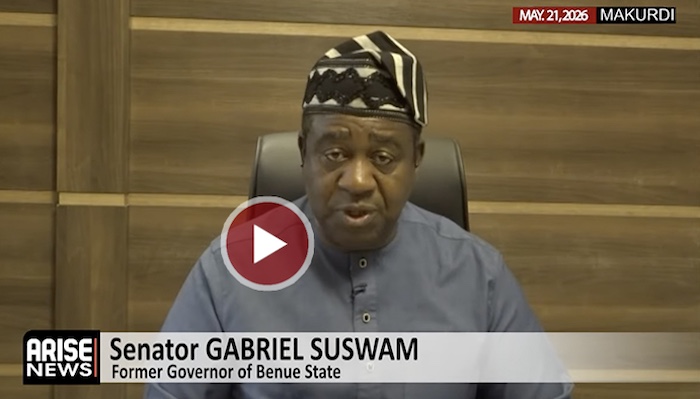

Former Benue State Governor, Senator Gabriel Suswam, has defended the conduct of the All Progressives Congress (APC) primaries in Benue State, insisting that direct primaries are designed to test the popularity of candidates rather than manipulate outcomes.
Speaking in an interview on ARISE NEWS on Thursday, Suswam dismissed allegations that the APC primaries in the state were manipulated to favour candidates aligned with Governor Hyacinth Alia.
Responding to claims that the process involved vote allocation and lacked transparency, Suswam said politicians often raise complaints after losing elections.
“There is the tendency for politicians in Nigeria, when they are on the losing end, they raise all kinds of issues,” he said.
“A lot of us, when we lose election, we raise all kinds of issues. We say this and that.”
The former governor argued that direct primaries depend heavily on grassroots support across wards, making it difficult for candidates without strong local acceptance to succeed.
“Direct primaries is primaries that you must be somebody who is on ground because it is done in each and every ward,” he said.
“For instance, in my zone, we have 84 wards. I could only go to my ward in my village and stay there.”
“So for you to win direct primaries, you must be somebody who is acceptable by at least majority of your constituents.”
Suswam also rejected allegations that the process was manipulated across the state’s wards.
“I don’t think any person was shortchanged,” he stated.
“This thing took place simultaneously in all the wards, and so I wasn’t in some of the wards. I was only in my ward of the 84 that constitutes my constituency.”
“So how would somebody then say that in all the 84 wards that it was manipulated, manipulated how?”
Explaining the voting method used during the primaries, Suswam said the process did not involve ballot papers or conventional voting centres.
“In direct primaries, it is not necessary voting,” he said.
“People line up and are counted. It’s not like there are boxes and ballot papers given to people to go and vote.”
“There are specific locations that this lining up and counting would take place.”
He maintained that the process directly measures the popularity of aspirants within their communities.
“Direct primary is one that tests people’s popularity,” Suswam said.
“You are not where people are lining up for you. In most places you will get zero because you have people who represent you, your agent, who will stand and hold your picture.”
“People line up behind that picture.”
“And most times, if people don’t like you, you will get zero.”
Suswam added that electoral complaints are common in Nigeria’s political system regardless of the process involved.
“There is no electoral process in this country that does not come with complaint. People will complain.”
Faridah Abdulkadiri